Light That Feels a Twist ✛
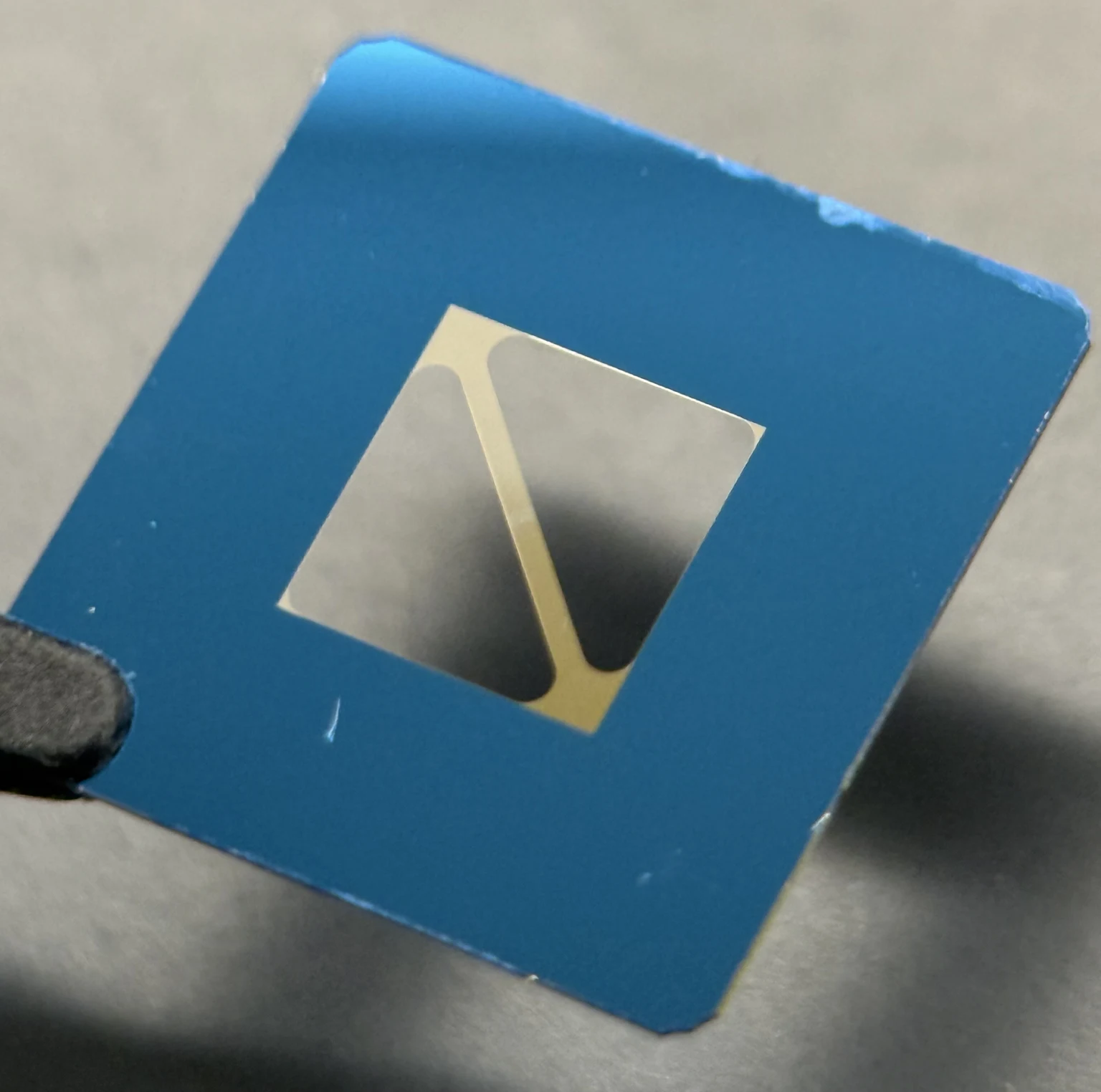
If you give a small mirror a slight twist, the sunbeam it reflects will move across the wall. The farther the wall, the more noticeable the shift. But what if there is no wall, and you need to measure the twist with extreme precision? Physicists at the University of Arizona have figured out how to do without a long light path: they patterned a thin membrane with parallel lines that are themselves extremely sensitive to tilt.
The pattern is a diffraction grating with a pitch smaller than the wavelength of light. When a laser beam hits it at just the right angle, light briefly gets 'trapped' in the pattern and barely passes through. This effect is called guided-mode resonance. If the membrane tilts ever so slightly, the angle of incidence changes, and the transmission of light sharply increases or drops. In this way, a twist becomes a change in brightness that is easy to measure.
Using this grating, the researchers watched a nanoribbon, a thin strip of material, quiver from heat, twisting around its own axis. Previously, such a measurement would have required a long optical lever with a mirror and a distant screen. Now everything fits on a chip and requires no precise alignment. This paves the way for compact rotation and torque sensors that could be useful in navigation and fundamental physics.
The guided-mode resonance in this work has an angular width of 2.5 mrad: that's like noticing a 2.5 mm deflection of a 1 km long beam. And the sensitivity of 3 nrad/√Hz is equivalent to measuring the angle subtended by a human hair from 1000 km away.
In Stanislaw Lem's novel 'Solaris', the ocean reacts to the slightest stimuli, and scientists try to detect its response. Here, a nanoribbon with a grating detects thermal fluctuations, a step toward sensors that sense the invisible.