How to Hear an Invisible Twist ✛
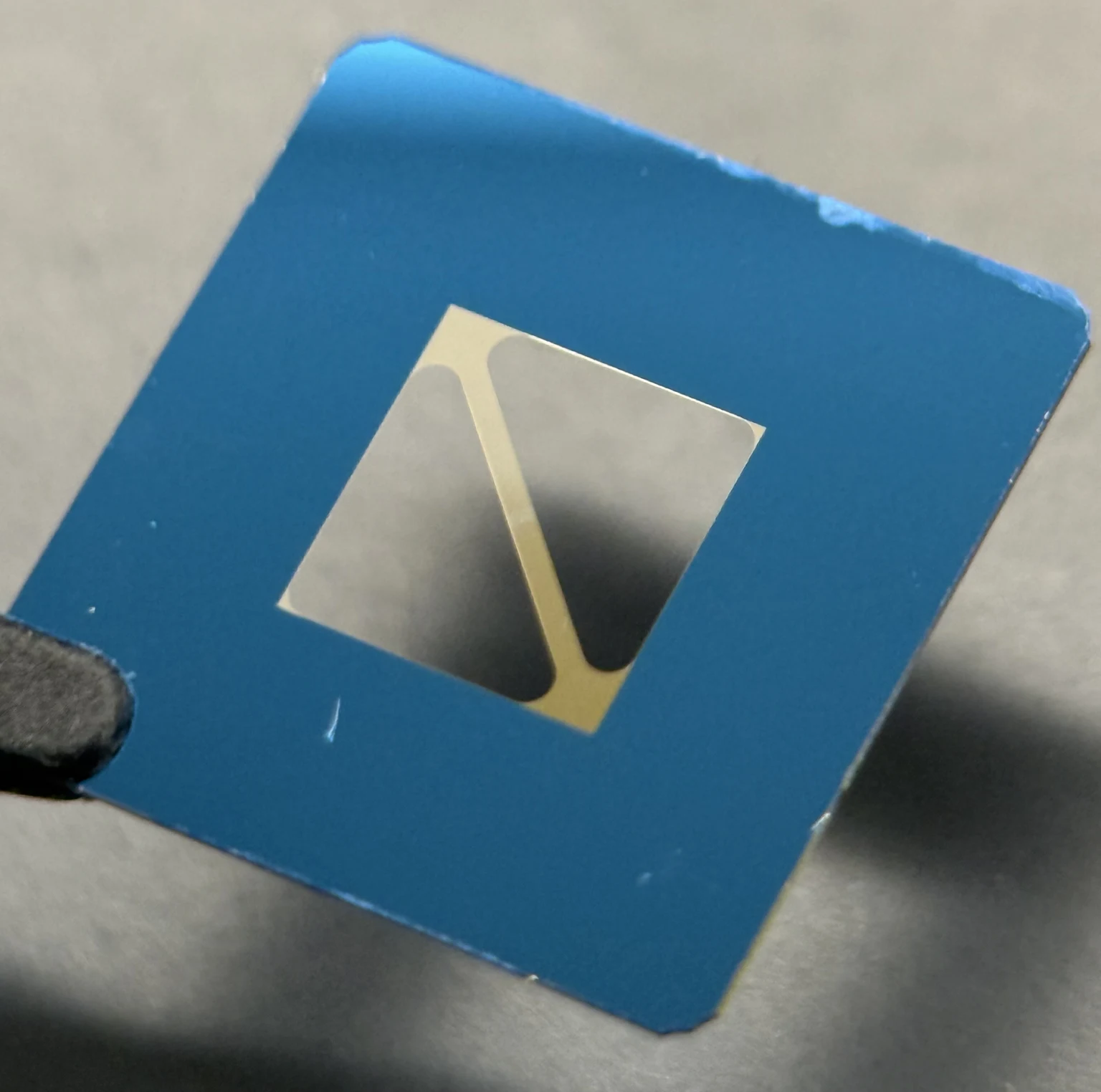
Imagine a string stretched between two tuning pegs. The slightest touch makes it vibrate, and from the pitch you can guess exactly how it was plucked. Physicists at the University of Arizona have stretched a similar string — not on a musical instrument, but on a silicon membrane just a hundred nanometers thick. Instead of listening to sound, though, they listen to light reflected off a tiny grating etched into that membrane.
The grating is a periodic pattern of lines with a pitch of about 700 nanometers, smaller than the wavelength of the light used. When a laser beam hits it at a certain angle, the light doesn't just reflect or pass through: it excites a special state in the grating called a guided-mode resonance. It's as if the light gets momentarily trapped inside the structure before escaping. The transmission drops sharply, and this dip is extremely sensitive to the angle of incidence.
If the membrane tilts ever so slightly, the local angle at which light meets the grating changes. The resonance shifts, and the intensity of the transmitted light is modulated. In this way, an angular displacement becomes a change in brightness that a photodiode can easily measure. In the experiment, they could detect rotations of 3 nanoradians per second of measurement with a light power of just 380 nanowatts — thousands of times weaker than a laser pointer.
That sensitivity was enough to see the thermal jitter of a nanoribbon — a thin strip of silicon nitride oscillating about its axis. Its quality factor, meaning the number of oscillations before dying out, was 1.5 million. The signal from this jitter was visible with a signal-to-noise ratio of 47 decibels, confirming that the method works at the limit set by the quantum nature of light.
Now that the string is strung and sounding, the next step is to tune it even finer. By narrowing the resonance and boosting the probe light power, they could reach a sensitivity of 0.01 nanoradians per root hertz — matching the best laboratory optical levers. That would open the door to quantum torque sensors capable of feeling rotational forces in zeptonewton-meters, and compact inertial sensors for navigation without GPS. A string that responds to the slightest twist could become the foundation of a new class of instruments.
The guided-mode resonance in this work has an angular width of 2.5 mrad: that's like noticing a 2.5 mm deflection of a 1 km long beam. And the sensitivity of 3 nrad/√Hz is equivalent to measuring the angle subtended by a human hair from 1000 km away.
In Stanislaw Lem's novel 'Solaris', the ocean reacts to the slightest stimuli, and scientists try to detect its response. Here, a nanoribbon with a grating detects thermal fluctuations, a step toward sensors that sense the invisible.