Angular Displacement under Resonant Control ✛
Context
Precise measurement of angular displacements of mechanical oscillators is a challenge in atomic force microscopy and tests of the equivalence principle. The classical optical lever is sensitive but requires long free-space beam propagation, hindering miniaturization. Nearby in the archive are works on suppressing instabilities in gravitational wave detectors, quantum scales on a web of light, and superconducting resonators—all seeking compact and precise readout of mechanical motion. This work fits into that vein, offering a resonant structure directly on a chip.
Methods
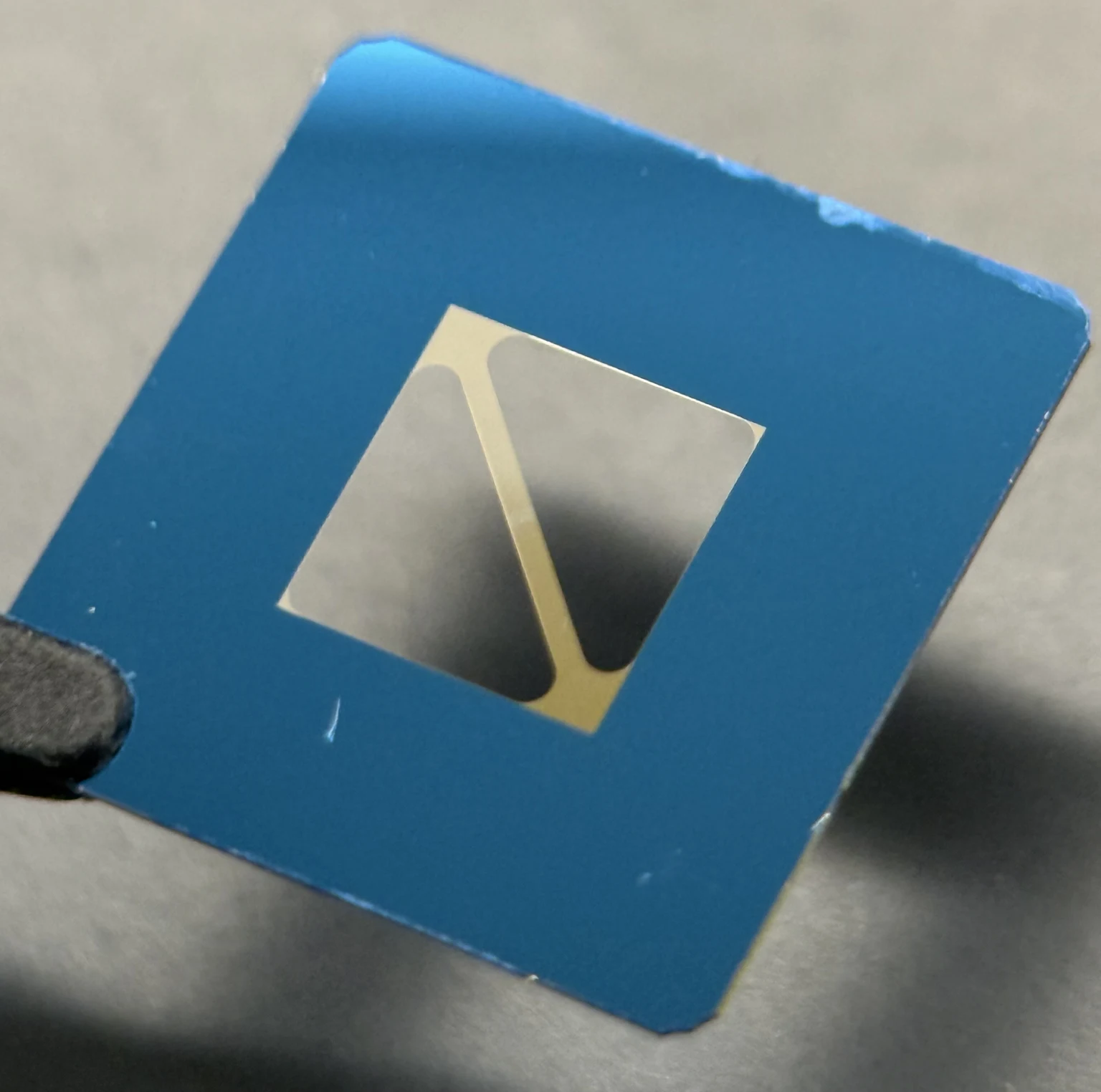
On a 100-nanometer silicon nitride membrane, a grating with a period of about 700 nm and a thickness of 25 nm was patterned using electron-beam lithography. Laser light at 835 nm wavelength was directed at the grating at a small angle; when matching the guided-mode resonance, transmission changed sharply. Angular displacement of the membrane altered the local angle of incidence, modulating the intensity of the transmitted beam. The signal was detected with an avalanche photodiode, and to verify the signal's origin, polarization and wavelength were varied.
Results
The resonance had an angular width of about 2.5 mrad and a frequency width of 0.41 THz, yielding a quantum-limited angular sensitivity of 3 nanoradians per root hertz at 380 nW optical power. This was sufficient to resolve the thermal motion of the torsional mode of a nanoribbon with a quality factor of 1.5 million and a signal-to-noise ratio of 47 dB. Control measurements confirmed that the signal arises from the guided-mode resonance, not parasitic effects.
Implications
This work demonstrates that a guided-mode resonance can serve as an integrated analog of an optical lever with quantum efficiency on the order of unity. Unlike neighboring works using free beams or complex resonators, here the readout is local and requires no precise alignment. This opens the path to chip-scale inertial and torque sensors with sensitivities rivaling the best laboratory setups.
Future development
Narrowing the resonance width and increasing probe power could achieve a sensitivity of 0.01 nrad/√Hz, comparable to the best optical levers. Hybrid structures combining guided-mode resonance with a Fabry–Perot interferometer could enhance optomechanical coupling. Selective coupling to individual mechanical modes is possible by tailoring the grating orientation.
Impact
The method will impact the development of quantum optomechanical sensors, atomic force microscopy, and fundamental physics tests requiring compact and sensitive angle sensors.
Next steps
Optimize the grating geometry to narrow the resonance and increase the throughput of the optical setup. Test the method on nanoribbons with quality factors above 10^8 to achieve zeptonewton-meter torque sensitivity.
Key open problems
In optomechanics, the problem of quantum-limited measurement at compact sizes remains. This work addresses it for angular displacements by offering a resonant structure with near-unity quantum efficiency, without bulky resonators.
The knowledge machine's view
This section is addressed to the author of the paper and their colleagues. Neighbouring works were found by meaning-based search across our archive, not by word overlap. We do not review: we show the field around the work.
What the work does
This work demonstrates an integrated optical angular displacement sensor based on guided-mode resonance in a diffraction grating on a silicon nitride membrane. The authors achieved a sensitivity of 3 nrad/√Hz at an optical power of 380 nW and resolved the thermal motion of the torsional mode with a quality factor of 1.5×10⁶ and an SNR of 47 dB.
Where its strength is
The key strength is local angle readout without a long free-space beam or complex alignment, with quantum efficiency on the order of unity, paving the way for compact inertial and torque sensors.
Where it could go next
- One could consider combining with approaches to suppress instabilities from nanomirror experiments for gravitational-wave detectors to stabilize the guided-mode resonance against slow drifts in temperature and mechanical stress.based on: Listening to the Shudder of Space: The Nano-Mirror Experiment arXiv:2510.07844
- It would be interesting to compare with superconducting resonator techniques, where small currents produce strong effects, and possibly adapt their signal amplification methods to improve the signal-to-noise ratio in optical readout.based on: Superconducting Resonators: Small Current, Big Effect arXiv:2512.23119
- Quantum scales on a web of light suggest the idea of using entangled light states to enhance sensitivity; one could explore whether this applies to guided-mode resonance to overcome shot noise.based on: Light Squeezed to the Limit arXiv:2603.02744
Worth trying
- Investigate whether grating parameters can be modulated to extend the linear range of the angular response.
- Fabricate an array of sensors on a single substrate for multiplexed readout of multiple oscillators.
- Assess the impact of temperature on the resonance and propose an active stabilization scheme.
Why this may matter
Compact, highly sensitive angular displacement sensors could find applications in inertial navigation, microscopy, and fundamental tests such as tests of the equivalence principle.
Nearby works in our archive
- Quantum gyroscope made of cold dropletssimilarity 0.64
- Listening to the Shudder of Space: The Nano-Mirror Experimentsimilarity 0.62
- Quantum microscope twists layerssimilarity 0.62
- Vortex Waves Sharpen the Picturesimilarity 0.62
- Superconducting Resonators: Small Current, Big Effectsimilarity 0.62
- A Compass That Hears Atomssimilarity 0.61
- Light Squeezed to the Limitsimilarity 0.61
The closest work in the archive sits at 0.64 by meaning — the usual level for our corpus.
Original abstract
as written by the authors arXiv:2608.14447v1
Measuring the angular displacement of a mechanical oscillator is a ubiquitous task; however, the multimode nature of angular optomechanical coupling makes coherent signal enhancement challenging. Here we demonstrate coherently enhanced angular displacement readout with an integrated guided mode resonance (GMR) structure, applying it to precision readout of a nanomechanical oscillator. Specifically, we fabricate subwavelength gratings into 100-nm-thick Si$$_3$$N$$_4$$ membranes and record their vibration by direct transmission measurements. The narrow linewidth $$\approx 2.5\;\text{mrad}$$ of the GMR enables a shot-noise-limited displacement imprecision of $$ 10^{-9}\;\text{rad}/\sqrt{\text{Hz}}$$ with nanowatts of optical power, sufficient to resolve the thermal motion of a $$Q\approx 10^6$$ torsion mode with a signal-to-noise ratio of 47 dB. Control experiments based on polarization and wavelength detuning confirm that the measured signal arises from GMR-mediated transduction. These results establish guided-mode resonance as an on-chip approach to angular displacement readout in quantum optomechanical sensors.
The guided-mode resonance in this work has an angular width of 2.5 mrad: that's like noticing a 2.5 mm deflection of a 1 km long beam. And the sensitivity of 3 nrad/√Hz is equivalent to measuring the angle subtended by a human hair from 1000 km away.
In Stanislaw Lem's novel 'Solaris', the ocean reacts to the slightest stimuli, and scientists try to detect its response. Here, a nanoribbon with a grating detects thermal fluctuations, a step toward sensors that sense the invisible.
Key numbers
- angular width of resonance: 2.5 mrad
- angular sensitivity: 3 nrad/√Hz at 380 nW
- quality factor of torsional mode: 1.5×10⁶
- signal-to-noise ratio: 47 dB
- torque sensitivity: 0.1 aN·m/√Hz