What's Inside a Neutron Star? AI Translates Data into the Language of Matter ✛
An interpreter gets distracted by every rustle in the room, and a one-hour meeting stretches into two. A neutron star squeezes the mass of the Sun into a city-sized sphere, and the matter at its core is denser than an atomic nucleus. Physicists can't test its structure in the lab: the required pressure is impossible to create. The equation of state, the link between pressure and energy density, remains the central puzzle.
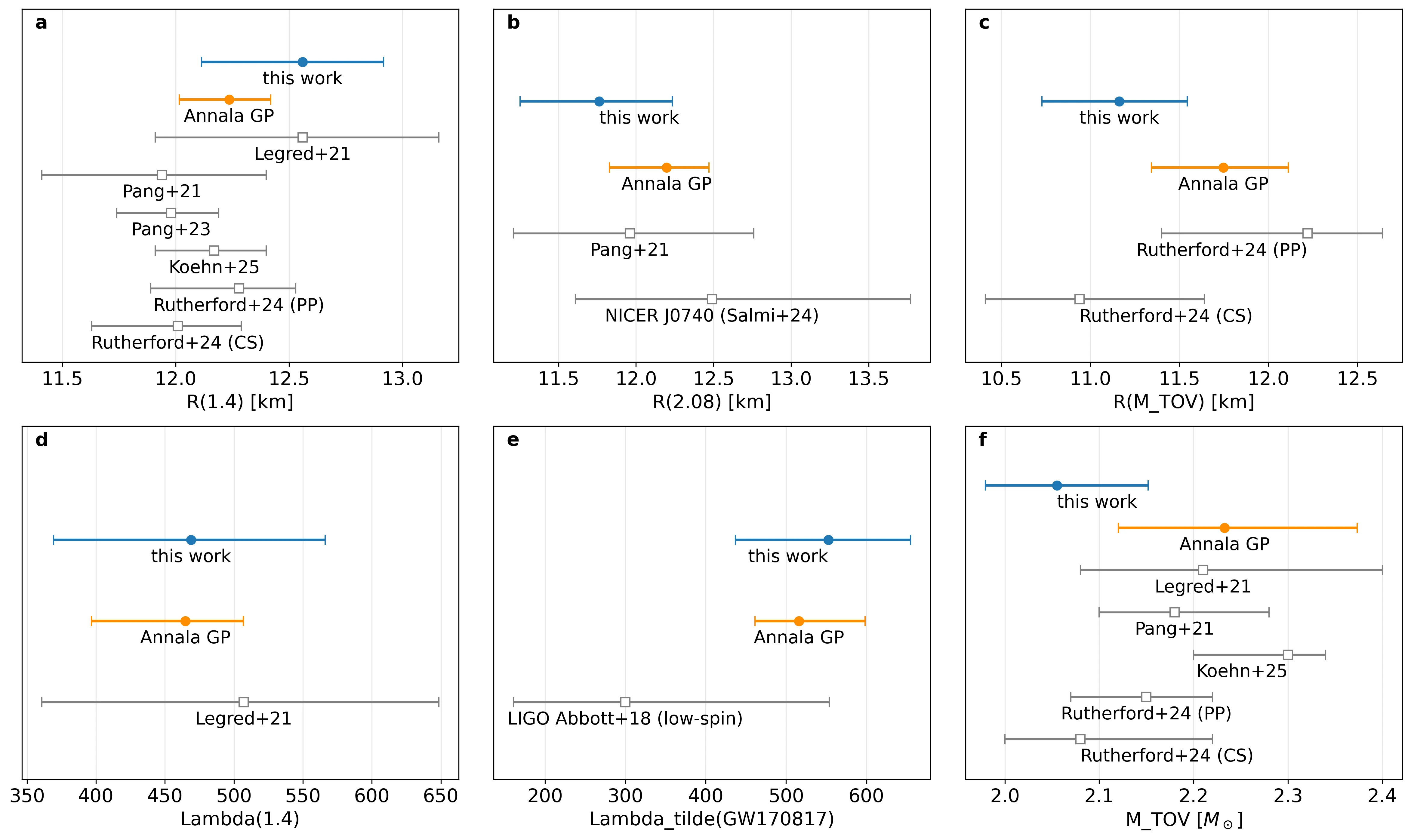
Piecing together a picture from fragments of data is like translating a phrase without knowing the language. Here's what they did: they trained a neural network on a million possible sound-speed curves, then applied nuclear theory and astrophysical data as separate filters, without mixing them. It turned out that the data don't require a sharp peak in the speed of sound, support stiff, nearly conformal matter, and a strong first-order phase transition is unlikely but not ruled out. The radius at 1.4 solar masses is 12.56 km, the tidal deformability is 469, and the maximum mass is 2.06 solar masses.
The interpreter doesn't impose their own style; they just convey meaning, separating voices. Same here: the network is only a prior, and future measurements will update the estimates by simple reweighting, without retraining. For the reader, the key takeaway is: the neutron star remains an interpreter from the language of extreme density, and now the translation is more honest.
A neutron star squeezes a solar mass into a sphere about 20 kilometers across, like fitting a mountain into a teaspoon. The density in its core is several times that of an atomic nucleus, and the speed of sound there reaches nearly half the speed of light.
In Bruce Sterling's novel 'Schismatrix', neutron stars are inhabited by intelligent beings whose physiology is based on exotic states of matter. This work on a stiff, nearly conformal core resonates with the idea of unexpected forms of matter under extreme conditions.