Generative AI Reconstructs Neutron Star Matter ✛
Context
Neutron star cores are the only place in the universe where cold, strongly interacting matter exists in bulk, and the only window into a quantum chromodynamics regime inaccessible to both experiments and first-principles calculations. Multimessenger astronomy has provided quantitative data: NICER X-ray pulsars, gravitational waves from the GW170817 merger, and radio timing of massive pulsars measure masses, radii, and tidal deformabilities. All these observables are linked by a single function—the equation of state—but reconstructing it from sparse and heterogeneous data is an ill-posed inverse problem. Existing approaches either hide the prior in a fixed parameterization or mix physics and data in neural network weights, preventing updates without retraining. This work joins the ranks of neutron star equation-of-state reconstructions, alongside Gaussian processes, interpolations, and 'agnostic' samplings, but differs in how it separates prior and likelihood.
Methods
A diffusion model is trained on a million synthetic sound-speed-squared profiles from 0.5 to 8 nuclear saturation densities. Profiles are generated from ten classes of functional forms: piecewise polytropes, spectral decompositions, logistic curves with a Gaussian peak, relativistic mean-field models, constant-speed-of-sound models with a phase transition, the McLerran–Reddy quarkyonic model, the Nambu–Jona-Lasinio crossover, and forms motivated by perturbative QCD. Constraints from chiral effective field theory are imposed during generation as inpainting anchors at five density points. Perturbative QCD and astrophysical likelihoods are applied after generation via reimportance weighting, keeping prior and data separate. Each surviving profile is integrated into an equation of state and solved through the Tolman–Oppenheimer–Volkoff equations to obtain masses, radii, and tidal deformabilities.
Results
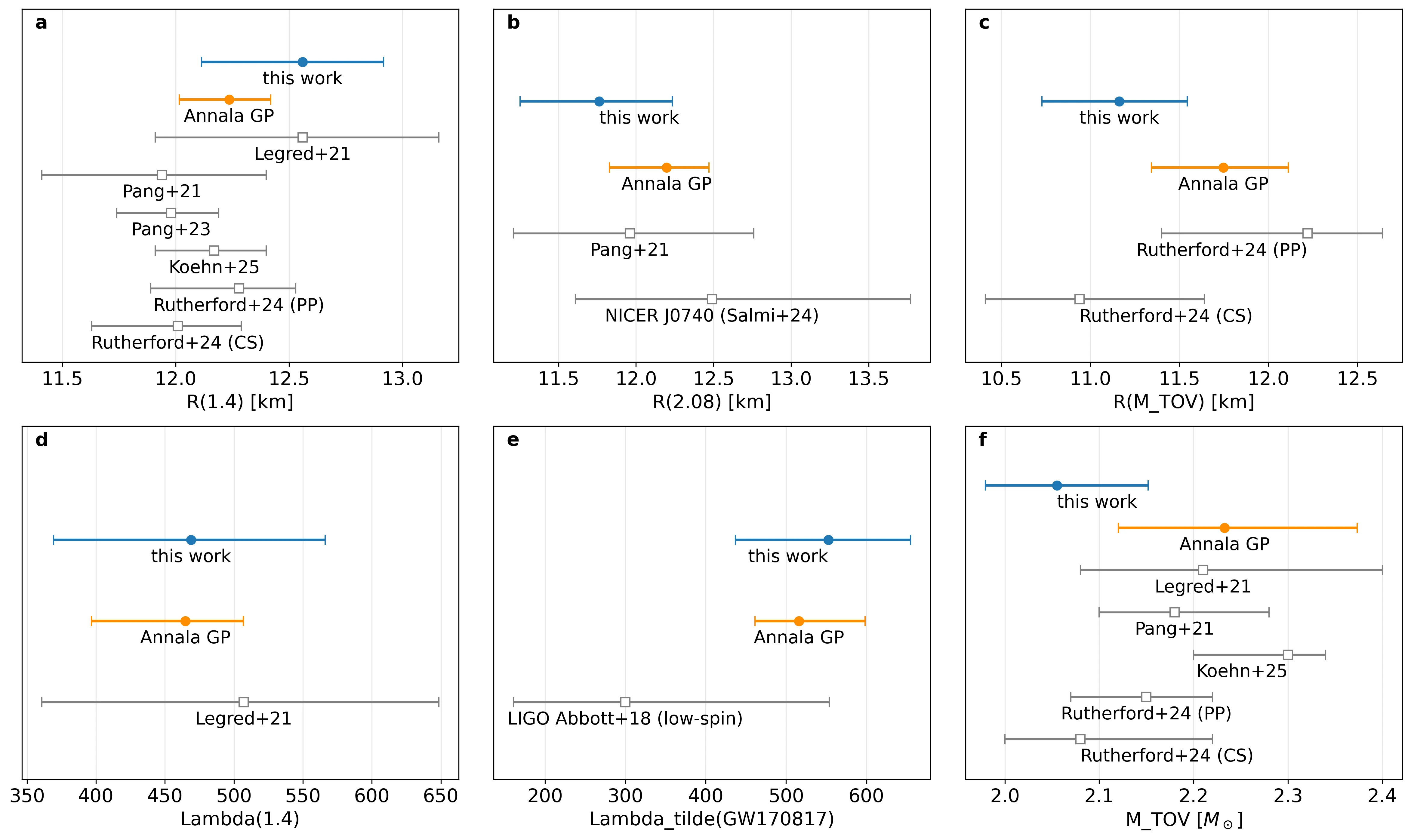
Of 100,000 generated profiles, 89,513 satisfy causality and thermodynamic stability. After weighting, the effective sample size is 4,187. The prior, constrained only by chiral theory, weakly determines the sound speed above 2 nuclear densities; perturbative QCD excludes too-soft equations of state, and astrophysical data require stiffness to support two-solar-mass pulsars. The full posterior sound speed reaches a plateau around 0.47 at the center of the most massive star, showing no sharp peak characteristic of Gaussian processes. Conformality diagnostics—polytropic index below 1.75, trace anomaly compatible with zero, and conformal distance below 0.2—indicate nearly conformal but stiff matter. The Bayes factor against a strong first-order phase transition is 0.14, i.e., odds of 7:1 against, but does not exclude it. The radius at 1.4 solar masses is 12.56 km, the tidal deformability is 469, and the maximum mass is 2.06 solar masses.
Implications
This work stands apart from its arXiv neighbors by being the first to apply a generative diffusion model to the inverse problem of the neutron star equation of state, separating prior, physics, and data. Unlike Gaussian processes and interpolations, which impose a sound-speed peak, here the peak is absent or shifted beyond the stars, reflecting the data rather than the parameterization. Unlike neural network maps that entangle physics in weights, here the network is only a prior, and future measurements will update the posterior via simple reweighting. This makes the result transparent and reproducible, and sets a template for other ill-posed inverse problems in nuclear physics.
Future development
Extending to temperature- and composition-dependent equations of state would allow the same approach to be applied to neutron star mergers, proto-neutron star cooling, and supernova core collapse, where finite temperature dominates and theoretically motivated priors are scarce. Post-merger gravitational waves, which probe temporarily higher densities, could localize the sound-speed peak if it exists inside the star. Microscopic models of hadronic and quark matter could be compared with extracted diagnostics, though composition-resolved input will be needed to localize relative to deconfinement.
Impact
The result will impact the interpretation of NICER and LIGO data, neutron star merger simulations, and high-density nuclear physics. The method of separating prior and likelihood can be transferred to other fields where theory and data constrain different regimes.
Next steps
The immediate next step is to incorporate new NICER and gravitational-wave measurements via reweighting without retraining. Also necessary is extending the approach to finite temperatures and composition.
Key open problems
For nuclear physics, the composition of matter at supernuclear densities remains an open question: nucleons, hyperons, meson condensates, or deconfined quarks. This work directly connects this question to observables through the sound speed and conformality diagnostics, but does not resolve it without additional microscopic models.
The knowledge machine's view
This section is addressed to the author of the paper and their colleagues. Neighbouring works were found by meaning-based search across our archive, not by word overlap. We do not review: we show the field around the work.
What the work does
The authors train a diffusion model on a million synthetic sound-speed profiles, generated from ten classes of functional forms with constraints from chiral effective field theory, and then apply perturbative QCD and astrophysical data via reimportance weighting without retraining. They obtain a radius of 12.6 km and a tidal deformability of 469 for a 1.4-solar-mass star, consistent with previous estimates, and indications of stiff, nearly conformal matter without a strong phase transition.
Where its strength is
The main strength is the strict separation of prior and likelihood, allowing the result to be updated with new data without retraining; the broad prior covering diverse physical scenarios is also valuable.
Where it could go next
- A nearby paper presents a neural network that instantly reconstructs the equation of state from astrophysical observations; your separated-prior approach might be used to calibrate or accelerate such methods.based on: Listening to the Stars: AI Decoder Instantly Reconstructs the Neutron Star Equation of State arXiv:2607.12722
- It may be interesting to explore the connection with a study on the influence of mass on magnetic field generation: your constraints on the equation of state and maximum mass could refine the classes of objects where such a scenario occurs.based on: Neutron Star's Sleeping Volcano: How Mass, Not Spin, Gives Birth to Magnetic Monsters arXiv:2607.17556v1
- There is an arXiv paper analyzing how atomic nuclei hint at neutron star properties; your prior generation method incorporating chiral effective field theory could be extended by adding more nuclear constraints from such approaches.based on: Atomic Nuclei Offer Clues on How to Squeeze a Neutron Star arXiv:2607.16683
Worth trying
- Consider using your diffusion model as a generator of training samples for fast neural-network emulators of the equation of state.
- Test how your posterior distributions change when adding maximum-mass constraints from observations of heavy pulsars.
- Try including scenarios with strong magnetic fields in profile generation to assess their impact on conclusions about conformality.
Why this may matter
This approach could become the standard for joint analysis of future NICER, gravitational-wave, and radio-timing data, enabling fast and transparent updates of the equation of state as observations accumulate.
Nearby works in our archive
- Seeing the Unseen: The Proton Without Formulassimilarity 0.65
- A Stellar Recipe on Papersimilarity 0.63
- Neutron Stars: How to Measure the Invisiblesimilarity 0.63
- Atomic Nuclei Offer Clues on How to Squeeze a Neutron Starsimilarity 0.63
- Neutron Star's Sleeping Volcano: How Mass, Not Spin, Gives Birth to Magnetic Monsterssimilarity 0.63
- Nebula Orchestra: Why Lines Hear Different Densitiessimilarity 0.62
- Listening to the Stars: AI Decoder Instantly Reconstructs the Neutron Star Equation of Statesimilarity 0.62
The closest work in the archive sits at 0.65 by meaning — the usual level for our corpus.
Original abstract
as written by the authors arXiv:2608.17457v1
Neutron-star cores hold the only known matter in the universe that is simultaneously cold and strongly interacting, compressed beyond nuclear density into a state of unknown composition. The equation of state links stellar masses, radii and tidal deformabilities to this regime, but recovering this key quantity from sparse observations is an ill-posed inverse problem. Existing analyses bury a prior in a fixed functional form, unevenly weighting admissible solutions and biasing the result. We reconstruct the equation of state with a denoising diffusion model that keeps prior, physics and data separate: it learns an inspectable, physically motivated prior anchored to first-principles nuclear theory, while perturbative-QCD and astrophysical constraints are imposed exactly. Future measurements therefore will update the posterior by reweighting alone, without retraining or resampling. The inferred radius of 12.6 km and tidal deformability of 469 at 1.4 solar masses reproduce Gaussian-process and heavy-ion-informed inferences despite a far broader prior. We find near-conformal but still stiff matter in the heaviest stars, consistent with a gradual hadron-quark crossover and disfavouring a strong first-order phase transition. More broadly, coupling a learned prior to exactly enforced physics establishes a template for ill-posed inverse problems where theory and data constrain different regions.
A neutron star squeezes a solar mass into a sphere about 20 kilometers across, like fitting a mountain into a teaspoon. The density in its core is several times that of an atomic nucleus, and the speed of sound there reaches nearly half the speed of light.
In Bruce Sterling's novel 'Schismatrix', neutron stars are inhabited by intelligent beings whose physiology is based on exotic states of matter. This work on a stiff, nearly conformal core resonates with the idea of unexpected forms of matter under extreme conditions.
Key numbers
- radius at 1.4 solar masses: 12.56 km
- tidal deformability at 1.4 solar masses: 469
- maximum mass: 2.06 solar masses
- Bayes factor against phase transition: 0.14
- effective sample size: 4187