Generative AI Reconstructs Neutron Star Matter ✛
An interpreter gets distracted by every rustle in the hall, and a one-hour meeting stretches into two. A neutron star compresses a solar mass into a sphere the size of a city, and the matter in its core is denser than an atomic nucleus. Physicists cannot probe its structure in the lab: the required pressures are unattainable. The equation of state, the link between pressure and energy density, remains the central puzzle.
Assembling a picture from fragmentary data is like translating a phrase without knowing the language. There are many approaches: some impose a rigid form, others mix physics and observations in a single neural network. Here they did something different. A diffusion model was trained on a million synthetic sound-speed profiles — from half to eight times nuclear density. The profiles came from ten classes: piecewise polytropes, spectral expansions, logistic curves with a peak, relativistic mean-field models, constant-speed-of-sound models with a phase transition, the McLerran–Reddy quarkyonic model, a Nambu–Jona-Lasinio crossover, and forms motivated by perturbative QCD. The theory of nuclear forces at low energies was embedded as anchors at five density points. Astrophysical data (masses, radii, tidal deformabilities) were applied after generation by reweighting the sample. The prior and the data remained separate.
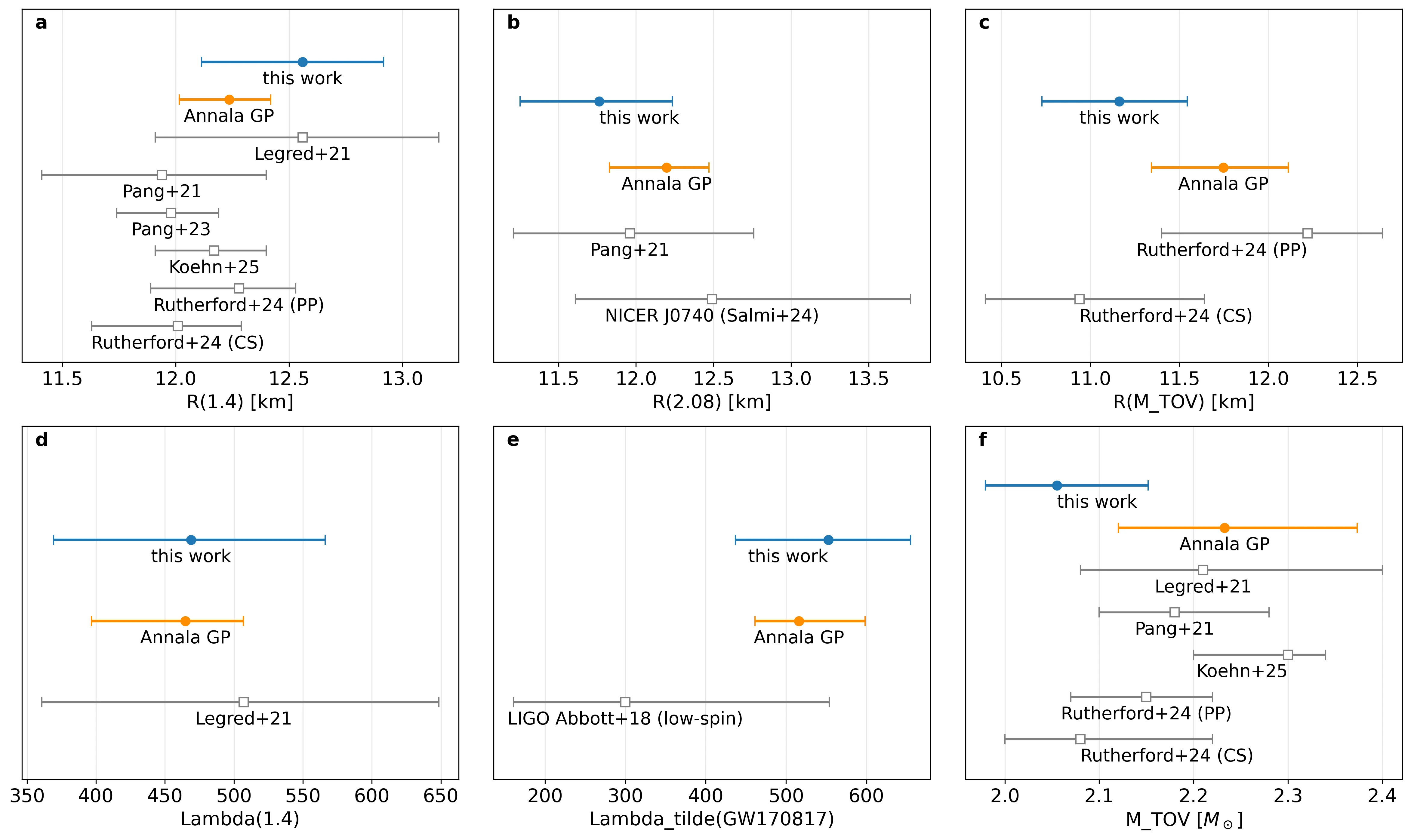
What came out? A prior constrained only by nuclear theory weakly determines the sound speed above twice nuclear density. Perturbative QCD rules out overly soft equations of state. Astrophysics demands stiffness to support two-solar-mass pulsars. The full posterior sound speed reaches a plateau around 0.47 in the center of the most massive star — without the sharp peak imposed by Gaussian processes. Conformality diagnostics — polytropic index below 1.75, trace anomaly consistent with zero, conformal distance below 0.2—indicate nearly conformal but stiff matter. The Bayes factor against a strong first-order phase transition is 0.14, meaning odds of 7:1 against, but it does not rule it out. The radius at 1.4 solar masses is 12.56 km, the tidal deformability is 469, and the maximum mass is 2.06 solar masses.
An interpreter does not impose their own style but merely conveys meaning, separating the voices. Here it is the same: the network is only a prior, and future measurements from NICER or LIGO will update the estimates by simple reweighting, without retraining. This sets a template for other ill-posed inverse problems in nuclear physics. For the reader, the takeaway is: the data do not require a sharp peak in the sound speed, support stiff, nearly conformal matter, and a strong first-order phase transition is unlikely but not excluded.
Neutron star remains an interpreter from the language of extreme density. Now the translation is more honest.
A neutron star squeezes a solar mass into a sphere about 20 kilometers across, like fitting a mountain into a teaspoon. The density in its core is several times that of an atomic nucleus, and the speed of sound there reaches nearly half the speed of light.
In Bruce Sterling's novel 'Schismatrix', neutron stars are inhabited by intelligent beings whose physiology is based on exotic states of matter. This work on a stiff, nearly conformal core resonates with the idea of unexpected forms of matter under extreme conditions.