Pinch Effect in Plasma: How a Tokamak Pulls Particles Inward on Its Own ✛
Context
This work stands somewhat apart from other studies of turbulence and transport in the tokamak edge plasma. Most neighboring works examine turbulent transport of heat and particles outward, fixing the density at the inner boundary or using simplified models. Here, for the first time in a global fluid simulation with a self-consistent density profile, the pinch emerges naturally without artificial assumptions. This connects the work to long-standing questions in confinement physics, such as pedestal density formation in H-mode.
Methods
The GDB code was used, a global three-dimensional electromagnetic model based on drift-reduced Braginskii equations. The simulated plasma had parameters close to those of Alcator C-Mod: major radius 68.5 cm, minor radius 22 cm, field 5.3 T. The computational domain covered the entire toroidal annular layer from 5.3 cm inside the last closed surface to 3.3 cm into the scrape-off layer. The initial density profile was flat, with a particle source localized near the separatrix and heat sources at the inner boundary. The simulation ran for 8.4 ms of transport time, allowing the density profile to reach a quasi-steady state. To analyze the mechanisms, additional runs were performed with electron thermal conductivity and cross-field heat fluxes turned off.
Results
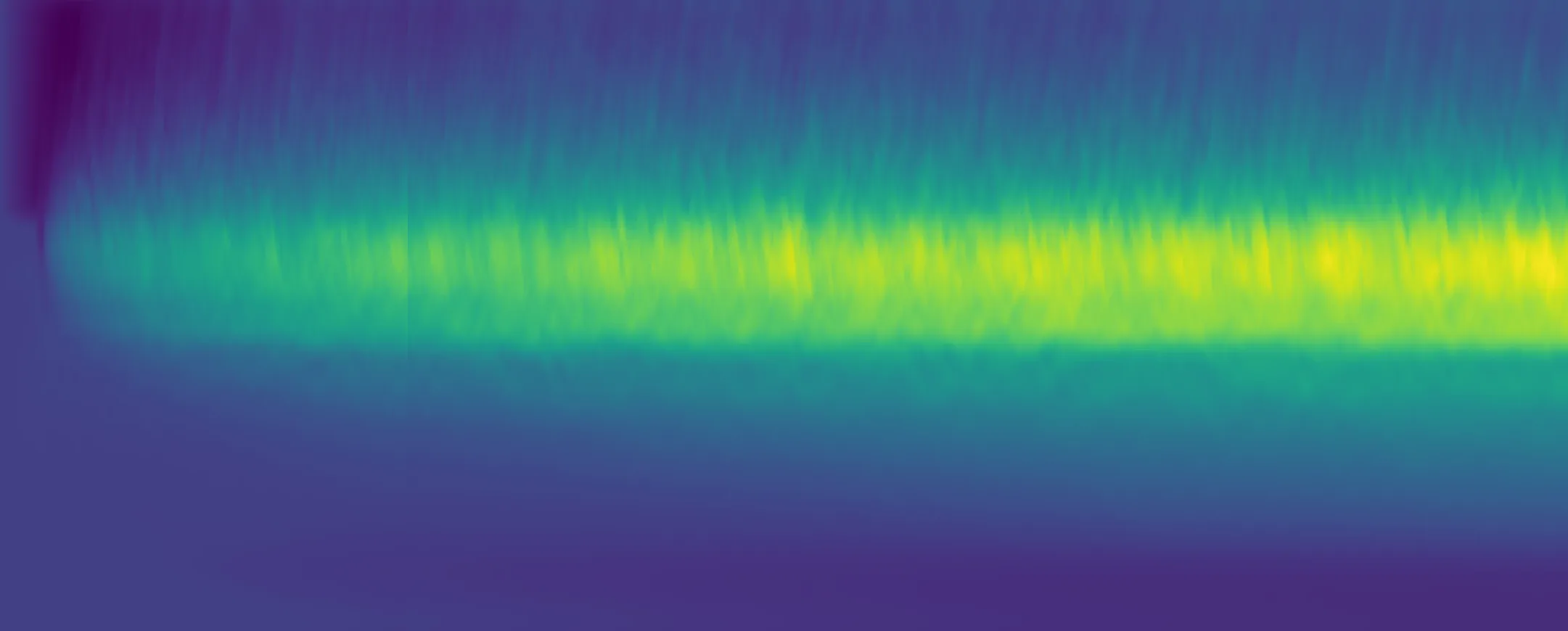
The simulation showed that from a flat initial profile, a density peak forms at the center of the computational domain within a few milliseconds. An inward particle flux exists throughout the evolution, but its nature changes. At the early stage, when the density gradient is positive (density increases outward), a turbulent flux driven by electron thermodiffusion dominates. Linear analysis of a reduced model showed that when the density-to-temperature gradient ratio is negative (η<0), drift waves create a phase shift between density and potential fluctuations, yielding a negative (inward) flux. At the later stage, when the density profile becomes flat, the turbulent contribution weakens, but an equilibrium E×B flow arises due to poloidal asymmetry in density and potential. This asymmetry is generated by Pfirsch-Schlüter heat flow, but classical neoclassical theory predicts zero net flux due to the Boltzmann response of electrons. The GDB model includes non-ideal effects (resistivity, electron inertia, electromagnetic induction) that create a small poloidal phase shift δs ≈ −0.08π between density and potential. This shift leads to a finite inward flux that quantitatively explains the density accumulation. Control runs with cross-field heat fluxes turned off showed that the density peak dissipates, confirming the role of poloidal asymmetry.
Implications
This work differs from neighboring studies in that it does not impose the density profile externally but allows it to evolve self-consistently. It is the first demonstration in a global fluid edge model that a particle pinch arises naturally and leads to density peaking. It shows that the classical neoclassical picture is incomplete: including non-idealities in Ohm's law opens an additional transport channel. This changes our understanding of particle balance in the edge plasma and provides a basis for more accurate predictions of density profiles.
Future development
The topic could develop toward more realistic geometry (e.g., elongation, divertor) and kinetic effects for hot plasmas. It is important to check whether the discovered non-ideal E×B pinch persists in gyrokinetic models and at lower collisionality. Also promising is investigating the role of poloidally asymmetric neutral ionization, which in real tokamaks could enhance or weaken the pinch.
Impact
The results will affect modeling of plasma confinement in tokamaks and stellarators, especially predictions of density profiles and transitions to improved confinement regimes. They are also useful for interpreting gas puff and pellet injection experiments.
Next steps
Next steps include comparing with experimental density profiles from Alcator C-Mod and other devices, as well as extending the model to include kinetic corrections and realistic geometry.
Key open problems
The work is directly related to the unresolved problem of pedestal density formation in H-mode and to the question of which mechanisms determine density peaking in different confinement regimes. It also sheds light on the long-standing puzzle of why the I-mode lacks a particle barrier even though a heat barrier exists.
The knowledge machine's view
This section is addressed to the author of the paper and their colleagues. Neighbouring works were found by meaning-based search across our archive, not by word overlap. We do not review: we show the field around the work.
What the work does
The model simulates the edge of a tokamak plasma with the GDB code, starting from a flat density profile and a particle source at the separatrix, and it shows the spontaneous formation of a peaked profile driven by an inward particle flux. Two mechanisms are identified: turbulent thermodiffusion at an early stage and a non-ideal equilibrium E×B flow at a late stage, caused by the poloidal asymmetry of density and potential.
Where its strength is
For the first time in global fluid modeling with a self-consistent density profile, it is shown that the pinch arises naturally, without artificial assumptions, and it is explained quantitatively through non-ideal effects that create a phase shift between density and potential.
Where it could go next
- It might be interesting to compare the resulting mechanism with approaches to heat confinement, where turbulence can also create inward fluxes.based on: Plasma on a Leash: How Turbulence Holds the Heat arXiv:2603.03123
- A related paper on the transition from quiet flow to turbulence sits nearby; perhaps a similar analysis could be applied to the evolution of the density profile to identify threshold conditions for the pinch.based on: How a calm flow turns itself into a storm arXiv:2602.21422
- One could consider a connection to studies of asymmetry in plasma, for example, how poloidal inhomogeneities affect particle transport.based on: Cosmic Blender: How Electrons Outrun Protons arXiv:2604.06749
Worth trying
- Check whether the pinch persists when parameters are changed, for example, when the temperature gradient is increased or the cross-section shape is altered.
- Investigate the role of electromagnetic effects in more detail by varying resistivity and electron inertia.
- Compare the model's predictions with experimental density profiles in Alcator C-Mod or other tokamaks.
Why this may matter
Understanding the natural particle pinch in the edge plasma may shed light on the formation of the density pedestal and the transition to H-mode, which is critical for future fusion reactors.
Nearby works in our archive
- Forty Years of Tokamak Defiance, and the Breakthroughsimilarity 0.54
- The Dense Dead End of Fusionsimilarity 0.53
- Cosmic Blender: How Electrons Outrun Protonssimilarity 0.52
- Plasma on a Leash: How Turbulence Holds the Heatsimilarity 0.52
- Light Vortices Stir Up Turbulencesimilarity 0.51
- What a Cosmic Hurricane Sounds Likesimilarity 0.51
- How a calm flow turns itself into a stormsimilarity 0.51
The archive is sparse around this work: the closest review is only 0.54, against a usual 0.64. It looks like few have drilled nearby.
In the simulation, particles 'swim against the current': they move from the edge toward the center even though the density gradient initially points outward. Such counterintuitive transport is possible due to correlations between density and electric field fluctuations, not ordinary diffusion.
The idea of plasma spontaneously compressing toward the center echoes the concept of the 'pinch' in science fiction, for example, in Larry Niven's novel 'Ringworld', where magnetic fields confine plasma in a reactor.
Key numbers
- simulation duration: 8.4 ms
- phase shift δs: ≈ −0.08π
- density peak: 1.6×10²⁰ m^-3
- density growth rate: profile becomes flat in 4 ms, peaked in 8 ms
- gradient ratio η: from −2 to +2