Xiang-Dong Li

4 articles · 21 co-authors · latest: 2026-05-16
3,866 citations · h-index 27 · 262 papersData: Semantic Scholar

We have retold 4 papers by this author. 2 of them with a full read. most often about: primordial black hole, Accretion disk, supernova remnant. 21 co-authors across our retellings.

Links in the knowledge graph
X-ray shell reveals supernova explosion in microquasar SS 433
North of the microquasar SS 433, an arc has emerged in the soft X-ray band. Faint and diffuse, yet stubbornly tracing contours already familiar from radio observations. Astronomers studied its spectrum and saw gas heated to eleven million kelvin. Gas that could not have been heated by the jets or the accretion disk wind.
The Quiet Supernova: Why Pa 30 Is Silent in Radio
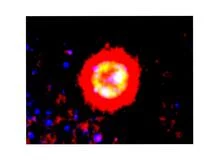
In 1181, Chinese and Japanese astronomers recorded the appearance of a 'guest star', a bright object that shone for six months in the constellation Cassiopeia and then vanished. Today, that spot hosts Pa 30: a nebula with a hot central source ejecting material at 16,000 km/s.
High Energy2026-01-072 minarXiv:2601.04355express
Dancing Stars
Two stars whirl in a tight dance. One is a neutron star — an ultra-dense sphere the size of a city but with a mass of one and a half Suns. The other is an ordinary star that swells and spills its matter onto its neighbor. Sometimes this transfer happens too fast, and the stars become enveloped in a shared gas shell, like two spoons in one pot of boiling soup.
Stellar2026-05-162 minarXiv:2605.16760express
How Stars Lose Their Hydrogen Envelope
In the crowded center of the galaxy, two stars orbit so close together that one strips the outer layers off the other, like wind blowing off a coat. What remains is a hot helium core, a star without a hydrogen envelope.