In the mid-19th century, German chemist Justus von Liebig studied what determines crop yield. He noticed that plants need many elements, but if one is lacking, the others do not help. He formulated this as the 'law of the minimum': growth is determined not by the total amount of resources, but by the one in the smallest relative quantity. The analogy of a barrel made of staves of different lengths: water leaks out through the shortest stave—similarly, yield is limited by the most deficient element. Later, the principle was expanded: the limiting factor can be not only nutrition, but also light, water, temperature. In ecology, this became the basis for understanding ecosystem productivity.
History
Justus von Liebig, a German chemist, published the book 'Chemistry in Its Application to Agriculture and Physiology' in 1840, where he presented the theory of mineral nutrition of plants. He refuted the humus theory and showed that plants absorb elements from the soil in the form of salts. Based on field experiments, he concluded that yield is limited by the element that is lacking, even if others are in excess. Later, in the early 20th century, Eilhard Mitscherlich supplemented the principle with the law of physiological relations, and in ecology, Victor Shelford extended the law of the minimum to the law of tolerance.
How it works
The principle is applied in agronomy to calculate fertilizer doses: first, the most deficient element is identified and applied, otherwise other fertilizers will have no effect. In ecology, the law of the minimum explains why algal blooms in a lake cease when phosphorus is depleted, even if nitrogen is abundant. Limits of applicability: the principle works when factors are independent and do not interact; with synergism or antagonism of elements (e.g., excess potassium blocks magnesium uptake), the simple minimum may be violated.
In practice
In agriculture: if the soil is deficient in phosphorus, adding nitrogen or potassium will not increase yield until phosphorus is replenished.
Fun fact
Liebig invented bouillon cubes—he evaporated meat extract to feed the poor with cheap protein. His law of the minimum came from agrochemistry and eventually influenced management: Goldratt's 'theory of constraints' is a direct descendant of Liebig's barrel.
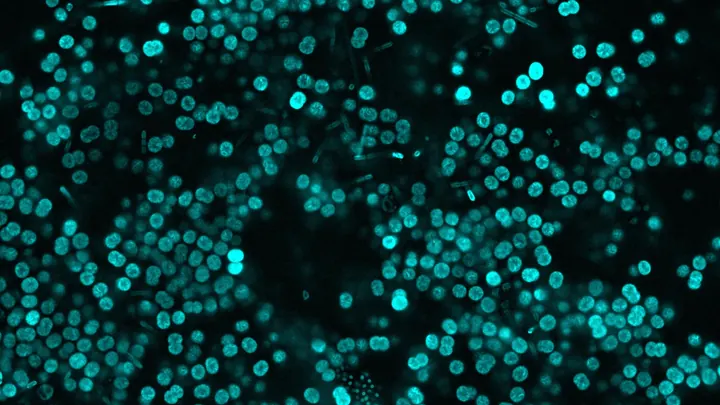
In the freshwater lakes, cyanobacteria Microcystis often cause toxic blooms. They gather into colonies — elastic little spheres, like dense jelly. The cells are glued together by a special substance based on carbon, acting as a powerful natural adhesive. Scientists tested these "jelly balls" for the first time and found their strength astonishing.
The heart doesn't push blood in a steady stream but in pulses. Each beat sends a wave racing through the arteries, like ripples along a taut garden hose. For a long time, it was thought that an animal's metabolic rate depended only on how vessels branch, like pipes in a house. But new work flips that view: what matters isn't the shape of the pipes but the pulse itself.
In urban planning, Braess's paradox is well known: adding a new road to a transport network can worsen traffic rather than ease it. For a long time, it was explained by the selfish behavior of drivers, each seeking personal gain. However, ant colonies, acting as a single coordinated superorganism without personal interests, exhibit the same trap.
An optical tweezer is a beam of light that holds and moves tiny objects like bacteria or dust grains. If you need to carry a particle from point A to point B, you could simply pull it straight there. But that would consume more energy than a cleverly chosen detour.
An active particle is a microscopic object that propels itself forward, like a tiny swimmer.
A neuron in the brain is like a person handing out business cards at a crowded conference. At first, making acquaintances is easy, but as the address book fills up, each new contact requires more effort: there's little room left. The authors based their model on this 'crowding' rule: the more incoming connections a neuron already has, the harder it is to form another one.
A branching network, like a river delta or a tree crown, is built on the principle of economy. The classic law, derived back in 1926, stated that the cube of the parent vessel's diameter equals the sum of the cubes of the daughter diameters. This rule worked beautifully for ideal tubes, but real arteries stubbornly gave a different exponent — around 2.7 instead of 3.
The authors of the new study found the reason.
Tiny particles live double lives, like a spinning coin that’s both heads and tails. Contact with the outside world forces them to pick one — a process called decoherence. Picture it as an echo in a room. The old rule assumed the room was bare, so the echo died instantly. Real surroundings have memory, like soft furnishings that hold sound a little longer. This memory changes the fade.