A Switch in Invisible Matter: Smooth or Clumpy Galaxies ✛
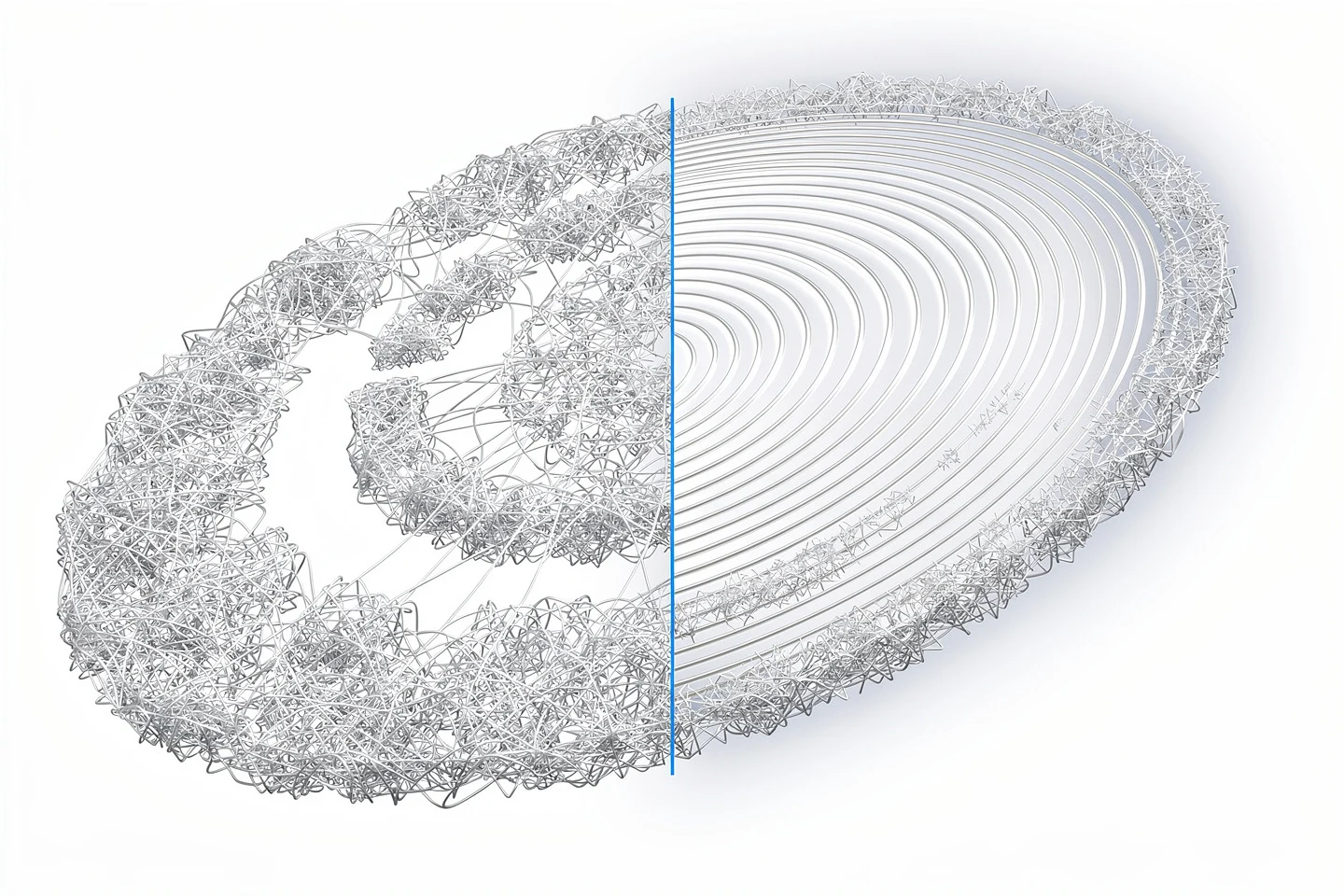
For a long time, astronomers couldn't understand: why is matter in the centers of dwarf galaxies distributed smoothly, not bunched into a tight knot? Ordinary dark matter (a mysterious invisible substance, five times more abundant in the Universe than normal matter) should clump together. The discovery made by Fritz Zwicky and confirmed by Vera Rubin showed that there is plenty of dark matter, but its nature remains elusive. New research turns this problem into an elegant mechanism — like switching a mode in a familiar household appliance.
Imagine you are whisking egg whites for meringue. At first, the liquid flows easily, but at some point the foam suddenly thickens — that's the tipping point. 'Fuzzy' dark matter behaves similarly: it consists of incredibly light particles, whose quantum nature acts as a pressure that prevents matter from shrinking too much. But particles also have random motions — like thermal agitation. Scientists discovered there is a clear boundary (let's call it α ≈ 0.5) where behavior abruptly changes. If quantum pressure dominates, small galaxies stay smooth inside; if motion takes over, structures become clumpy.
After the Big Bang, such effects governed the birth of the first clumps of matter. Now we can see their traces in the spectra of distant quasars — as peculiar 'forests' of absorption lines of hydrogen (the Lyman-alpha forest). Light, traversing cosmic distances at the speed of light, leaves an imprint of dark matter's distribution on these lines. Quantum laws, discovered by Schrödinger, operate here on galactic scales. Unlike systems where quantum entanglement is important, the key here is the collective wave of matter. Thanks to the new theory, we can simultaneously determine both the particle mass and their chaotic velocity — two parameters that previously eluded measurement. This is a big step toward unraveling dark matter, and in the future it will help clarify exactly how all galaxies, including ours, form.
One striking comparison: such dark matter particles are about a hundred billion billion times lighter than a proton, and their quantum 'fuzziness' stretches across thousands of light-years — about the size of a small galaxy.