El Niño: Each Event Has Its Own Predictability Limit
Context
El Niño–Southern Oscillation (ENSO) is the dominant interannual climate signal in the tropics. For a long time it was viewed as a symmetric cycle, but observations reveal diversity: events differ in where the maximum warming occurs, their intensity, and duration. Existing models forecast the Niño3.4 index 6–12 months ahead, yet the question of the predictability limit has remained open. This work fits into a body of research where neighboring studies have explored El Niño prediction up to a year and a half, neural network mapping of galaxy gravitational fields, quantum resources near horizons, and how part shape determines material properties. What sets this paper apart is that it is the first to quantitatively separate the predictability of different event types within ENSO's complexity, rather than estimating it with a single number.
Methods
The authors build a framework based on information theory. From observations, they compute the climatological probability density and the autocorrelation function. They then use a recently developed multiscale stochastic ENSO model that reproduces not only large-scale dynamics but also statistics: non-Gaussian distributions, seasonal phase locking, spectra, and memory. For each initial state, they run an ensemble of 2000 members and track how the forecast distribution diverges from the climatological one. The measure is relative entropy (information gain), which is decomposed into signal and dispersion parts. The Gaussian approximation is checked for accuracy.
Results
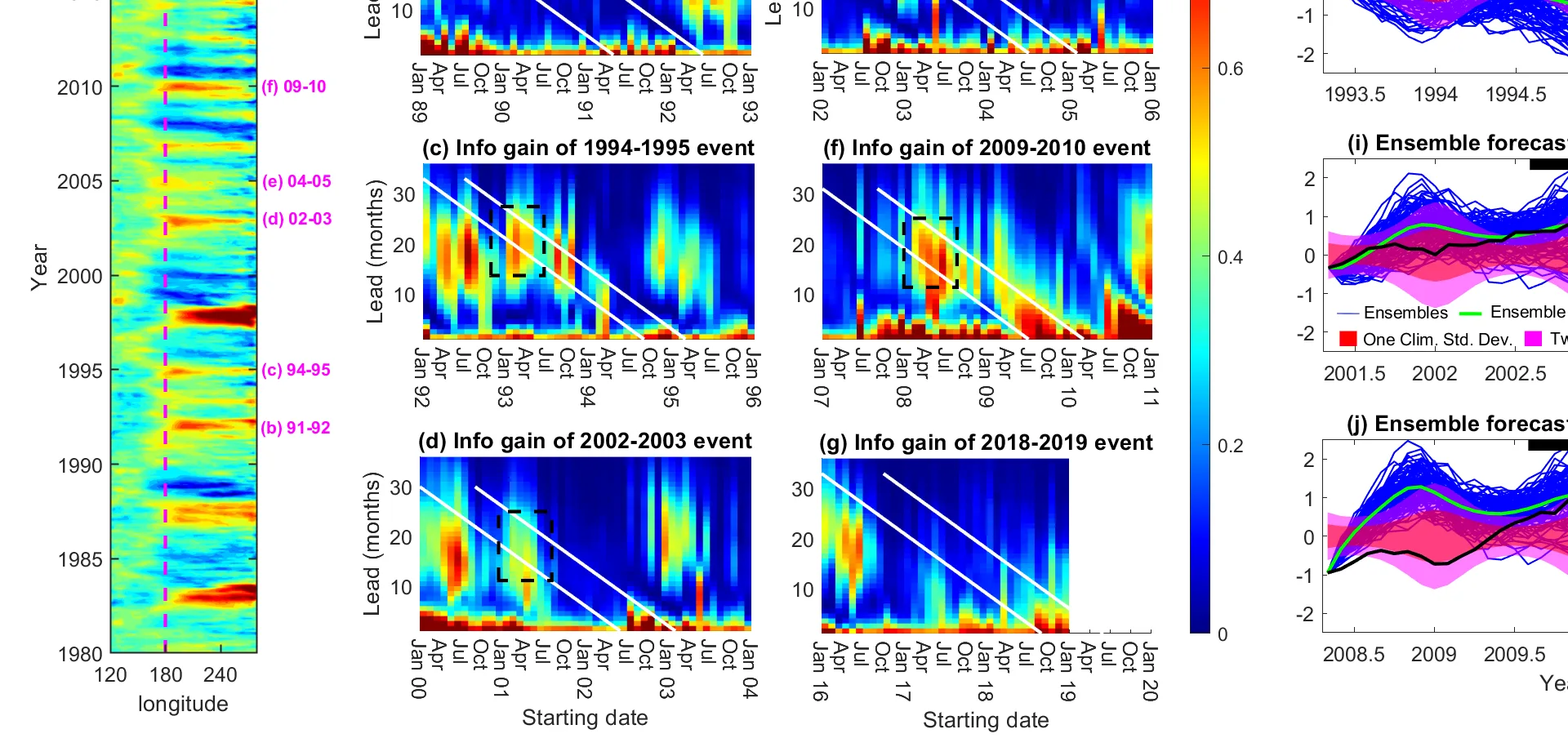
Different ENSO events have sharply different predictability limits. For eastern Pacific El Niño, the onset is hard to predict: information is lost within 6–10 months. For central Pacific events, a universal trend emerges: up to 20 months before the peak, the information gain remains significant, allowing their occurrence to be forecast roughly two years ahead. La Niña events are more predictable than either type of El Niño, especially when starting from an El Niño phase. The dispersion part contributes notably to predictability in the eastern region, while the signal part dominates in the central region. Under a scenario of a strengthened Walker circulation, predictability of central Pacific temperature increases in summer and autumn. The Gaussian approximation proved accurate, simplifying calculations for complex models.
Implications
The work shows that a single predictability limit for all of ENSO is too crude. Unlike neighboring studies that often give an average estimate over the whole record, here predictability is computed for each individual event. This changes the view of the spring predictability barrier: statistically, it is not a fundamental limitation. The results also underscore the importance of considering the full ensemble, not just the mean, because variance carries independent information.
Future development
The topic could evolve toward applying the framework to more complex models, including intermediate and full general circulation models. The Gaussian approximation allows smaller ensembles. Another path is using information gain to select models in multimodel forecasts and to assess the impact of data assimilation on the predictability limit.
Impact
The results could influence operational ENSO forecasting by indicating which events are worth attempting to predict on long lead times and which are fundamentally unpredictable. They also guide model developers: improvements should target not only the mean but also the ensemble spread.
Next steps
The next step is to test the conclusions on intermediate and full climate models. It is also important to understand how data assimilation changes the predictability limit and whether it can be extended through coupled ocean–atmosphere assimilation.
Key open problems
An unresolved question in atmospheric science is why some ENSO events are more predictable than others and what role random wind bursts play. This work directly links predictability to initial conditions and the contribution of different time scales, bringing us closer to understanding forecast limits in a chaotic climate system.
The information gain for central Pacific El Niño remains significant 20 months before the event, even though the ensemble mean in some cases is still far from the truth: some ensemble members 'guess' the event, while others do not.
Key numbers
- lead time for CP El Niño: about 20 months
- predictability of EP El Niño: 6–10 months
- ensemble size: 2000 members
- observation period: 1982–2019
- anomaly threshold for event: 0.5 °C