El Niño as a harbinger of heat over Eurasia ✛
Context
The work sits on the fringe of climate-signal studies: nearby lie analyses of solar cycles, ancient Martian climate, and neutrino flares, but there are almost no direct neighbors on predicting regional anomalies from El Niño phases. The closest in spirit are works on the difference between weather and climate and on seasonal space weather, but they do not touch the mechanism of atmospheric blockings. This article fills that gap by linking El Niño phase to specific regional consequences through statistics of long observational records.
Methods
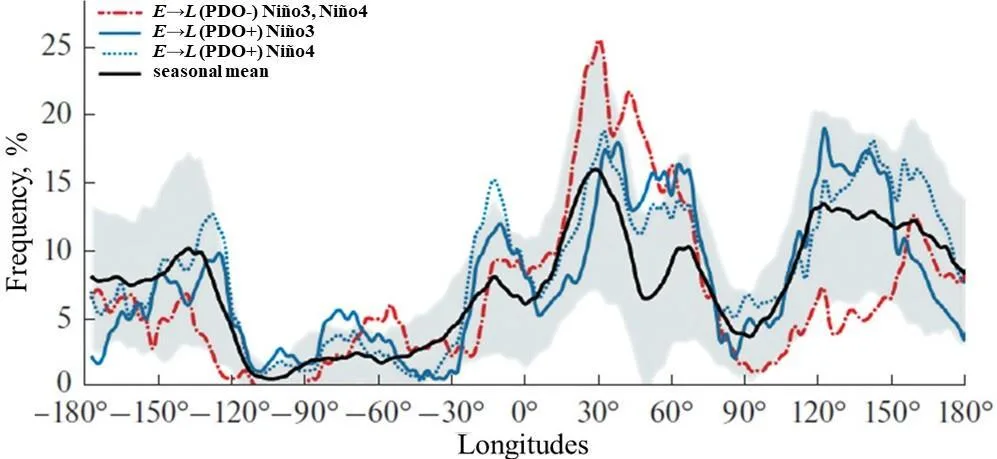
We used time series of surface air temperature, precipitation, and drought indices for the mid-latitudes of European and Asian Russia from 1891 to 2015. El Niño and La Niña phases were defined by sea surface temperature anomalies in three equatorial Pacific regions: Niño3 (eastern), Niño3.4 (central-eastern), and Niño4 (central). Transitions between phases were classified into nine possible scenarios, for example, from El Niño early in the year to La Niña late in the year. For each transition, we calculated the frequency of positive and negative temperature and precipitation anomalies, as well as extremes. Additionally, we analyzed the frequency of atmospheric blockings by longitude in the Northern Hemisphere from 1979 to 2019.
Results
For the El Niño → La Niña transition, positive temperature anomalies in European Russia in May–July occurred in 8 out of 9 cases (89%) using the Niño3 index and in 10 out of 12 (83%) using Niño3.4. Extremely warm months (anomaly greater than 1 K) occurred in 5 out of 9 (56%) and 5 out of 12 (42%), respectively. The probability of drought with index D≥20% reached 67% using Niño3, and with D≥30%, 44%. For precipitation, the difference between positive and negative anomalies was less pronounced: the frequency of precipitation deficits was about 40–50%. Atmospheric blockings over Eastern Europe during the El Niño → La Niña transition in the negative phase of the Pacific Decadal Oscillation exceeded the long-term average frequency by more than one standard deviation.
Implications
Unlike neighboring works that consider either global trends or individual events, this article provides quantitative probabilities of regional anomalies depending on the specific type of El Niño transition and the chosen index. It shows that choosing the Niño3 or Niño4 index substantially changes the estimates: for drought, the difference reaches 17 percentage points. This underscores the need to account not only for the El Niño phase but also for its spatial structure, as well as the phase of the Pacific Decadal Oscillation.
Future development
The topic could develop toward joint analysis of several climate modes, including the North Atlantic Oscillation and the Arctic Oscillation. It is also promising to use high-resolution ensemble forecasts to test whether models reproduce the observed link between blockings and El Niño phases. Climate warming may alter the frequency of blockings, so predictability estimates will require regular updates.
Impact
The results are applicable to seasonal forecasting for agriculture, water resource management, and fire risk assessment in European Russia. They are also useful for insurance companies and emergency response services.
Next steps
Test the robustness of the identified relationships on independent data after 2015 and on an ensemble of climate models. Refine the role of different El Niño types (eastern and central) in the formation of blockings.
Key open problems
In climatology, the question remains open as to how predictable regional anomalies are given a certain El Niño phase. This work shows that even for the same phase transition, the probability of drought can vary depending on the index and the phase of the Pacific Decadal Oscillation, indicating that our knowledge of interactions between climate modes is incomplete.
The knowledge machine's view
This section is addressed to the author of the paper and their colleagues. Neighbouring works were found by meaning-based search across our archive, not by word overlap. We do not review: we show the field around the work.
What the work does
This study examines the link between El Niño-to-La Niña transitions and temperature and precipitation anomalies in European Russia, using 125 years of observational records and classifying transitions into nine scenarios. It shows that an El Niño → La Niña transition raises the probability of positive temperature anomalies to 89% and extreme heat to 56%, and also influences the frequency of atmospheric blockings.
Where its strength is
The strength of this work lies in its quantitative assessment of regional anomaly probabilities for specific transition types and El Niño indices, which is rare in the literature. The results depend on the choice of index and the phase of the Pacific Decadal Oscillation, highlighting the complexity of forecasting.
Where it could go next
- It might be interesting to compare statistical probabilities with results from machine learning models that predict El Niño a year in advance. This would help assess how reliably transitions and associated regional anomalies can be forecast.based on: The Network That Hears El Niño a Year in Advance arXiv:1910.14642
- A related study examines the impact of La Niña on the U.S. power grid through temperature anomalies. A similar analysis for Eurasia could demonstrate the practical value of your results for planning electricity load during hot periods.based on: The Ocean Conducts Blackouts: How La Niña Steers the US Power Grid arXiv:2406.14474
- There is research in the archive that treats El Niño as a conductor, but winter anomalies in Transbaikalia do not directly follow Pacific phases. You might check how your results for European Russia relate to the Asian part and where the limits of your statistical approach lie.based on: El Niño as Conductor: Why Winters in Transbaikalia Don't Follow the Pacific arXiv:2201.00050
Worth trying
- Test whether adding the Pacific Decadal Oscillation index as a predictor improves the quality of probabilistic drought estimates.
- Compare the frequency of blockings in your data with model simulations or reanalysis over the same period to confirm the physical mechanism.
- Assess how sensitive your probabilities are to the choice of anomaly threshold (e.g., 0.5 K instead of 1 K).
Why this may matter
This work fills a gap in understanding the regional impacts of El Niño transitions on Eurasia, which is important for seasonal forecasting and adaptation to extreme weather. The quantitative estimates can inform planning in agriculture, water resources, and energy.
Nearby works in our archive
- The Network That Hears El Niño a Year in Advancesimilarity 0.61
- The Ocean Conducts Blackouts: How La Niña Steers the US Power Gridsimilarity 0.60
- El Niño: Predicting Strength and Onset a Year in Advancesimilarity 0.60
- Graph Neural Networks Predict El Niño More Accuratelysimilarity 0.60
- El Niño as Conductor: Why Winters in Transbaikalia Don't Follow the Pacificsimilarity 0.60
The closest work in the archive sits at 0.61 by meaning — the usual level for our corpus.
In the summer of 2010, European Russia experienced a record-long atmospheric blocking of about two months, leading to anomalous heat and fires. That very scenario was considered the most likely for 2024.
Key numbers
- probability of positive temperature anomaly (E→L, Niño3): 89%
- probability of extreme heat >1K (E→L, Niño3): 56%
- probability of drought D≥20% (E→L, Niño3): 67%
- number of years in archive: 125