Simple

Who's Lurking in the Radio Glow of Galaxies? ⚡ экспресс

Original: "Classifying Compact Radio Emission in Nearby Galaxies: a 10GHz Study of Active Galactic Nuclei, Supernovae, Anomalous Microwave Emission and Star Forming Regions"
arXiv:2507.23332 · 2025-07-31 · CC BY 4.0 · ⏱ 1 min · Galaxies High Energy
A powerful radio telescope found 115 compact sources in three galaxies; some turned out to be distant black holes masquerading as neighbors.
Abstract

Imagine you're studying fireflies in your backyard and suddenly spot a few intensely bright points. Turns out, they're headlights from a car on a faraway road — much like how astronomers, while studying three galaxies, found 115 radio sources, and among them were not just local "stellar nurseries" and a supernova remnant, but also interlopers from distant active nuclei. Without such "unmasking", it's easy to misinterpret the life of galaxies.

Links in the knowledge graph 1

Radio astronomers aimed the VLA telescope at three spiral galaxies – NGC 5474, NGC 4631, and M51 – and saw a scene resembling a city at night: 115 bright points, like streetlights and lit windows. The telescope worked in maximum resolution mode, capturing radio waves to which space is almost transparent.

Among these "lights" are the expanding cloud from supernova SN 2011dh, eight stellar nurseries, and four mysterious patches with warm radio emission (possibly due to spinning cosmic dust).

The big surprise came when comparing with X-ray images. Nine sources coincided with X-ray dots. They were expected to be binary systems with black holes within galaxies, but almost all turned out to be distant quasars – their light piercing the disk of a neighboring galaxy like a searchlight through frosted glass. Worse, some of these "searchlights" had been wrongly labeled as local objects for decades. Without accounting for such impostors, astronomers risk overestimating the number of their own black holes many times over. That's why new giant radio telescopes are learning to separate native lights from background high beams.

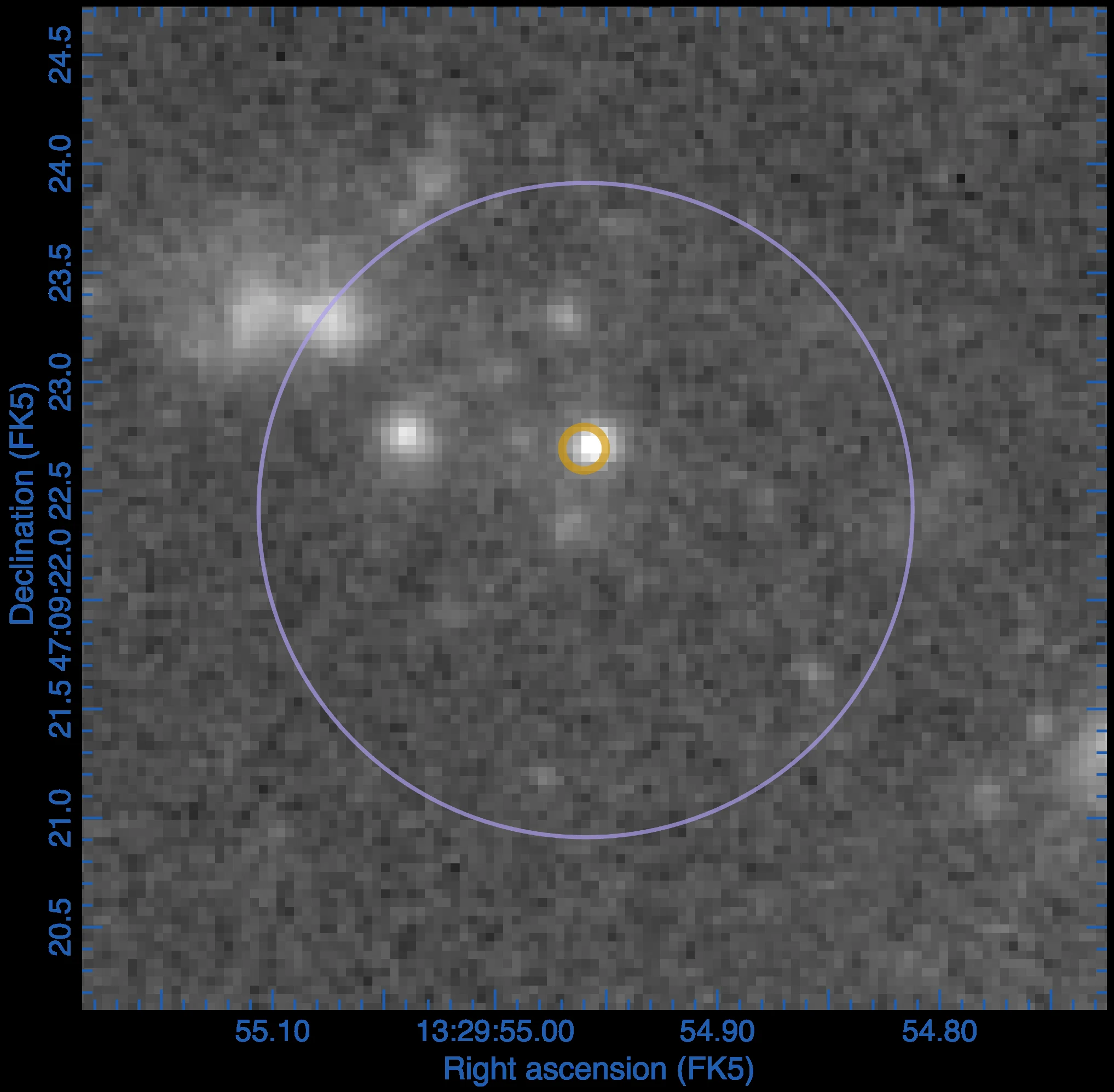
🎯 The radio echo of supernova SN 2011dh, captured in this survey, resembles a slowly dissipating patch of fog that reveals an unexpected detail: before the explosion, the star shed a record amount of mass, hastening its end.

Scientists
Stephen HawkingJacob BekensteinAlbert EinsteinFritz ZwickyVera RubinBernhard Riemann
Tags
galaxy supernova black hole cosmic dust
Laws
Hawking radiationgravitational lensingBekenstein-Hawking entropyEinstein field equationsvirial theoremChandrasekhar limit
Original: arXiv:2507.23332 · CC BY 4.0 · bridge42worlds