Radio Map of Three Galaxies: Compact Sources Versus Diffuse Background ✛
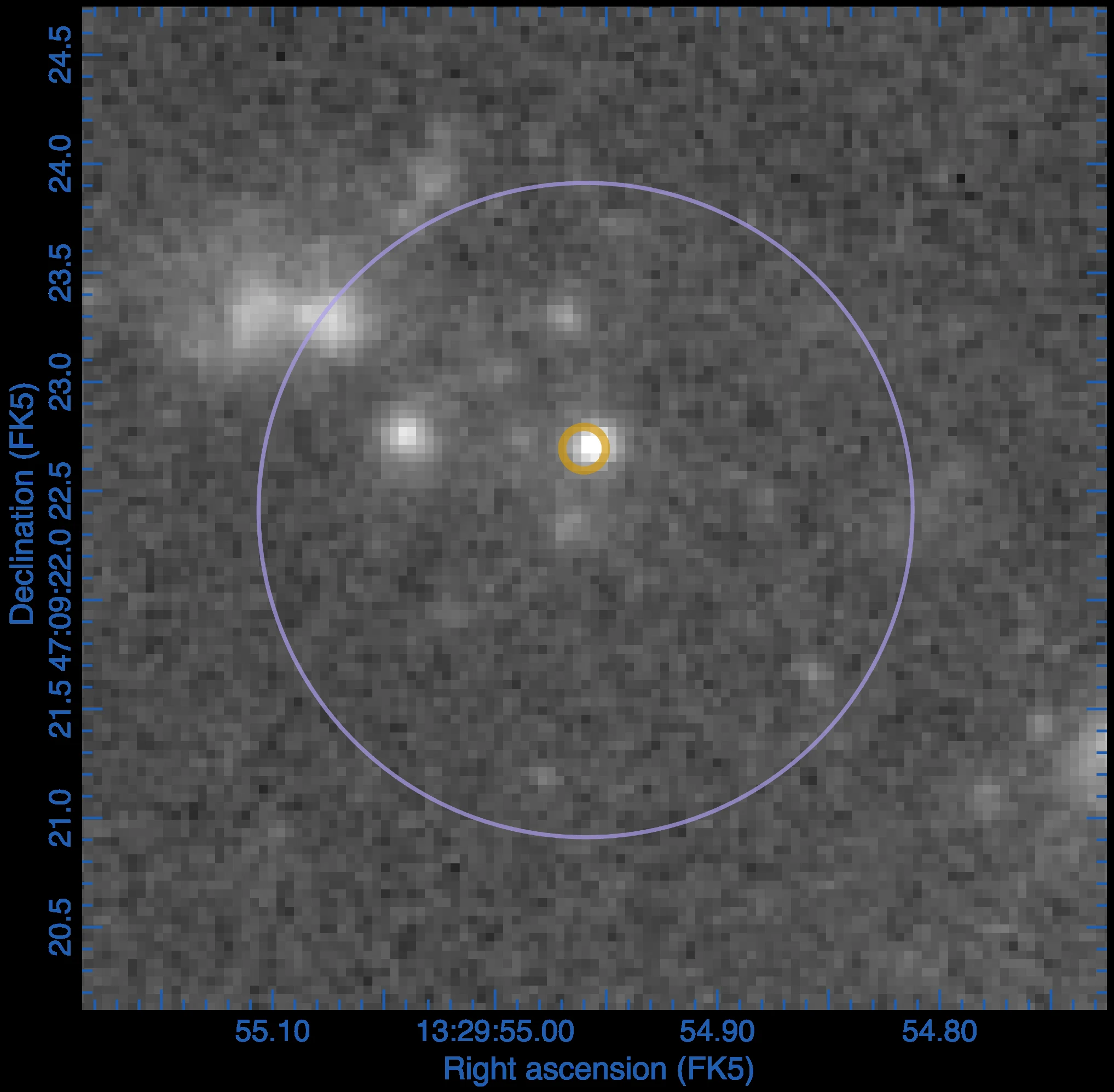
At a distance of 8.58 megaparsecs, the spiral galaxy M51 spins its arms, while the VLA radio telescope in its most extended configuration observes it with a resolution of 0.16×0.14 arcseconds. That is like spotting a coin on the surface of the Moon from Earth. At this sharpness, three nearby galaxies—M51, NGC 4449, and NGC 4631—have for the first time revealed their compact radio sources separately from the diffuse background.
Astronomers sifted the galactic light through a fine sieve. Diffuse emission on kiloparsec scales is the coarse sand that previously obscured individual grains: compact objects a few parsecs in size. The sieve is the synthesized beam of the radio telescope after processing in CASA. Through it passed 115 sources, found automatically with a 5σ threshold. Each grain was compared with the diffuse emission catalog of Linden et al. (2020) and Chandra X-ray data. The median ratio of diffuse to compact flux was 29.2 for NGC 4631 and 10.7 for M51: most of the emission remains unresolved even in the most extended VLA configuration.
In NGC 4631, a source previously classified as a star-forming region and as an X-ray binary turned out to be an active galactic nucleus with jets about 5 arcseconds wide. In M51, Source 65 showed a spectral index α=2.7±0.1, which indicates optically thick free-free emission from a compact HII region. Such findings change the picture: background active nuclei can contaminate catalogs of X-ray binaries and star-forming regions even within the optical radius of a galaxy.
This work is the first to systematically compare compact and diffuse components for three galaxies. It allows us to estimate the true fraction of misclassifications and to identify candidates for anomalous microwave emission that were previously invisible as compact sources. With the advent of the Square Kilometre Array and the next generation VLA, sensitivity and resolution will improve by orders of magnitude. Multi-wavelength surveys with high resolution will become the standard, and the fine sieve of radio maps will sift through thousands of galaxies, separating the contributions of HII regions, supernova remnants, and active nuclei.
A resolution of 0.15 arcseconds at the distance of M51 is equivalent to spotting a coin on the surface of the Moon from Earth. Yet the median diffuse-to-compact flux ratio in NGC 4631 reaches 29, meaning most of the emission remains unresolved even in the most extended VLA configuration.