Millimeter waves are electromagnetic radiation with wavelengths between roughly one and ten millimeters, placing them in the spectrum between microwaves and infrared. This band is scientifically valuable because it carries information from cold, dark regions of the universe—molecular clouds, dusty star-forming regions, and the faint afterglow of the Big Bang—that are invisible in optical light. The title 'Радиоэхо из тёмных веков Вселенной' points to their role in probing the early universe, while 'Вспышка на Солнце: что увидел радиотелескоп' shows their use in studying energetic solar events.
History
The millimeter-wave window was opened in the 1960s and 1970s with the development of sensitive heterodyne receivers. Early observations of carbon monoxide (CO) in molecular clouds by groups like that of Arno Penzias and Robert Wilson helped establish the field, though the specific history of the term itself is not tied to a single inventor.
How it works
Millimeter waves are generated naturally by thermal emission from dust and gas at temperatures of a few tens of Kelvin, as well as by non-thermal processes like synchrotron radiation. On Earth, they are detected with specialized radio telescopes equipped with cryogenically cooled receivers that amplify the faint signals. Because water vapor in the atmosphere absorbs these waves, observatories are placed at high, dry sites or in space. The short wavelengths allow high angular resolution with relatively compact dishes, and interferometry can combine multiple antennas to achieve even finer detail.
In practice
Beyond astronomy, millimeter waves are used in airport security scanners, automotive radar for collision avoidance, and high-frequency wireless communications (5G and beyond).
Fun fact
Millimeter waves can penetrate fog and dust far better than infraredlight, which is why they are used for 'seeing through' haze in both radar and imaging systems.
The night sky is full of rings and bubbles, but in the radio band they look different. In data from the Australian radio telescope ASKAP, a structure has surfaced that resembles two soap bubbles blown from the same straw.
The galaxy cluster RXC J0528.9−3927 is like a city shrouded in fog: at its center, a radio halo shines brightly, but farther out, beyond the usual boundaries, astronomers have spotted a barely visible glow. It stretches for two million light-years — three times farther than the halo itself.
When designing smartphone antennas, engineers need a reference — something like a tuning fork for adjusting musical instruments. As Maxwell showed, radio waves and light are of the same nature, and the new antenna module uses 5G millimeter waves traveling at the speed of light.
The cosmic microwave background is the afterglow of the Big Bang, which we see at millimeter wavelengths. But it also has a long-wavelength tail extending into the radio range.
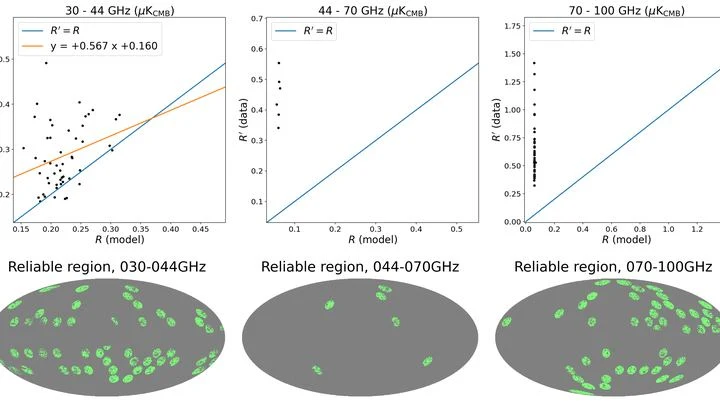
Astronomers are trying to capture the radio echo of the Big Bang — a faint glow that fills the entire universe. But the receiver is choking with noise: our Galaxy is packed with glowing interstellar dust, whose emission can easily be mistaken for a signal from the distant past.
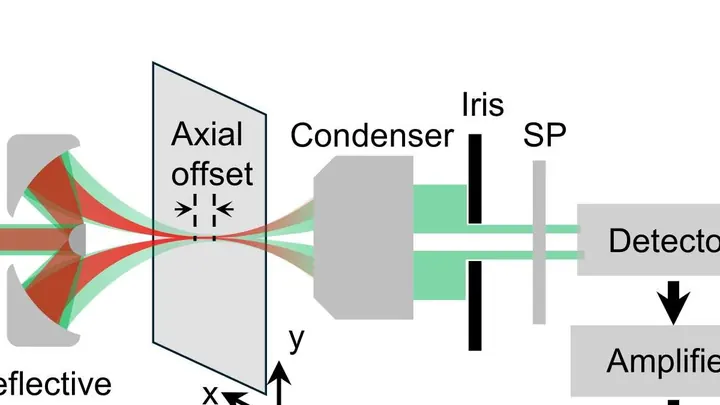
Light we can't see but feel as heat turns out to be the key to cellular life. A new type of microscope uses waves 2000–2500 nanometers long, three times longer than red light, and such waves barely scatter in tissue. Thanks to this, the device peers into a tumor spheroid like a flashlight through frosted glass, illuminating individual molecules.
At the heart of the Milky Way spins a stellar bar — an elongated cluster, like a rotating paddle. Its gravity creates a rhythmic field around it, like waves from a speedboat.
The solar corona, the Sun's outer atmosphere, stretches millions of kilometers, yet it's visible only during a total eclipse or with specialized instruments. Typically, we gauge the corona's density by how it scatters white light, but that method relies on simplifications that can skew the results.
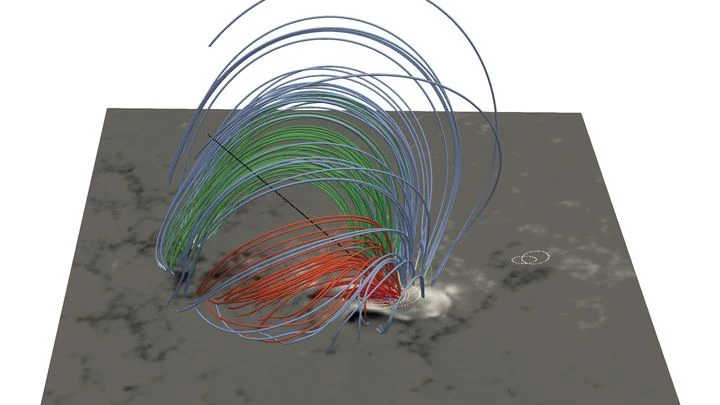
A solar flare is like thunder on a clear day: a short but powerful burst of energy. The MeerKAT radio telescope in South Africa caught one such M1.3-class flare and examined it with unprecedented clarity. Ordinary instruments see either bright details or faint ones, but not both at once.
A solar flare is like an explosion in a star's atmosphere: in minutes, it releases energy comparable to billions of nuclear bombs. On May 4, 2022, the RT-7.5 radio telescope in Moscow was watching an M5.7-class flare. The instrument was catching millimeter radio waves: those shorter than a centimeter and invisible to the eye.
In Chile's Atacama Desert, at an altitude of nearly five kilometers, stands a radio telescope that catches millimeter waves from the depths of space. These waves carry the heat of distant galaxies, but first they must pass through a window — a thin plate of silicon that separates the cold receiver from the warm outside world.
Cosmic neutrinos are ghost particles, passing freely through the Earth. The IceCube telescope in the ice of Antarctica once caught such a neutrino, and it matched an infrared flare. That flare turned out to be the moment a black hole tore a star apart in a distant galaxy.
The night of March 4, 2024. The MeerKAT radio telescope in South Africa catches a millisecond pulse: a fast radio burst coming from a depth of 17.4 gigaparsecs. This is light that traveled 10.5 billion years to reach Earth.
At a distance of 8.58 megaparsecs, the spiral galaxy M51 spins its arms, while the VLA radio telescope in its most extended configuration observes it with a resolution of 0.16×0.14 arcseconds. That is like spotting a coin on the surface of the Moon from Earth.
The RATAN-600 radio telescope is a ring of hundreds of aluminum panels on a mountainside in Karachay-Cherkessia. In the spring of 2018, its mirror caught radio waves from sixteen red dwarfs — small, dim, but very long-lived stars.