A Score for Two Molecules: Permanent Dipoles Conduct Dark States ✛
Two voices in a molecular duet can sound in unison or cancel each other into silence. In physics, such silence is called a dark state: a quantum excitation that does not interact with light and therefore lives unusually long. For a pair of coupled molecules, a dimer, dark states have long been a working tool, but until now calculations have ignored one detail that, it turns out, can completely change the score. That detail is permanent dipoles, the charge separation that exists in a molecule even without an external field.
Many organic molecules have a permanent dipole: in the ground state, the electron cloud is shifted to one side, and after excitation, to the other. This difference may seem small, but in a dimer it acts like a conductor changing the interaction between voices. The authors built a dimer Hamiltonian explicitly including the permanent dipole moments of both monomers and considered three types of electrostatic coupling: direct between excited states, indirect through the common ground state, and mixed. It turned out that for indirect coupling, permanent dipoles interfere with transition dipoles, the measure of a molecule's ability to absorb or emit light. This allows dark states to form even when the monomer transition dipoles are orthogonal and the usual way of constructing a dark state fails.
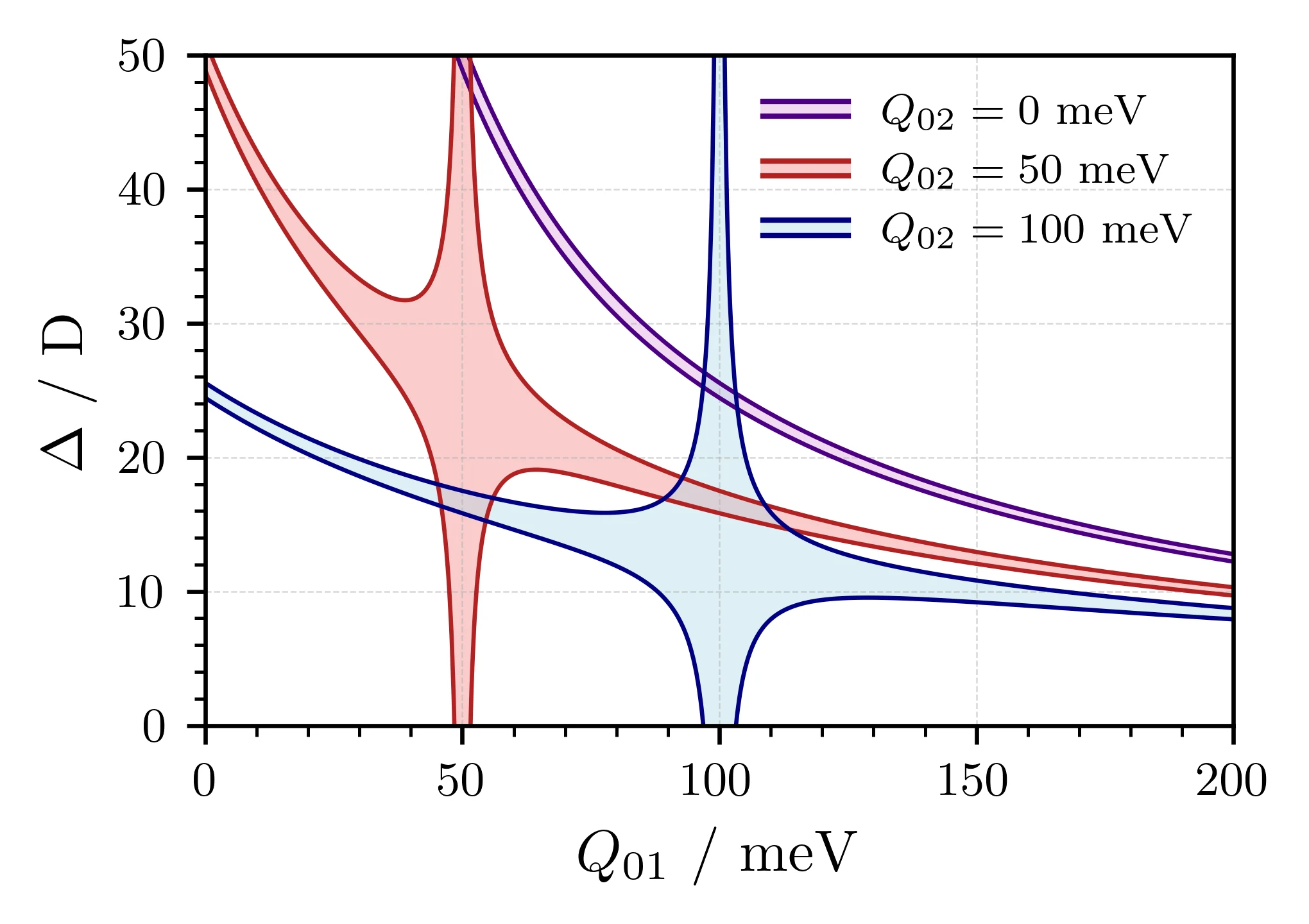
Mixed coupling opens an even more interesting possibility: fully localized dark states. The excitation is trapped on one monomer but optically accessible through another excited level. Numerical simulations with thermal perturbations (standard deviation 25 meV) showed that at the optimal ratio of direct to indirect coupling, the decay rate of the dark state drops by orders of magnitude. For example, at $Q_X$=0, decay from state |2(C)⟩ is 100 times slower than from |1(C)⟩. Thermal noise, which usually destroys coherence, is almost powerless here.
Previously, permanent dipoles were considered a small correction not worth attention. Now it is clear: they are an active tool for tuning optical properties. Accounting for these dipoles allows the deliberate construction of robust dark states that can serve as reliable cells for energy storage or quantum information. In organic solar cells, such states reduce recombination losses, and in quantum technologies, they protect against degradation. Two voices, conducted by permanent dipoles, can now hold a pause much longer than was thought possible.
Permanent dipole moments of organic molecules can reach several debyes, comparable to the dipole between two elementary charges separated by fractions of an angstrom. In a dimer, such dipoles can completely "switch off" the optical transition, making the molecule invisible to light.