Permanent Dipoles: How Dark States Become More Robust ✛
Context
This research lies in the field of quantum optics of molecular systems, where dark states, coherent superpositions of excited states that do not interact with light, play a key role in suppressing radiative losses. Nearby work includes studies on controlling light from single molecules and exciton transport in nanostructures, but almost all of them neglect permanent dipoles. This work fills that gap by showing that permanent dipoles are not just a small correction but an active tool for tuning optical properties.
Methods
The authors constructed a Hamiltonian for a molecular dimer, explicitly including permanent dipole moments in the ground and excited states of each monomer. Three types of electrostatic coupling were considered: direct (between excited states), indirect (through the common ground state), and mixed. The dynamics were described by the secularized Redfield equation, and to test the stability of dark states against thermal fluctuations, numerical simulations were performed with Gaussian perturbations of the energy levels (standard deviation 25 meV).
Results
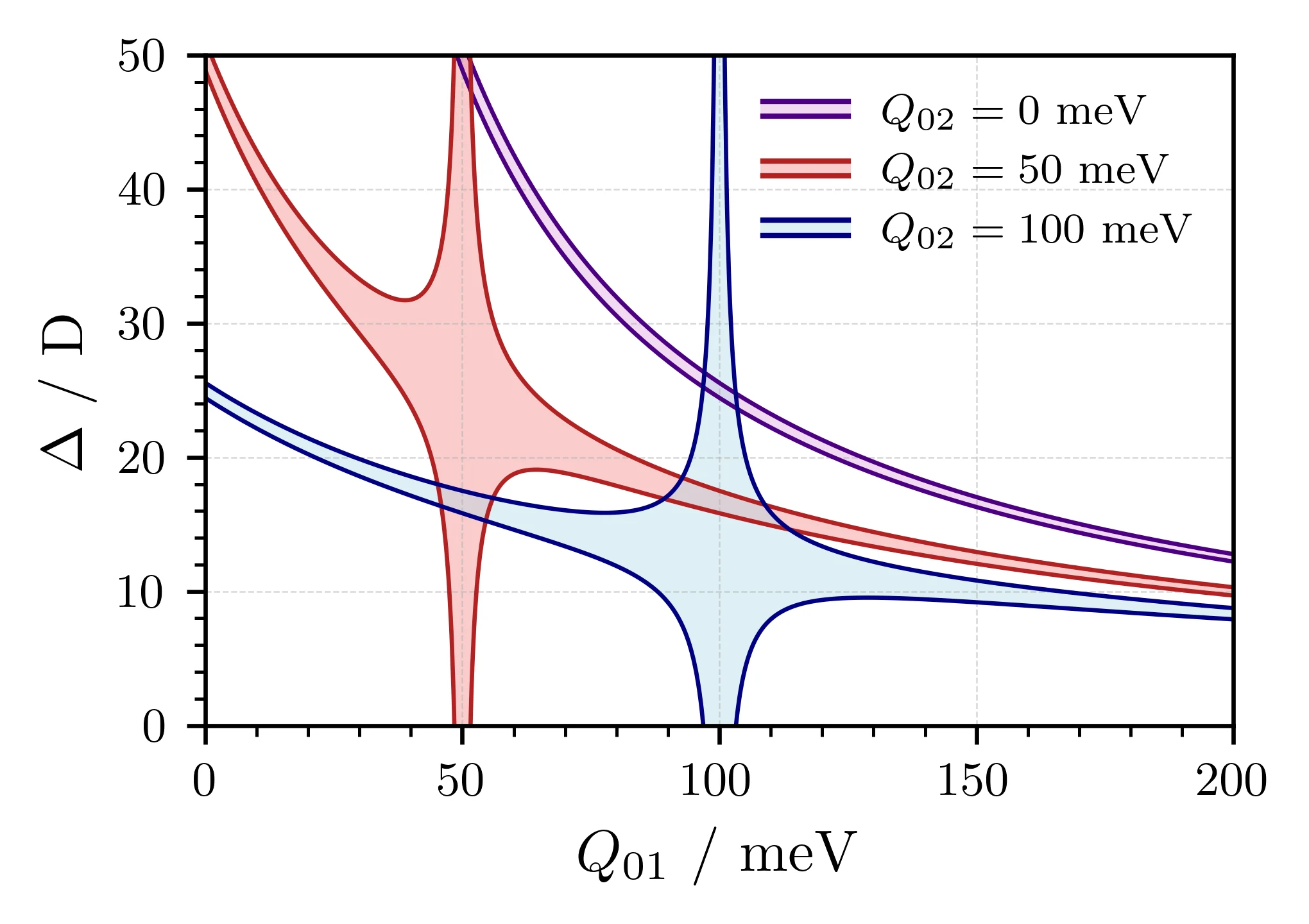
It is shown that under indirect coupling, permanent dipoles interfere with transition dipoles, allowing dark states to form even when the monomer transition dipoles are orthogonal. In the mixed case, fully localized dark states are possible, where the excitation is trapped on one monomer but is optically accessible through another excited level. Numerical analysis revealed that at the optimal ratio of direct to indirect coupling, the average decay rate of the dark state is reduced by orders of magnitude compared to the case without permanent dipoles (for example, at $Q_X$=0 the decay rate from |2(C)⟩ is 100 times higher than from |1(C)⟩).
Implications
This work differs from neighboring studies in that it does not merely state the existence of dark states but shows how permanent dipoles can be used for their targeted construction and enhanced robustness. This paves the way for more efficient control of exciton transport in organic materials, where thermal noise usually destroys coherence.
Future development
A promising direction is extending the model to larger aggregates and incorporating strong coupling with cavity modes, which could amplify the effects of permanent dipoles. It is also important to consider the influence of vibronic interactions and inhomogeneous broadening in real molecular ensembles.
Impact
The results can be used in the design of organic solar cells and light-emitting devices to reduce energy losses. They are also relevant for quantum technologies, where dark states serve for storing and transferring quantum information.
Next steps
The next step will be experimental verification of the predictions on dimers with known permanent dipoles, for example, in polar organic molecules. In parallel, the theory needs to be developed to account for environmental effects beyond the weak coupling limit.
Key open problems
The work is directly related to the problem of controlling exciton dynamics in disordered media, where thermal fluctuations limit the efficiency of energy transfer. The proposed mechanism for enhancing the robustness of dark states could become a universal recipe for molecular photonics.
The knowledge machine's view
This section is addressed to the author of the paper and their colleagues. Neighbouring works were found by meaning-based search across our archive, not by word overlap. We do not review: we show the field around the work.
What the work does
This paper builds a model of a molecular dimer that explicitly accounts for permanent dipole moments in the ground and excited states. It considers direct, indirect, and mixed electrostatic coupling, describes the dynamics with the secularized Redfield equation, and numerically tests the stability of dark states under Gaussian fluctuations of energy levels. The results show that permanent dipoles can create dark states with orthogonal transition dipoles and form fully localized dark states with reduced decay rates.
Where its strength is
The work demonstrates that permanent dipoles are not a minor correction but an active tool for engineering robust dark states, expanding the possibilities for controlling the optical properties of molecular aggregates.
Where it could go next
- It might be interesting to compare the localized dark states found here with single-molecule light control via atomic switches, where fine-tuning of interactions is also used to control emission.based on: Atomic Switch Controls Light from Molecules arXiv:2603.29286
- Related work on dark excitations in pristine graphene also discusses states weakly coupled to light; one could transfer the idea of permanent dipoles to low-dimensional systems to enhance localization.based on: Dark Excitations on Clean Graphene arXiv:2603.02301
- There is a study in the archive on exciton transport in nanostructures with an emphasis on coherence; one could check how the dark states engineered here affect energy transfer in larger aggregates.based on: Light from a Single Molecule arXiv:2603.01897
Worth trying
- Test whether the robustness of dark states persists when vibronic interactions beyond the secularized Redfield equation are included.
- Consider a chain of several monomers with permanent dipoles to see whether fully localized dark states can exist at the chain edges.
- Assess the impact of orientational disorder of permanent dipoles on the stability of dark states in realistic molecular films.
Why this may matter
If permanent dipoles can indeed create long-lived dark states in organic materials, this could improve the efficiency of photovoltaic devices by suppressing radiative losses and enhancing exciton transport.
Nearby works in our archive
- Atomic Switch Controls Light from Moleculessimilarity 0.55
- Dark Excitations on Clean Graphenesimilarity 0.54
- Light from a Single Moleculesimilarity 0.53
- Light Finds the Point Where Scattering Blows Upsimilarity 0.52
- A Light Trap Rewrites the Fate of Moleculessimilarity 0.52
The archive is sparse around this work: the closest review is only 0.55, against a usual 0.64. It looks like few have drilled nearby.
Permanent dipole moments of organic molecules can reach several debyes, comparable to the dipole between two elementary charges separated by fractions of an angstrom. In a dimer, such dipoles can completely 'switch off' an optical transition, making the molecule invisible to light.
Key numbers
- standard deviation of thermal fluctuations: 25 meV
- monomer excitation energy: 2.4 eV
- transition dipole strength: 10 Debye
- difference in decay rate at Q_X=0: 100 times
- spectral density cutoff frequency: 10 eV