Gravitational wave detection noise refers to the various sources of interference that obscure the incredibly faint signals from cosmic events like black hole mergers. These noises arise from both instrumental limitations (e.g., thermal vibrations in mirrors, laser shot noise) and environmental factors (e.g., seismic activity on Earth, cosmic ray showers). The challenge is that gravitational waves cause minuscule distortions — on the order of a thousandth of a proton's diameter — so any background disturbance can easily mask the signal. Researchers must meticulously characterize and subtract these noise sources to confidently claim a detection.
History
The problem of noise has been central to gravitational wave astronomy since the first detectors were built in the 1960s. The breakthrough detection in 2015 was only possible after decades of noise reduction efforts, and the field continues to push toward even quieter detectors.
How it works
Detectors like LIGO use laser interferometry to measure tiny changes in the length of two perpendicular arms. Noise enters through multiple channels: seismic vibrations shake the mirrors, thermal noise jitters the atoms in the mirrors and suspensions, and quantum noise arises from the discrete nature of light. Advanced techniques, such as squeezing the laser light to reduce quantum noise, and sophisticated data analysis algorithms that model and subtract noise, are employed to improve sensitivity. The signal-to-noise ratio is the critical metric — a detection is only claimed when the signal stands clearly above the noise floor.
In practice
Noise mitigation techniques are essential for all current and future gravitational wave observatories, including LIGO, Virgo, KAGRA, and the planned space-based LISA mission.
Fun fact
Some noise sources are so persistent that scientists have to 'subtract' the effect of passing clouds, which slightly change the local gravitational pull on the mirrors.
Imagine a lottery where instead of money, you win black holes. Each ticket is a random spot on the sky, and the prize is a gravitational wave from the merger of two giants. The chance of hitting the jackpot is minuscule, but if you do, the wave is heard across the entire universe.
A handful of pebbles drops into a pond: each one sends out ripples. If the pebbles are different, the ripples will be different too: some sharp, some smooth. But when you look at the water from a distance and see only a small part of the ripples, all those differences blur together.
Eight bright spots on the radio sky. They are all the same quasar HS 0810+2554, whose light passed through a gravitational lens — a massive foreground galaxy.
A gravitational wave observatory is like a set of microphones scattered across the Earth. When a signal arrives from space (say, from a black hole merger or a supernova explosion) each microphone hears something slightly different.
At the center of the Milky Way, like a matryoshka doll within a matryoshka doll, lies a supermassive black hole, surrounded by a swarm of stars and an invisible shell of dark matter. This shell, or "spike," is expected to be extremely dense right at the horizon.
When two black holes merge, the resulting black hole 'rings' for a while, emitting gravitational waves — like a dying bell. This ringing is captured by giant detectors created by Rainer Weiss and Kip Thorne.
Physicists are trying to hear a whisper in a noisy room. They build a soundproof booth, but even inside, their own breathing and heartbeat create interference. That's roughly how the search for quantum gravity goes: they want to see gravity bind two particles into a single whole — entangle them.
A pebble dropped in a pond creates curved ripples, but from far away they appear as straight lines. Gamma-ray flashes from an evaporating black hole behave the same: a distant burst sends flat waves, while a nearby one arrives curved.
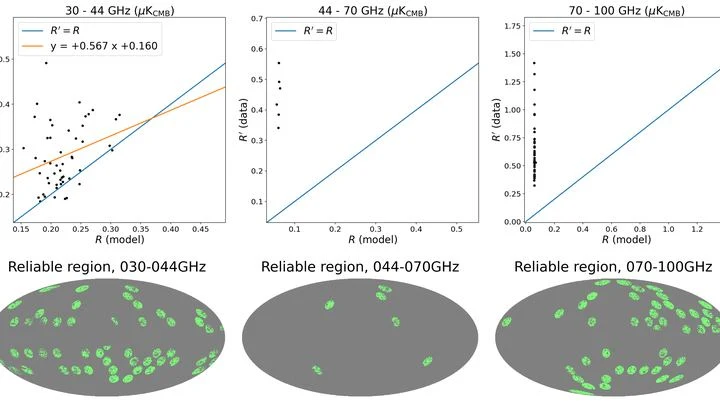
Astronomers are trying to capture the radio echo of the Big Bang — a faint glow that fills the entire universe. But the receiver is choking with noise: our Galaxy is packed with glowing interstellar dust, whose emission can easily be mistaken for a signal from the distant past.
Detectors of gravitational waves usually compare the signal with ready-made templates, as if searching for a familiar melody in the noise. This allows them to track only known scenarios, such as black hole mergers.
When two black holes merge, the newborn hole rings like a bell, emitting gravitational waves. In the past, only the fundamental tone of this ringing was captured. But analysis of the GW250114 merger showed that the signal hides extra faint vibrations — nonlinear overtones.
In a courtroom, there isn't always a video recording of the crime. Sometimes the verdict is based on witness testimony: what happened before, what happened after. That's exactly how physicists treated the signal GW250114, detected on January 14, 2025.
An ordinary black hole is the perfect devourer: everything that crosses its horizon disappears forever. But in recent decades, this picture has been cracking at the seams. The information paradox, singularities, firewalls: theorists are looking for a way out, and one candidate replacement is the black mirror.