A planet moves around the Sun: the closer, the faster. The line connecting the planet and the Sun sweeps out equal areas in equal time intervals. A figure skater pulling in their arms spins faster — the same principle applies here.
History
Johannes Kepler obtained the second law during many years of attempts to describe the orbit of Mars using Tycho Brahe's data. He abandoned circular orbits and discovered that the planet's speed changes, but the area swept out by the Sun-planet line remains constant. The result was published in 1609. Later, Isaac Newton in 'Mathematical Principles of Natural Philosophy' (1687) showed that Kepler's second law is equivalent to the conservation of angular momentum. Emmy Noether in 1918 linked this conservation to the isotropy of space.
How it works
The law is applied in celestial mechanics to compute the position of bodies in orbit at any moment of time, as well as in astrophysics to analyze radial velocity curves of stars with exoplanets. Limits of applicability: in strong gravitational fields, for example near neutron stars, relativistic corrections violate the Keplerian picture; in many-body systems, orbits are perturbed, and the law holds only approximately. When the potential deviates from spherical symmetry (flattened galaxies), the areal velocity is not strictly conserved.
Fun fact
If the orbit were a perfect circle, the planet's speed would remain constant. But on an ellipse, Earth is 3% faster in January than in July.
As planets orbit the Sun, they don't just follow their paths: they give each other a slight tug. It's like a dance where each partner feels the movements of the others. Scientists set out to determine how strongly this mutual attraction alters the planets' trajectories.
It turns out there are small corrections that were previously overlooked.
A thrown stone arcs through the air, but a planet around the Sun follows a closed curve. Why an ellipse, and not a circle or a spiral? Kepler's first law provides the answer, but its usual proof requires heavy computation. This work offers a shorter path — through a single simple ratio of velocities.
In 1929, Edwin Hubble pointed his telescope at distant galaxies and discovered they were receding. Ninety years later, two measurements of this recession rate, from ancient light and from nearby stars, stubbornly disagree. A 9% discrepancy cannot be chalked up to error. It is as if the Universe in its youth and in its maturity runs on different clocks.
A light ray passing by a massive body gets deflected: this is the effect of gravitational lensing, familiar from images of distant galaxies. The astrophysicists started with a rotating black hole (Kerr spacetime) and added a tiny correction to how light itself propagates.
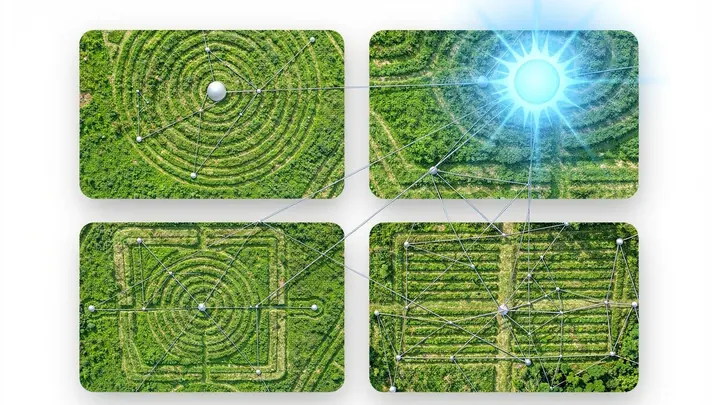
Deep in the Amazon rainforest, beneath a multi-layered canopy of leaves, lie vast earthen figures — squares, rectangles, the occasional rhombus. For decades they teased archaeologists with their silent geometry, until a researcher armed with orbital optics saw them as an astronomical instrument.
Every quantum particle has spin — an intrinsic magnetic property, like a tiny arrow. In an experiment, a beam of such particles passing through a magnet splits in two, like a coin that lands either heads or tails. That’s exactly how particles like a hydrogen atom behave.
An ordinary photometry detector can't tell a left photon from a right one. But let it start moving, and everything changes.
Imagine a rower moving between two flutists playing the same note. His ear is perfectly tuned to that note and ignores all others. As he moves, the pitch from the flutist ahead sounds higher, and from the one behind sounds lower.
In 1965, Penrose unleashed a mathematical thunderbolt on physics: any sufficiently massive star, shrinking under its own weight, inevitably collapses into a singularity — a region where spacetime curvature becomes infinite and the laws of physics break down.
Two black holes, orbiting each other, behave like a boat rowing with stars. Each passing star is flung away, like a stroke of an oar, and transfers momentum to the pair. For a long time, it was thought this simply brings the black holes closer. But new analysis has shown: by flinging stars unevenly, the system pushes itself sideways, spins, and tilts the orbit.
A black hole is like a giant whirlpool in a river — space and time swirl around it and get pulled inward. Mathematically, this whirlpool is described by the Kerr solution, but it has remained a mystery why perturbations on such a background split into independent parts.
Cosmologists have measured how fast distant galaxies are receding in different parts of the sky. To do this, they used two kinds of "cosmic rulers": galaxy clusters and a certain type of supernova explosion. Both methods showed the same thing: in one direction, the Universe is expanding slightly faster than in the opposite direction.
The Mpemba effect is surprising: hot water sometimes freezes faster than cold. Scientists built a simple model: a bead in a thick, honey-like medium, on a landscape with two dips and a wall at the edge. The bead moves viscously, unable to hop over the central bump.
When a typical computer searches for a law of nature from data, it tries to guess a complete formula in one go. It's like a cook who, without knowing the recipe, dumps all the ingredients into a pot at once and hopes for soup. Most often, the result is an inedible mess: the formula is long but meaningless, and it fails on new data.
Water in a glass cools, ice melts, and a kettle heats the stove: that's how the world works: heat always flows from hot to cold. This is the second law of thermodynamics, a law that has never been broken.
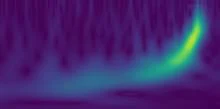
In a courtroom, there isn't always a video recording of the crime. Sometimes the verdict is based on witness testimony: what happened before, what happened after. That's exactly how physicists treated the signal GW250114, detected on January 14, 2025.