Simple

Binary Stars Build Dark Matter Molecules ⚡ экспресс

Original: "Ultralight Boson Ionization from Comparable-Mass Binary Black Holes"
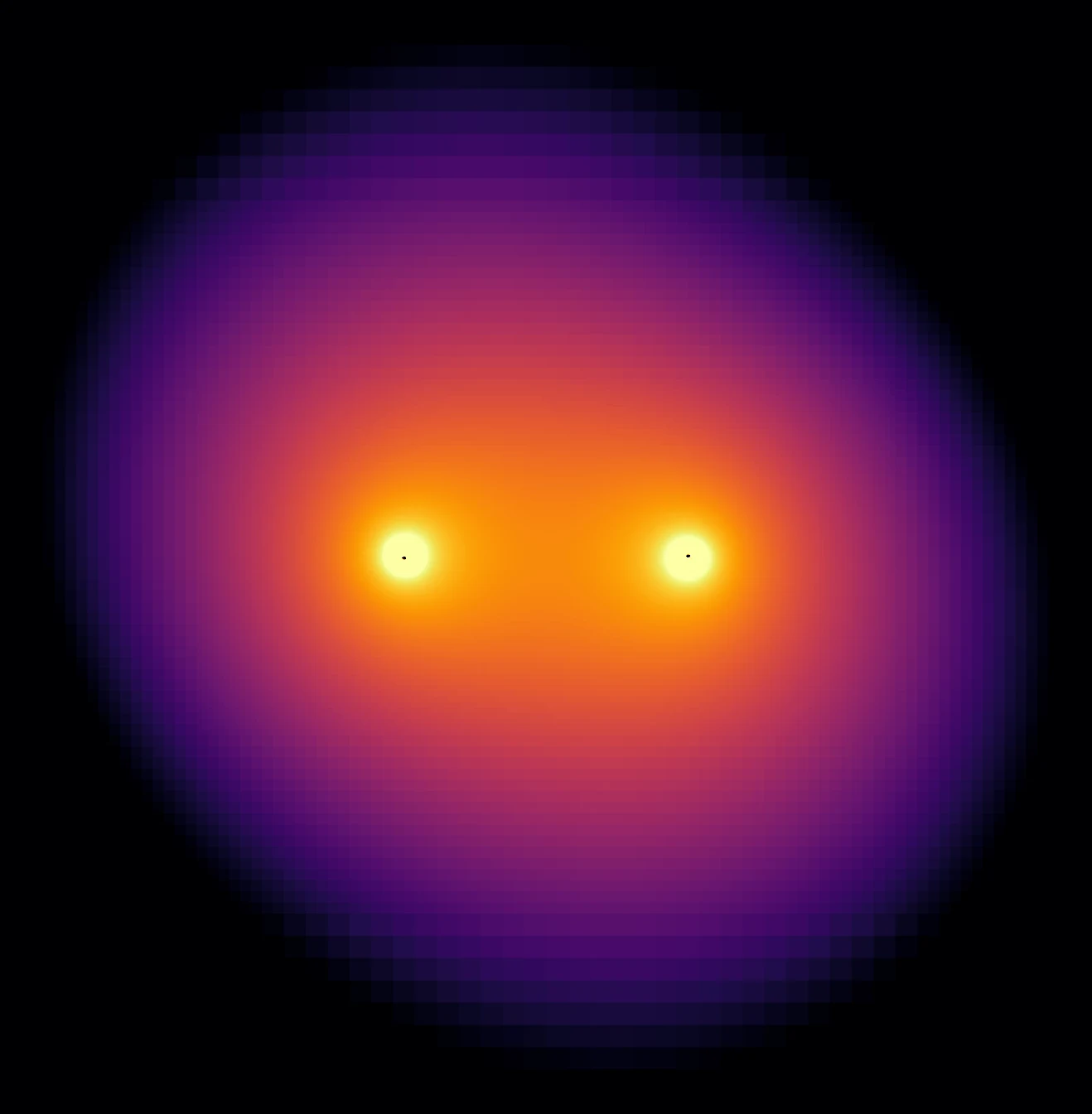
Two swirling stars gather dark matter into a giant cloud that resembles a molecule.
Abstract

Around a pair of tightly orbiting stars, ultralight particles can gather into something like a giant 'molecule.' As the stars close in, this structure starts losing particles (ionizing), which affects their orbit more than gravitational waves do. It's like a cloud speeding up and shaking off droplets — except here it alters the dance of the stars themselves.

Links in the knowledge graph 1

A pair of stars whirling in elongated orbits acts like a giant nucleus, and the cloud of dark matter around them—like an electron cloud in a molecule. This 'gravitational molecule' stretches billions of kilometers—more than from the Sun to Pluto. Its size is determined by an analog of the Niels Bohr radius, familiar from the hydrogen atom.

The motion of the stars shakes this cloud, ripping particles out of it—a process similar to atomic ionization. Due to the loss of particles, the pair's orbit gradually rounds: the ellipse becomes a circle. Notably, in the early stages, this effect can surpass the emission of gravitational waves, leaving a characteristic kink in their background.

🎯 The radius of such a 'gravitational molecule' can exceed the distance from the Sun to Pluto, even though the very concept of a radius comes from the microworld.

Scientists
Albert EinsteinFritz ZwickyVera RubinCharles-Augustin de CoulombJames Clerk MaxwellBernhard Riemann
Tags
gravitational waves dark matter hydrogen
Laws
gravitational lensingCoulomb's lawEinstein field equationsRydberg formulavirial theoremBalmer formula
Original: arXiv:2509.09643 · CC BY 4.0 · bridge42worlds