Ultralight Bosons Ionize Gravitational Molecules of Black Holes ✛
Context
Gravitational waves have opened a new window onto black holes, but their signal depends on the environment: stars, gas, dark matter. Ultralight bosons with masses below an electronvolt are popular dark matter candidates, and around a single black hole they form a 'gravitational atom.' When two black holes approach each other, the atoms morph into 'gravitational molecules'—bound states that partially co-rotate with the pair. Prior work in this area ranges from gravitational echoes and black hole braking by light particles to neutrino signatures and cosmic loops catching gravitational waves. This paper stands apart: its nearest semantic neighbor sits at a distance of 0.582, with nothing closer. It fills a gap in understanding molecule ionization for comparable-mass black holes.
Methods
The authors solved the Klein–Gordon equation for a scalar field in the background metric of a binary black hole using the open-source code GRDzhadzha. They used equal masses (q=1), semi-major axis a=20M (in units of mass), and boson mass μM=0.2, giving a Bohr radius of 25M. The initial field was a spherically symmetric Gaussian profile. They simulated eccentricities e=0, 0.1, 0.3 over 10–20 orbits. For ionization analysis, they developed a semi-analytical approach, splitting the bound state into a co-rotating region (inside radius a) and a non-co-rotating one (outside), and applied Fermi's golden rule to compute fluxes.
Results
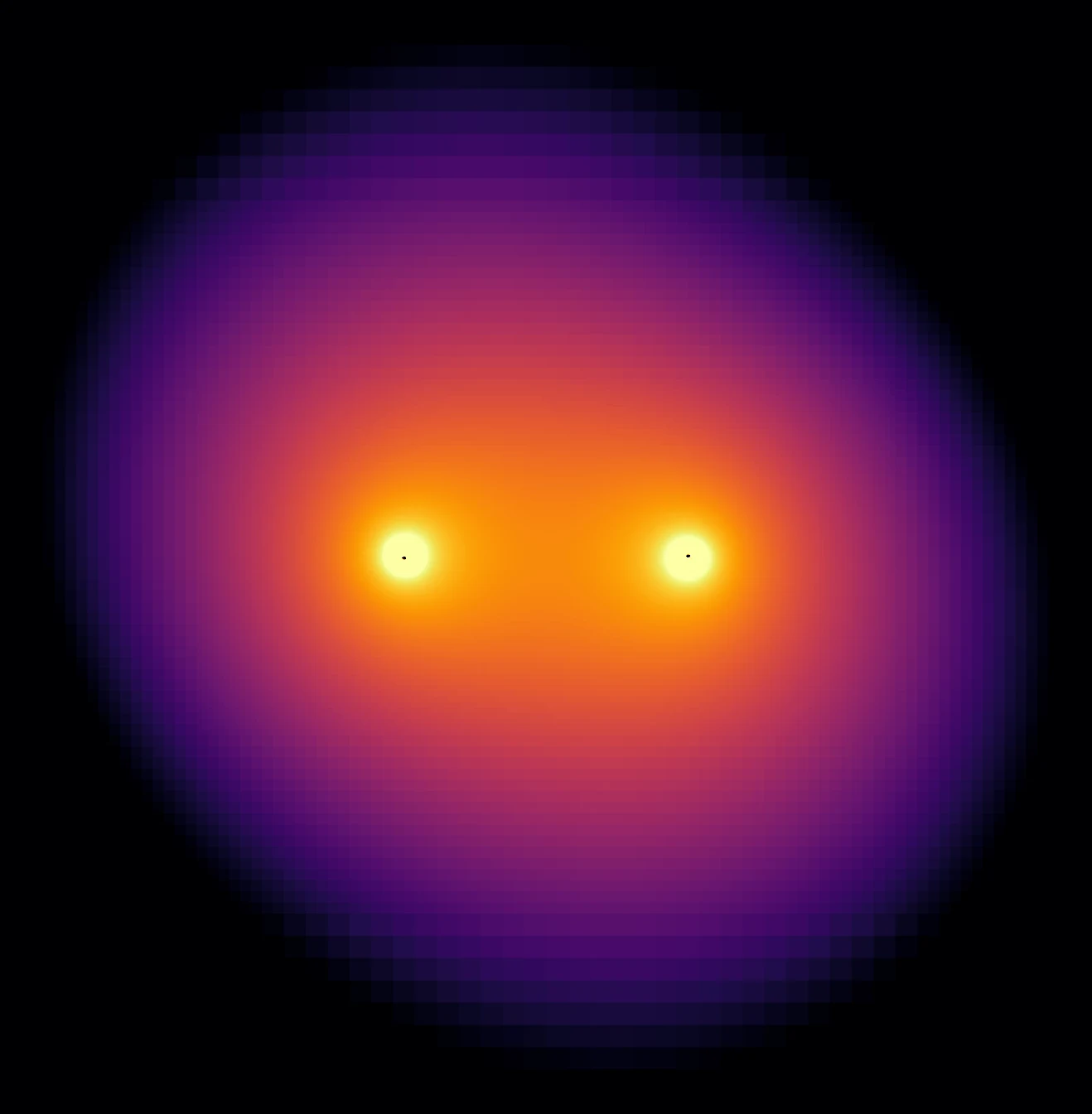
Numerical simulations showed the formation of gravitationally bound states resembling the ground and first excited levels of a gravitational atom. The inner region (up to r≈a/2) co-rotates with the orbit, while the outer region lags behind. Ionization peaks in the spectrum appear at frequencies shifted from the bound states by integer multiples of the orbital frequency Ω. For circular orbits the (2,2) mode dominates at N=2, while for eccentric orbits the (0,0) mode at N=1 dominates, with amplitude growing as $e^N$. Semi-analytical estimates gave a mode ratio (0,0):(2,0):(2,2) of about 6:1:1, whereas the simulation gave 6:1:3; the difference is attributed to the initial (2,2) component. Ionization of the co-rotating part occurs only through eccentricity and leads to orbital circularization, while the non-co-rotating part can dominate only at very small separations (a<0.001 Bohr radius). At early stages, ionization can exceed gravitational-wave losses, creating a break in the stochastic background spectrum at a frequency of about 2.8 nHz for typical parameters.
Implications
This work differs from neighboring studies by being the first to systematically compute the ionization of gravitational molecules for comparable-mass black holes, separating co-rotating and non-co-rotating components. Neighbors studied gravitational atoms, echoes, braking, or neutrino signals, but did not provide a complete picture of molecular-state ionization. Here it is shown that ionization can affect orbital evolution more strongly than gravitational waves and leave an observable imprint on pulsar timing array spectra.
Future development
The topic could develop toward including boson self-interactions, coupling to photons (axions), and particle production in dense clouds. This would open the path to multimessenger astronomy: gravitational waves plus electromagnetic and neutrino signals. It is also important to investigate how molecules form from dark matter under realistic initial conditions and how they survive mergers.
Impact
The results will affect the interpretation of pulsar timing array data and future gravitational-wave detectors, as well as models of supermassive black hole binary evolution.
Next steps
The next step is to include self-interactions and axion-photon coupling in simulations, and to consider unequal masses and extreme mass ratios.
Key open problems
This work directly relates to the unresolved final-parsec problem: how supermassive black hole binaries overcome the one-parsec gap and merge. Ionization of gravitational molecules may be an additional mechanism for extracting energy and angular momentum, accelerating the merger, which is important for understanding the sources of the nanohertz gravitational-wave background.
The knowledge machine's view
This section is addressed to the author of the paper and their colleagues. Neighbouring works were found by meaning-based search across our archive, not by word overlap. We do not review: we show the field around the work.
What the work does
The authors numerically model the formation of gravitational molecules from ultralight bosons around a pair of equal-mass black holes and compute ionization fluxes driven by orbital motion at various eccentricities. They develop a semi-analytic formalism that splits the bound state into co-rotating and non-co-rotating components, which agrees with the numerical results. They show that ionization can dominate over gravitational wave emission at early stages, leading to orbital circularization and a characteristic break in the stochastic gravitational wave background.
Where its strength is
A systematic calculation of gravitational molecule ionization for comparable-mass black holes, including a semi-analytic formalism that captures both co-rotating and non-co-rotating components, and predicts observable features in the stochastic background spectrum.
Where it could go next
- It might be interesting to compare ionization fluxes with estimates of gravitational echo from gravitational atoms, to understand how ionization affects echo signatures in binary systems.based on: Black Hole as a Gravitational Atom: Gravitational Echo arXiv:2606.10776
- A related study examines the evolution of gravitational atoms in black hole pairs; their approach to resonant transitions could complement the picture of ionization at different inspiral stages.based on: Gravitational atoms of axions sing in black hole pairs arXiv:2606.28161
- One could explore how including the backreaction of ionization on the orbit (circularization) aligns with dynamical friction from light particles, as considered in a neighboring work.based on: How Light Particles Put the Brakes on Black Holes arXiv:2608.09811v1
Worth trying
- Check how the break in the stochastic background spectrum from ionization relates to predictions for gravitational atoms around single black holes.
- Assess whether orbital circularization can serve as an observable signature of ultralight bosons in future LISA data.
- Consider the unequal-mass case to see how ionization modes and their contribution to system evolution change.
Why this may matter
If ionization indeed dominates at early stages, it changes the expected signal from merging black holes and could offer a new way to search for ultralight bosons in gravitational wave detector data.
Nearby works in our archive
- Black Hole as a Gravitational Atom: Gravitational Echosimilarity 0.61
- Gravitational atoms of axions sing in black hole pairssimilarity 0.59
- How Black Holes Amplify Gravitational Wavessimilarity 0.58
- Gravitational Atoms: How Black Holes Give Dark Matter a Voicesimilarity 0.57
- How Light Particles Put the Brakes on Black Holessimilarity 0.57
The archive is sparse around this work: the closest review is only 0.61, against a usual 0.64. It looks like few have drilled nearby.
A gravitational molecule resembles an H2+ ion: two heavy nuclei and a shared electron cloud. Only here the nuclei are black holes, and the electron's role is played by an ultralight boson field smeared over tens of kilometers.
In Liu Cixin's novel 'The Three-Body Problem,' gravitational interactions in a triple system lead to chaos. Here, a pair of black holes and a boson cloud form an ordered 'molecule,' but its ionization injects an element of unpredictability into the system's fate.
Key numbers
- Bohr radius: 25M for μM=0.2
- Orbital frequency: Ω≈0.011/M
- Characteristic break frequency: about 2.8 nHz
- Mode ratio (0,0):(2,0):(2,2): about 6:1:3 in simulation
- Threshold for non-co-rotating ionization dominance: a<0.001 Bohr radius