The Dance of Black Holes and the Birth of Gravitational Molecules ✛
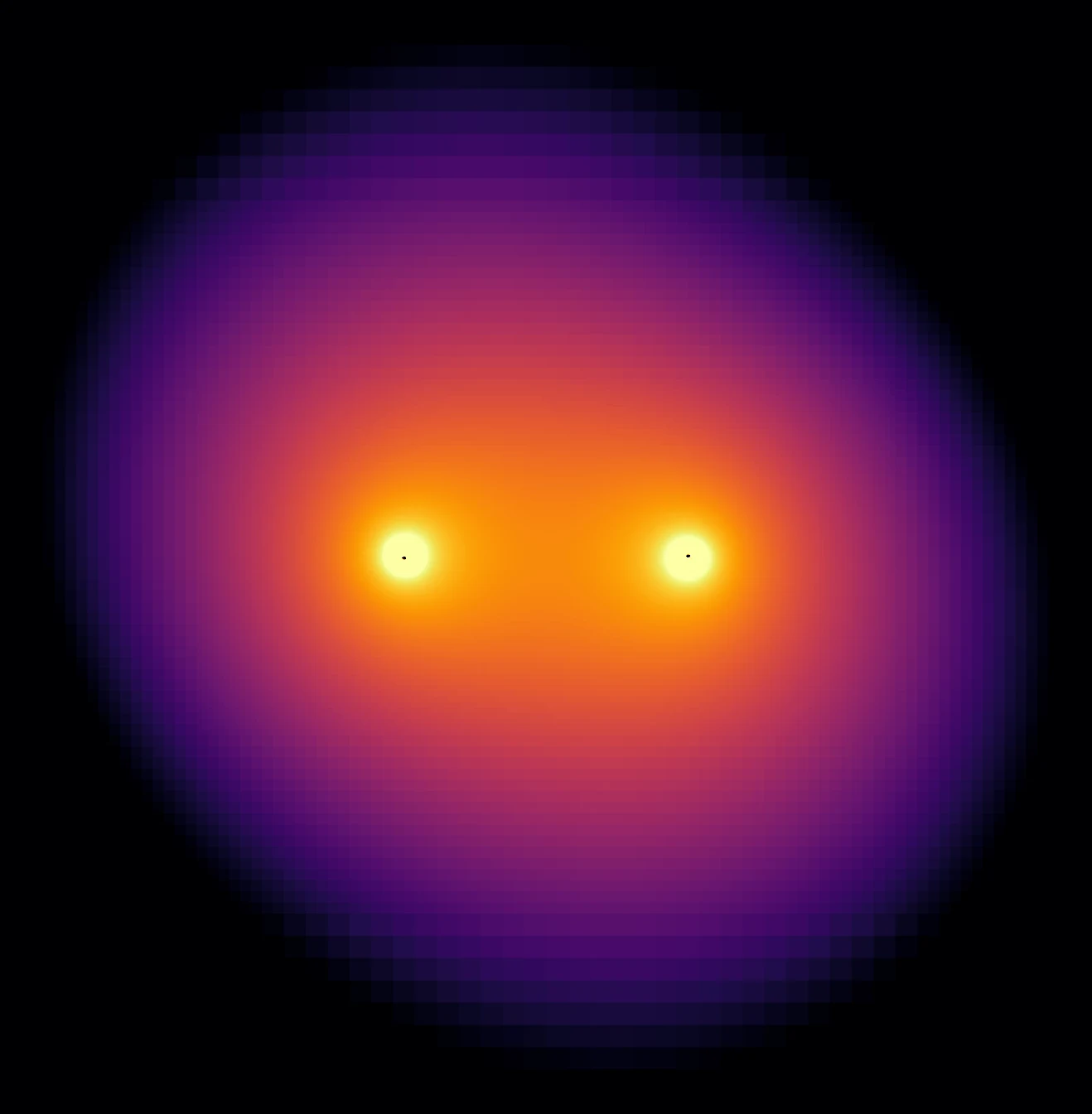
Two black holes circle in a tight dance, and around them something remarkable is born: a gravitational molecule. A cloud of ultralight bosons, particles with masses below an electronvolt, envelops the pair like the electron cloud in an H2+ ion. Only here, the nuclei are black holes, and the electron is a field smeared over tens of kilometers. This dance is not flawless: the inner part of the molecule spins in sync with the orbit, while the outer part lags behind, and sparks fly off as bosons escape from the bound state. Physicists call this process ionization.
Previously, it was unclear how this cloud behaves when the black holes have comparable masses. The researchers simulated the dance on a supercomputer: they took equal masses, a separation of 20 black hole masses, and a boson mass of 0.2 in units of the black hole mass. This yielded a Bohr radius of 25M, the characteristic size of the gravitational atom. They found that the inner region, out to half the separation, co-rotates with the orbit, while the outer region lags. Ionization peaks in the spectrum appear at frequencies shifted from the bound states by integer multiples of the orbital frequency. For circular orbits, one mode dominates; for eccentric orbits, another does, with an amplitude growing as a power of eccentricity.
This discovery changes the picture of binary black hole evolution. Ionization can drain energy and angular momentum faster than gravitational wave emission, especially at early stages. The stochastic gravitational wave background spectrum should show a characteristic break at a frequency around 2.8 nHz for typical parameters. Such data can already be sought in pulsar timing array observations. This is a step toward solving the final parsec problem: how supermassive binary black holes overcome the last parsec and merge. Ionization of gravitational molecules might be the mechanism that accelerates the merger.
The dance of black holes and boson clouds continues, and each escaping boson is a spark carrying away energy. The molecule melts, the orbit shrinks, and eventually the black holes merge into a single entity. Gravitational waves from this merger will carry the memory of the dance, and perhaps it is in their spectrum that we will see the imprint of a gravitational molecule.
A gravitational molecule resembles an H2+ ion: two heavy nuclei sharing an electron cloud. Only here, the nuclei are black holes, and the electron is an ultralight boson field spread over tens of kilometers.
In Liu Cixin's novel 'The Three-Body Problem', gravitational interactions in a triple system lead to chaos. Here, a pair of black holes and a boson cloud form an ordered 'molecule', but its ionization introduces an element of unpredictability into the system's fate.