Earth as a Lens for Searching Dark Matter express
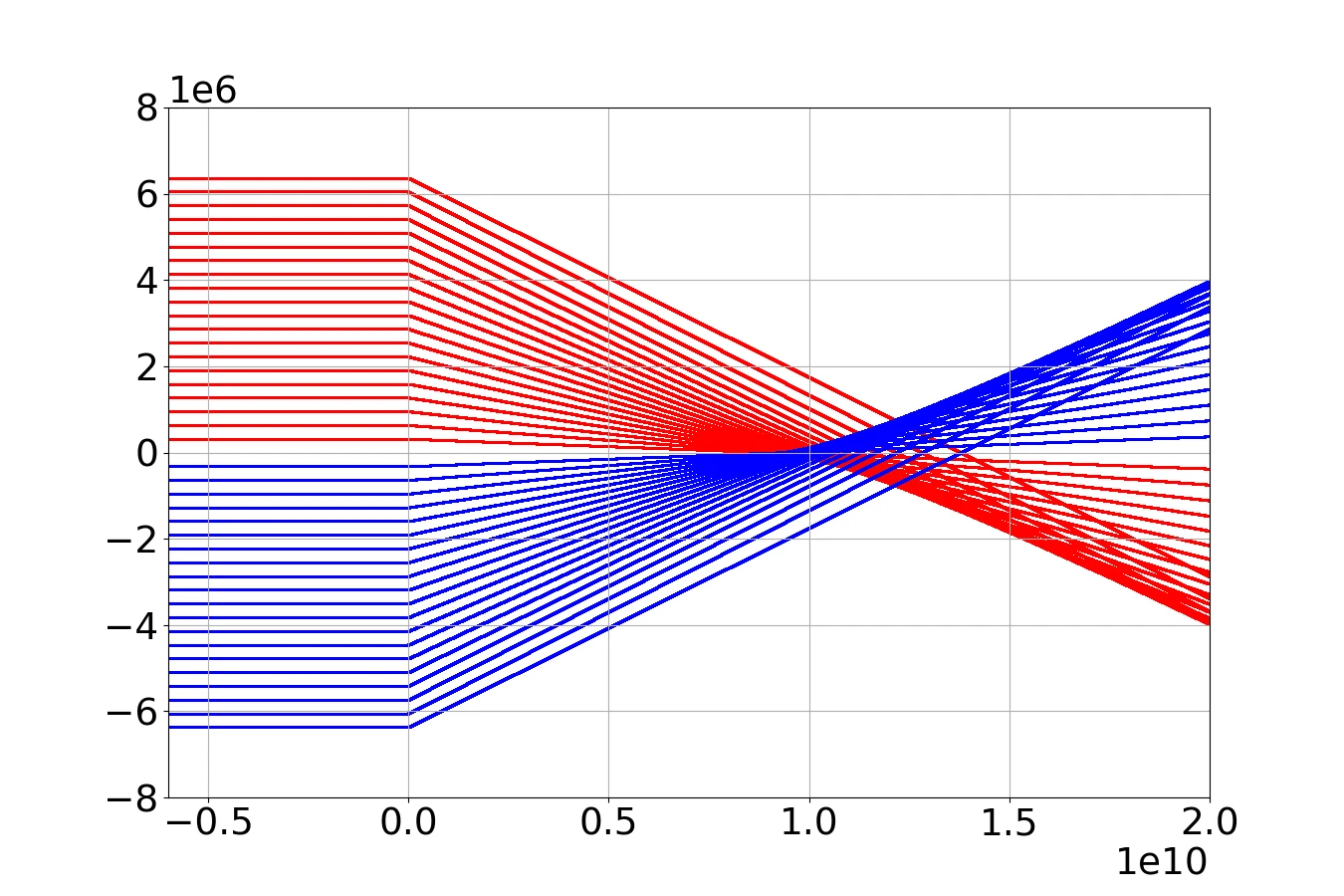
Dark matter is the invisible backbone of the universe. Vera Rubin proved its existence by the motion of stars, yet the particles themselves have never been captured. A new method turns Earth into a giant gravitational lens: a massive body, as shown by Einstein, curves spacetime and focuses passing dark matter particles into a point beyond Pluto's orbit. That spot is about the size of a football field.
A powerful laser is aimed at the focus. If dark matter consists of axions – ultralight particles outside the Standard Model – the beam makes them momentarily turn into photons and reflect light back. Like a match igniting invisible gunpowder, the laser triggers a flash that can be registered.
Calculations show: at speeds around 520 km/s, the focus lies 9–14 billion meters away. The sensitivity is such that a signal can be picked up even from the opposite edge of the Galaxy. This approach paves the way for a space observatory to directly detect dark matter.
Original abstract
as written by the authors arXiv:2510.27416
We propose a novel telescope concept based on Earth's gravitational lensing effect, optimized for the detection of distant dark matter sources, particularly axion-like particles (ALPs). When a unidirectional flux of dark matter passes through Earth at sufficiently high velocity, gravitational lensing can concentrate the flux at a distant focal region in space. Our method combines this lensing effect with stimulated backward reflection (SBR), arising from ALP decays that are induced by directing a coherent electromagnetic beam toward the focal point. The aim of this work is to numerically analyze the structure of the focal region and to develop a framework for estimating the sensitivity to ALP-photon coupling via this mechanism. Numerical calculations show that, assuming an average ALP velocity of 520,km/s -- as suggested by the observed stellar stream S1 -- the focal region extends from $$9 \times 10^9$$,m to $$1.4 \times 10^{10}$$,m, with peak density near $$9.6 \times 10^9$$,m. For a conservative point-like ALP source located approximately 8,kpc from the solar system, based on the S1 stream, the estimated sensitivity in the eV mass range reaches $$g/M = \mathcal{O}(10^{-22}),\mathrm{GeV}^{-1}$$. This concept thus opens a path toward a general-purpose, space-based ALP observatory that could, in principle, detect more distant sources -- well beyond $$\mathcal{O}(10),\mathrm{kpc}$$ -- provided that ALP-photon coupling is sufficiently strong, that is, $$M \ll M_\mathrm{Planck}$$.
The distance to Earth's gravitational focus is roughly the distance light travels in half a minute — farther than Pluto, but still within our solar system.