Wind for the swift: how turbulence heats the solar corona express
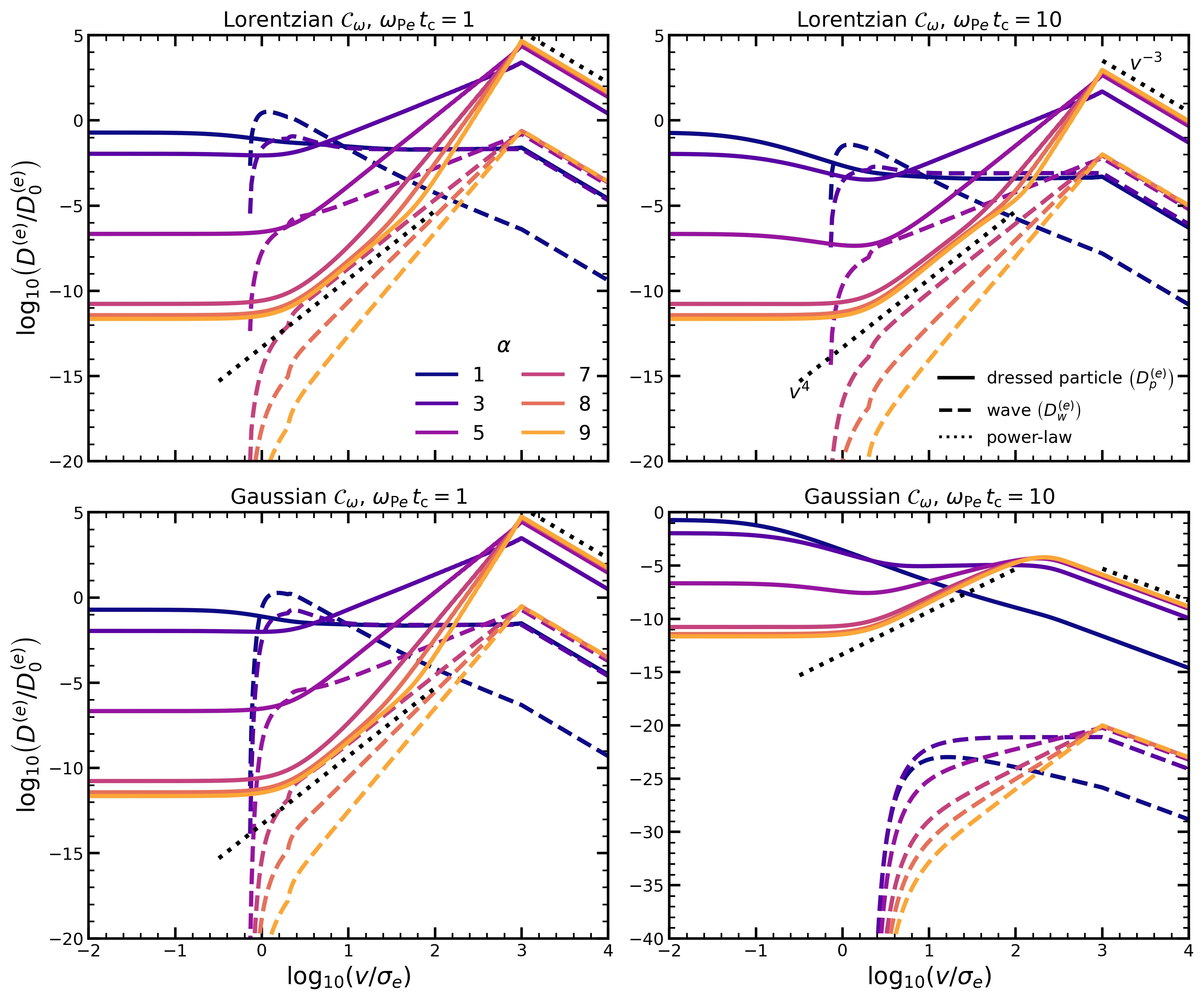
In a hot gas of charged particles — plasma — chaotic electric fields work like a sieve. A slow particle gets surrounded by a cloud of opposite charges, which cancels the external field. A fast one sheds this armor and gets accelerated.
Physicists proved: if the energy of the fields decreases with frequency according to a certain law, almost any initial state collapses to a universal velocity distribution. The probability of finding a particle with speed v drops as 1/v⁵. The system tends toward this 'tailed' portrait — an entropic attractor — rather than the bell curve of Maxwell and Boltzmann, where fast particles are almost absent. The resulting tail exactly matched the κ-distribution at κ=1.5 — a formula astrophysicists used blindly.
This unveils the riddle of the solar corona. The Sun's surface is heated to 5800 K, while the corona blazes at millions of degrees. Electric fields born in the boiling chromosphere filter ions: they accelerate only the fastest — hydrogen and helium — hurling them into the corona. There they create a monstrous heat. This same mechanism of speed filtration causes electrons in tokamaks to suddenly accelerate to dangerous energies, threatening the reactor walls.
Original abstract
as written by the authors arXiv:2601.03344v2
Non-thermal power-law distribution functions are ubiquitous in astrophysical, space, and laboratory kinetic plasmas, but their origin remains unclear. A related puzzle is the temperature inversion of the solar corona. We show that these phenomena are deeply connected by developing a self-consistent quasilinear theory for electromagnetically driven, unmagnetized kinetic plasmas. The theory yields a multi-species Fokker-Planck equation with drive-induced diffusion from direct acceleration by broad-band turbulent or narrow-band wave-like fields, indirect acceleration by excited waves, and Balescu-Lenard diffusion/drag from Debye-scale fluctuations and Coulomb collisions. For a super-Debye turbulent electric-field spectrum, $$|{\bf E}_{\bf k}|^2\propto k^{-\alpha}$$, electrons and ions relax toward a universal $$f(v)\propto v^{-5}$$, or $$N(E)\propto E^{-2}$$, attractor, equivalent to the high-energy tail of a $$\kappa=1.5$$ distribution, when $$\alpha\ge5$$. This universality follows from Debye screening: large-scale fields accelerate unscreened fast particles but not screened slow ones. For shallower spectra, $$\alpha<5$$, the tail scales as $$v^{-\alpha}$$; incomplete relaxation and anisotropy also break universality. Anisotropic wave drives yield branch- and spectrum-dependent exponents. Because collisions cannot decelerate suprathermal particles, the tails resist Maxwellianization. In the solar atmosphere, such tails may be generated by chromospheric convection or nanoflares despite collisional and radiative losses. Direct wave heating energizes electrons through Landau-resonant interactions with whistler and electron-cyclotron waves, while ions may be accelerated by turbulent ambipolar fields. Resulting $$\kappa\simeq1.5$$--$$3$$ distributions produce an abrupt upper-chromosphere/lower-corona transition and velocity-filtration-driven inverted profiles, yielding coronal temperatures $$\sim10^6\,{\rm K}$$.
The solar corona's temperature reaches 1–2 million kelvins, while the surface is about 5800 K. A kettle that heats the air around it more than its own handle.
Someday satellites might 'bathe' in the solar corona, filtering out fast particles to charge their batteries.