Solar Eruptions: Neutral Helium Reveals the Magnetic Field express
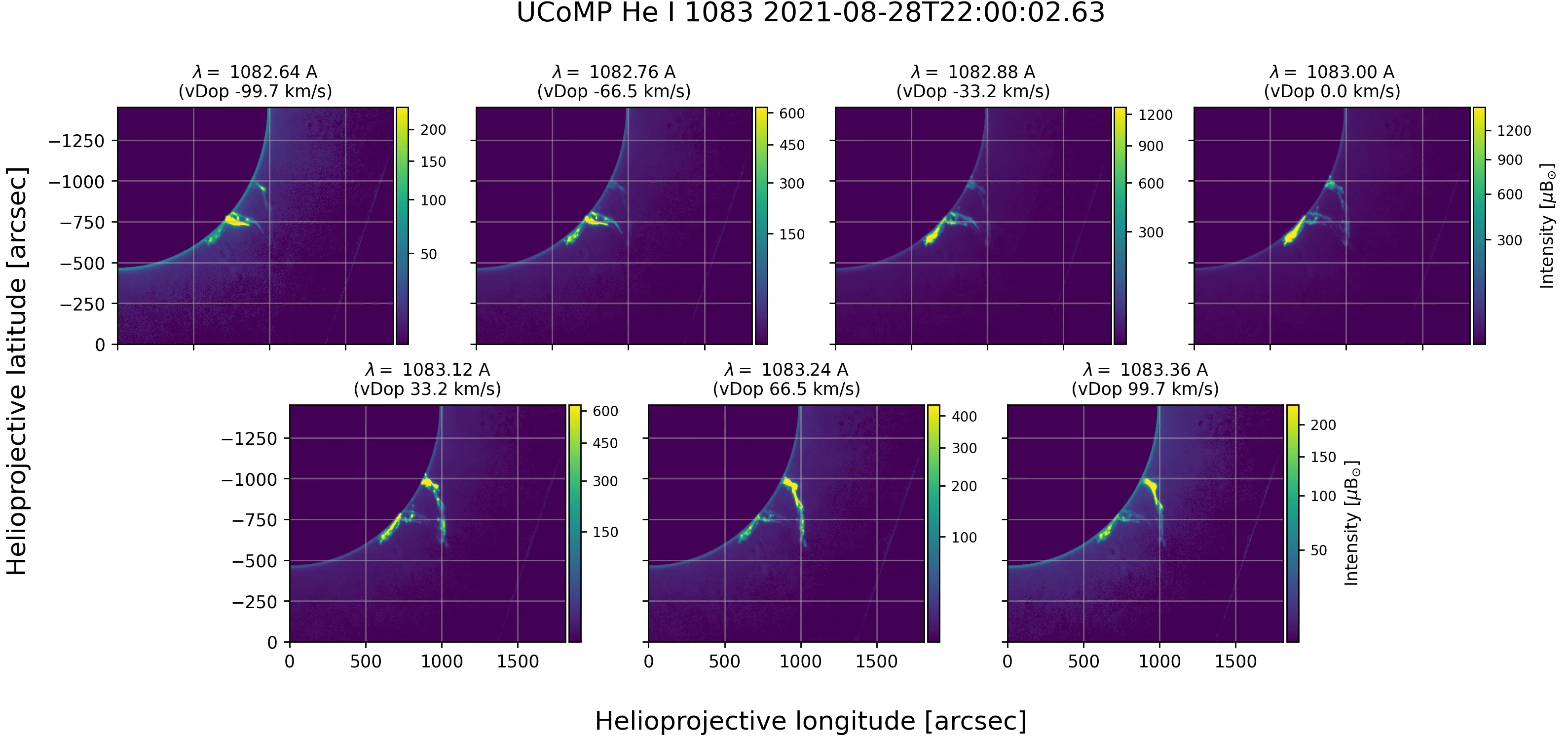
The Sun occasionally hurls enormous clouds of plasma into space — coronal mass ejections. Often tangled within these clouds are prominences: cooler, denser clumps of material. These contain plenty of neutral atoms that shine brightly in specific spectral lines.
Astronomers used the UCoMP instrument, which measures the polarization of light in the infrared helium line at a wavelength of 1083 nanometers. They found that neutral helium is clearly visible in erupting prominences as they pass through the lower and middle solar corona — up to two solar radii from the surface.
Such observations provide valuable data on the line-of-sight velocity of the ejection. This complements the picture obtained from ultraviolet telescopes and white-light coronagraphs. The earlier we can spot an ejection headed toward Earth, the more accurately we can predict magnetic storms and protect satellites, communications, and power grids.
Original abstract
as written by the authors arXiv:2602.09390
Coronal mass ejections (CMEs) are a major driver of space weather as they propagate through the heliosphere. Many CMEs have associated prominence material entangled in their magnetic structure which contains cooler plasma. This cooler CME component contains significant amounts of neutral elements, which emit brightly in permitted atomic lines. It has been hypothesized that permitted transitions of neutral elements in eruptions could be used for inferring the magnetic field in CMEs, which is crucial for space weather forecasting. We present observations made with the Upgraded Coronal Multi-channel Polarimeter (UCoMP) in He I 1083 nm that clearly show the presence of neutral helium in eruptive prominences associated with CMEs as they propagate through the lower and middle corona. We find that solar prominence eruptions can be detected in He I 1083 nm observations up to the edge of the instrument field of view at about 2 solar radii, providing valuable spectral information that complements existing extreme ultraviolet and white-light coronal imaging observatories. These results illustrate the capability of UCoMP to probe the dynamic behavior of prominence eruptions, allowing for their line-of-sight velocity estimation, and potentially improving space weather forecasting by enabling earlier and more accurate identification of Earth-directed eruptions.
The helium line at 1083 nm lies in the near-infrared — invisible to the eye, but easily detected by specialized instruments.