Four Giants and Traces of Snow Lines express
130 light-years away, four giant planets orbit the young star HR 8799—each 5 to 10 times more massive than Jupiter. They lie far from the star, at distances from 15 to 70 astronomical units (one astronomical unit is the distance from Earth to the Sun). The James Webb Space Telescope peered into their atmospheres and found that their gas compositions differ.
The NIRSpec spectrometer split the planets' light into thousands of shades, like a prism splitting a sunbeam. From the dark bands in this 'rainbow' spectrum, scientists identified which gases are present. All four planets show water, methane, carbon monoxide, carbon dioxide, and hydrogen sulfide. But ammonia appears only on the most distant planet — HR 8799 b.
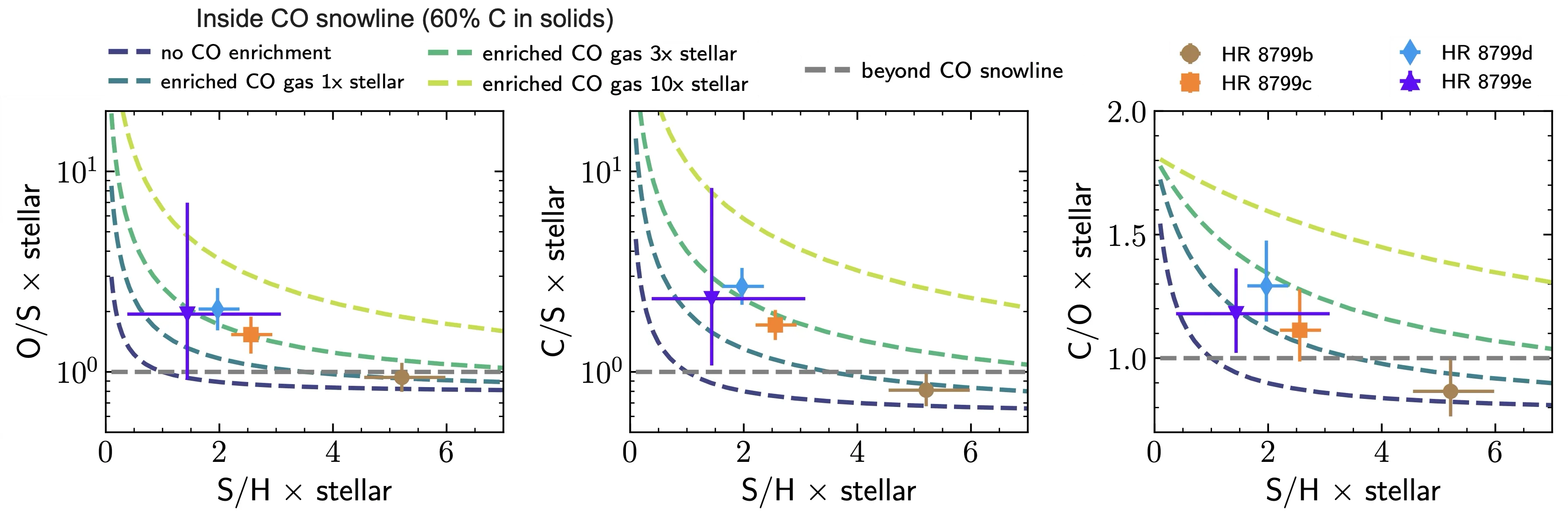
Next, the team compared how much carbon, oxygen, nitrogen, and sulfur each atmosphere has relative to hydrogen. It turned out that carbon and oxygen are roughly equal across all planets: 3 to 5 times more than in the star itself. But sulfur is more abundant on planets farther from the star. Sulfur is part of refractory dust grains and pebbles, so its excess hints that the outer planets collected more solid material.
From the ammonia on planet b, they calculated that its atmosphere has 21 times more nitrogen than the star. This means planet b absorbed nitrogen-rich gas — gas that could only exist beyond the nitrogen snow line. A snow line is a boundary in the disk where a substance stops being gas and freezes into ice. Water has its own snow line, carbon dioxide has another, and nitrogen's lies even farther from the star. Planet b, it seems, formed between the carbon monoxide snow line and the nitrogen snow line.
From these data, a picture emerges: the inner planets (c, d, e) gathered gas enriched in carbon monoxide inside its snow line. The outer planet b added nitrogen ice to its 'menu.' To explain the excess of volatiles, scientists calculated how many icy pebbles must have vaporized at the snow lines. They found that a stream of pebbles with a total mass of about 750 Earth masses passed through the disk. This number agrees with models of planet growth from both pebbles and planetesimals (planetary embryos).
Thus, four distant planets, like four witnesses, told the story of how icy particles moved and vaporized in the young system. Their composition is not just a set of gases but a map of the conditions in which they were born.
The HR 8799 system was the first where planets were seen directly, not by indirect signs. In 2008, astronomers captured images of three planets at once, and the fourth was found later.