Doug Johnstone

11 articles · 30 co-authors · latest: 2026-09-09
90 citations · h-index 5 · 15 papersData: Semantic Scholar

We have retold 11 papers by this author. 3 of them with a full read. most often about: exoplanet, exoplanet atmosphere, Hubble Space Telescope. 30 co-authors across our retellings.

Links in the knowledge graph
Exoplanets2025-10-101 minarXiv:2510.09809express
Stellar2026-01-131 minarXiv:2601.08948express
Stellar Bakeries: Two Suns, One Organic Recipe
In the stellar nursery HOPS-288, where three suns are forming, the ALMA telescope revealed two scorching regions around a pair of them. At –170°C, ice on cosmic dust melts, and reactions bubble up in the gas: organic molecules are born — methanol and methyl formate.
Exoplanets2026-02-103 minarXiv:2602.09422express
Four Giants and Traces of Snow Lines
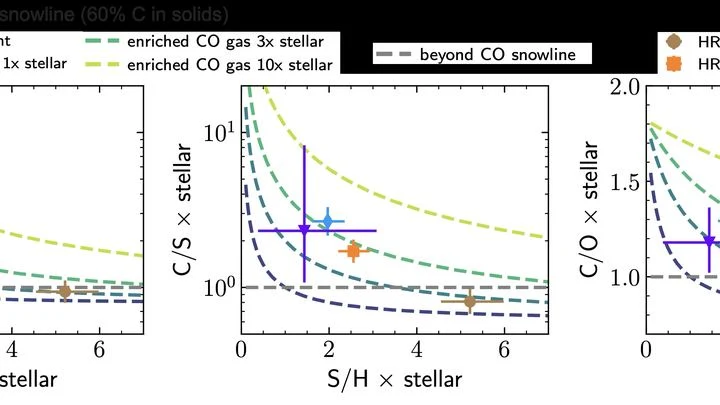
130 light-years away, four giant planets orbit the young star HR 8799—each 5 to 10 times more massive than Jupiter. They lie far from the star, at distances from 15 to 70 astronomical units (one astronomical unit is the distance from Earth to the Sun).
Stellar2026-02-122 minarXiv:2602.12060express
A Star Baby Sneezes: The Outburst of Protostar B335
The young star B335, which hasn't grown up yet, suddenly sneezed, and that sneeze is still going on. Astronomers spotted the outburst in the scattered light from its outflow cavity, and it offered a rare chance to see how such an energy release affects a jet — a stream of gas shooting out…
Exoplanets2026-02-231 minarXiv:2602.20346express
Cosmic Disks Flicker Like Candles
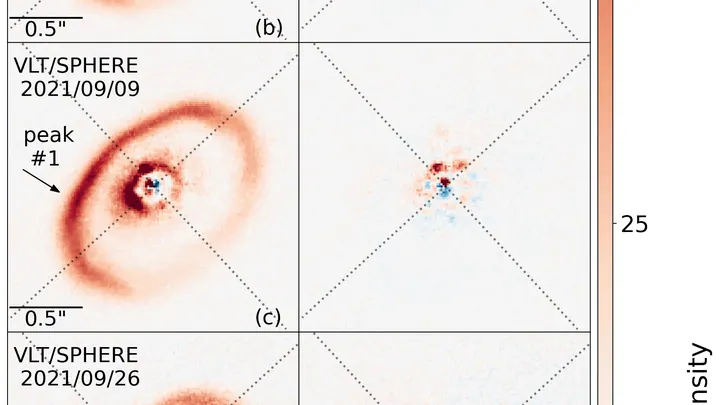
Around young stars, flat clouds of gas and dust swirl — the building material for future planets. Starlight reflects off these clouds, and astronomers see them as faint disks. But sometimes bright spots or dark bands appear in such disks. Fresh observations with the Subaru Telescope show these patterns can change within a matter of months.
Galaxies2026-04-101 minarXiv:2604.09770express
Magnetic Field in a Cloud: From Order to Chaos
In a large gas cloud where stars are born, the magnetic field lines are roughly aligned in one direction, like the fibers in a piece of felt. But look inside, into the dense clumps that will eventually become stars, and the picture changes: there the lines are twisted every which way, like a ball of yarn after a kitten has played with it.
Exoplanets2026-05-022 minarXiv:2605.01589express
A Planet Where Day Melts Hydrogen and Night Hides Clouds
Planet WASP-121 b always shows the same face to its star, like a rock in a campfire. The dayside is so hot that ordinary hydrogen, the very stuff most of the universe is made of, can't take it: its molecules tear apart into individual atoms, and the temperature flips upside down: the higher you go, the hotter it gets.
Shadow Theater at TW Hydrae: Webb Catches the Hidden Drama of Planet Birth
Edge of the spotlight. Remove the dazzling light of the central star, and a theater of shadows emerges. The James Webb coronagraph, like a dense curtain, hid the star TW Hydrae — and on a stage 120 astronomical units long (four times the distance to Neptune), its protoplanetary disk came alive.
Exoplanets2026-07-301 minarXiv:2607.27765express
The Stellar Forge: A First Glimpse at the Birth of Cosmic Crystals
In the furnace of star formation, the heat reaches 900 degrees Celsius, like a glowing blast furnace. It is in this hellish heat that cosmic crystals are born. Astronomers have for the first time caught the moment when crystalline dust appears right during an accretion flare (when the star gobbles up surrounding gas) at the very young star EC 53, still cocooned in dense gas.
Stellar2026-09-092 minarXiv:2609.09722
A Furnace for Planets: The Outburst of PR Ori B
In the constellation Orion, in the cloud of gas and dust L1641, the young star PR Ori B suddenly flared up like a furnace that someone had thrown fuel into. Its brightness rose fivefold, and astronomers watched for the first time as a fuor was born, a rare event in which a star begins greedily swallowing material from the surrounding disk.
The Fifth Planet of HR 8799: A Whisper in the Roar of the Orchestra
The orchestra is playing fortissimo, and someone in the third row is whispering. Hearing that whisper is the challenge astronomers face at the star HR 8799: four bright giant planets drown out the faint light of a possible fifth, hidden very close to the star. The HR 8799 system is a proving ground for direct exoplanet imaging.