Michael R. Meyer

5 articles · 30 co-authors · latest: 2026-09-09
176 citations · h-index 8 · 29 papersData: Semantic Scholar

We have retold 5 papers by this author. 2 of them with a full read. most often about: exoplanet, exoplanet atmosphere, Hubble Space Telescope. 30 co-authors across our retellings.

Links in the knowledge graph
Exoplanets2025-10-101 minarXiv:2510.09809express
Exoplanets2026-02-103 minarXiv:2602.09422express
Four Giants and Traces of Snow Lines
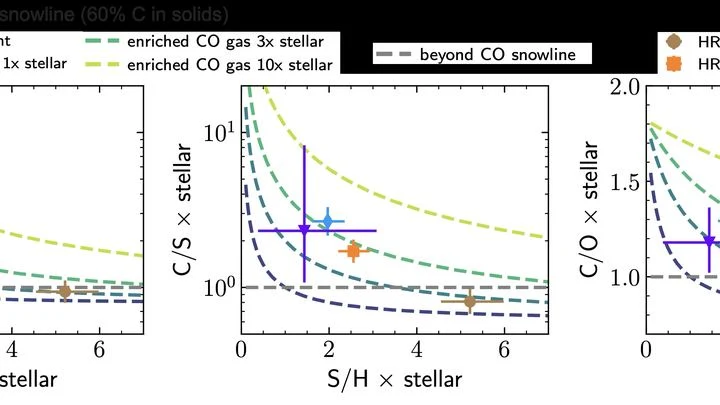
130 light-years away, four giant planets orbit the young star HR 8799—each 5 to 10 times more massive than Jupiter. They lie far from the star, at distances from 15 to 70 astronomical units (one astronomical unit is the distance from Earth to the Sun).
Exoplanets2026-05-022 minarXiv:2605.01589express
A Planet Where Day Melts Hydrogen and Night Hides Clouds
Planet WASP-121 b always shows the same face to its star, like a rock in a campfire. The dayside is so hot that ordinary hydrogen, the very stuff most of the universe is made of, can't take it: its molecules tear apart into individual atoms, and the temperature flips upside down: the higher you go, the hotter it gets.
Shadow Theater at TW Hydrae: Webb Catches the Hidden Drama of Planet Birth
Edge of the spotlight. Remove the dazzling light of the central star, and a theater of shadows emerges. The James Webb coronagraph, like a dense curtain, hid the star TW Hydrae — and on a stage 120 astronomical units long (four times the distance to Neptune), its protoplanetary disk came alive.
The Fifth Planet of HR 8799: A Whisper in the Roar of the Orchestra
The orchestra is playing fortissimo, and someone in the third row is whispering. Hearing that whisper is the challenge astronomers face at the star HR 8799: four bright giant planets drown out the faint light of a possible fifth, hidden very close to the star. The HR 8799 system is a proving ground for direct exoplanet imaging.