Why Some Vortices Are Predictable and Others Aren't express
In a turbulent flow, like a raging river, energy constantly cascades from large whirlpools to small ones. Occasionally, particularly powerful bursts occur, resembling sudden waves crashing against the shore. Scientists asked: can we know in advance when such a "wave" will strike? It turns out the answer depends on which vortices are present in the flow at that moment.
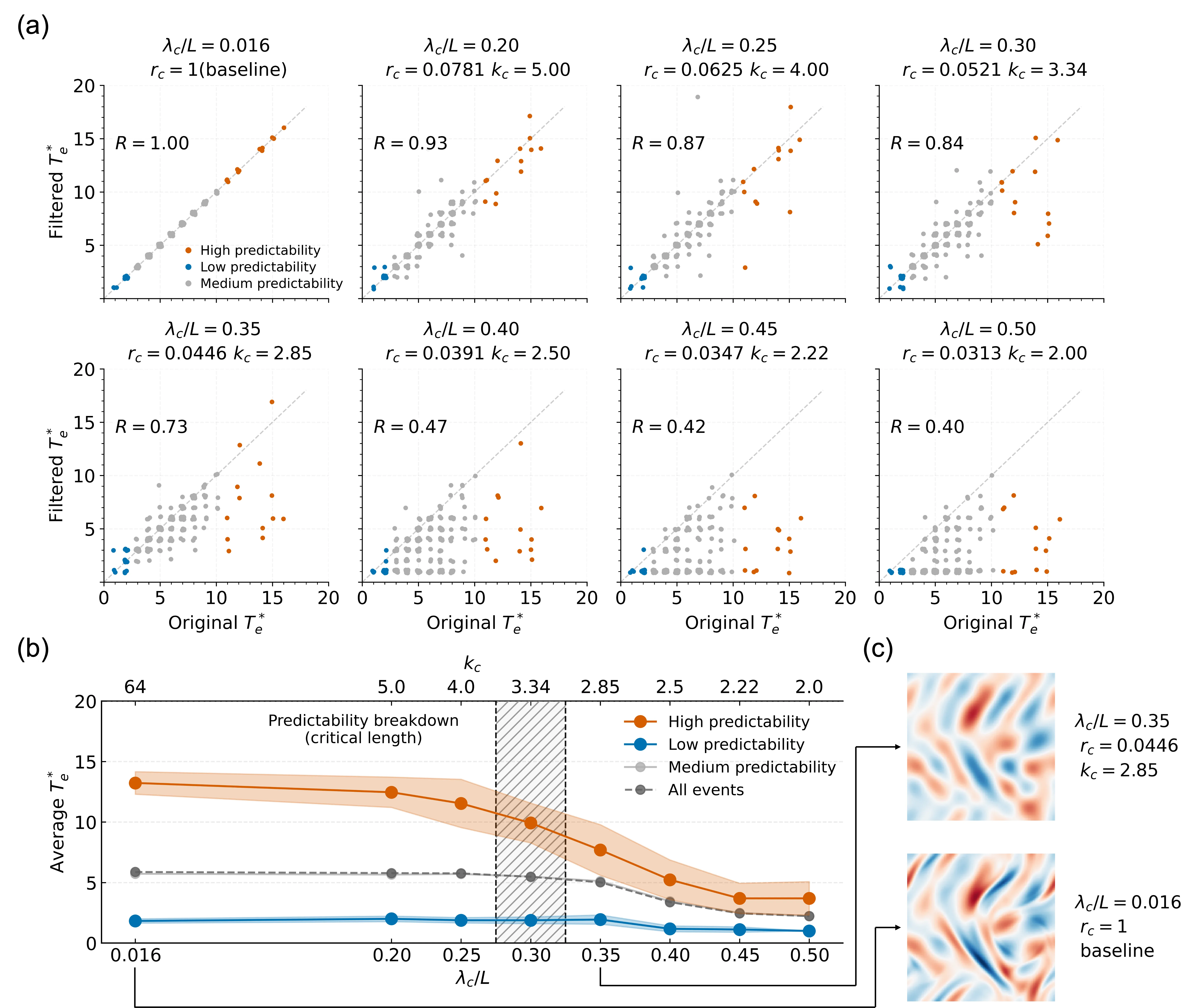
Stochastic modeling of a two-dimensional flow (flat, like the surface of water) showed that each extreme energy burst has its own predictability horizon. Some bursts can be foreseen one chaos period ahead — the time it takes for the flow to completely "forget" its initial state. Others can be foreseen more than four such periods ahead. The deciding factor is the longevity of large vortex structures, which scientists call quadrupolar vortex packets. These structures resemble four connected whirlpools that rotate together.
When such vortex packets live long, they "organize" the flow and make its behavior more predictable. When they quickly decay, the flow becomes chaotic, and the prediction horizon sharply shortens. This conclusion was obtained using a neural network trained on thousands of numerical experiments. The neural network learned to predict energy bursts, and then scientists measured how far into the future its predictions remained accurate.
This approach is like forecasting weather by observing clouds: you don't need to solve complex equations; you just need to recognize the type of clouds and know how long they typically last. This opens a path to estimating predictability limits from real observations — without expensive computations.
Original abstract
as written by the authors arXiv:2603.13789
Extreme-event predictability in turbulence is strongly state dependent, yet event-by-event predictability horizons are difficult to quantify without access to governing equations or costly perturbation ensembles. Here we train an autoregressive conditional diffusion model on direct numerical simulations of the two-dimensional Kolmogorov flow and use a CRPS-based skill score to define an event-wise predictability horizon. Enstrophy extremes exhibit a pronounced hierarchy: forecast skill persists from $$\approx 1$$ to $$> 4$$ Lyapunov times across events. Spectral filtering shows that these horizons are controlled predominantly by large-scale structures. Extremes are preceded by intense strain cores organizing quadrupolar vortex packets, whose lifetime sharply separates long- from short-horizon events. These results identify coherent-structure persistence as a governing mechanism for the predictability of turbulence extremes and provide a data-driven route to diagnose predictability limits from observations.
In two-dimensional turbulence, energy behaves differently than in three-dimensional: large vortices do not break down into smaller ones but instead merge into even larger structures. Therefore, predictability can be higher there.