The Hurst exponent is a single number that tells you how much a time series—like river levels, stock prices, or temperature records—'remembers' its own past. If the exponent is above 0.5, the series is persistent: a high value tends to be followed by another high value, and a low by a low, creating long-term trends. If it is below 0.5, the series is anti-persistent: it tends to flip direction, so a rise is likely followed by a fall. An exponent exactly 0.5 means the series is completely random, with no memory at all.
History
It was introduced by the British hydrologist Harold Edwin Hurst in 1951 while he was studying the Nile River's long-term flooding patterns, which led him to develop the rescaled range analysis.
How it works
The exponent is derived from how the range of cumulative deviations from the mean scales with the length of the time window. For a self-similar series, the rescaled range (the range divided by the standard deviation) grows as a power of the window length, and that power is the Hurst exponent. It is estimated by plotting the rescaled range against window size on a log-log scale and measuring the slope.
In practice
It is used in finance to assess market efficiency, in hydrology for dam design, and in climate science to detect long-term persistence in temperature or precipitation records.
Fun fact
Hurst's original data on Nile floods showed an exponent near 0.7, meaning the river's behavior was far more persistent than random, a finding that surprised statisticians of his time.
A translator at a meeting keeps getting distracted by every rustle in the room, then suddenly dives into a long monologue by the speaker. That's exactly how the fast radio burst source FRB 20240114A behaves: in one hour, its pulses fire randomly, but over months they line up into a predictable drift.
A city at night: lights on in some windows, dark in others. If you connect with lines the windows that light up simultaneously, you get a web of connections. Researchers studied such a web in tiny brain organoids — living clusters of nerve cells grown in the lab.
Gravitational waves are the very trembling of space, born when black holes or other massive bodies collide. Their main oddity isn't that they pass through us, but that they permanently alter the curvature of spacetime and the distances between everything they touch.
A barometer on Tahiti and one in Darwin, Australia, breathe in opposite phases. When pressure rises on one, it falls on the other, and this difference, known as the Southern Oscillation Index, serves as a pendulum for the global climate.
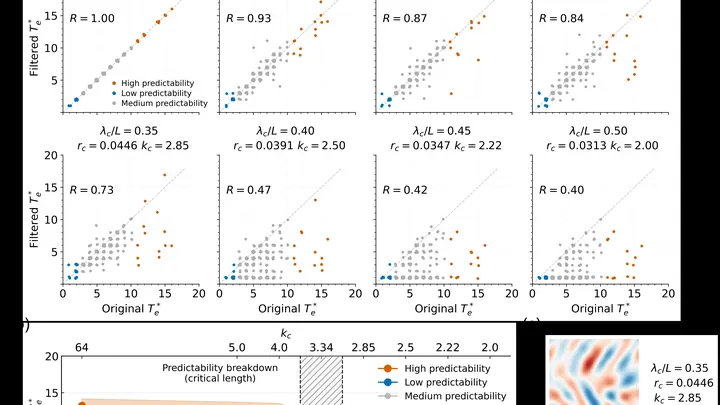
In a turbulent flow, like a raging river, energy constantly cascades from large whirlpools to small ones. Occasionally, particularly powerful bursts occur, resembling sudden waves crashing against the shore. Scientists asked: can we know in advance when such a "wave" will strike? It turns out the answer depends on which vortices are present in the flow at that moment.
A solar panel on a roof produces little current in the morning, a lot at noon, and stays silent at night. Wind doesn't blow randomly either: it's often stronger in the morning and evening than during the day. Energy providers need to know in advance how much energy will be available in an hour or three, so they can switch on backup plants or store electricity in batteries in time.
Tiny particles live double lives, like a spinning coin that’s both heads and tails. Contact with the outside world forces them to pick one — a process called decoherence. Picture it as an echo in a room. The old rule assumed the room was bare, so the echo died instantly. Real surroundings have memory, like soft furnishings that hold sound a little longer. This memory changes the fade.
The Paglia River behaves like a pendulum that resists being pushed. If a sudden influx of water pours in, the river does not keep gaining strength but quickly swings back to its usual level. This behavior is called antipersistence, and it was found in a twenty-two-year record of half-hourly discharge measurements near the Italian town of Orvieto.