Laser Printing of Electron Bunches express
A typical accelerator is like an assembly line where electrons are the workpieces. To get the desired X-ray pulse, the workpiece is fine-tuned after it's already on the line: squeezed, filtered, corrected. In the new work, engineers decided to take a different approach — shaping the workpiece before it even hits the conveyor.
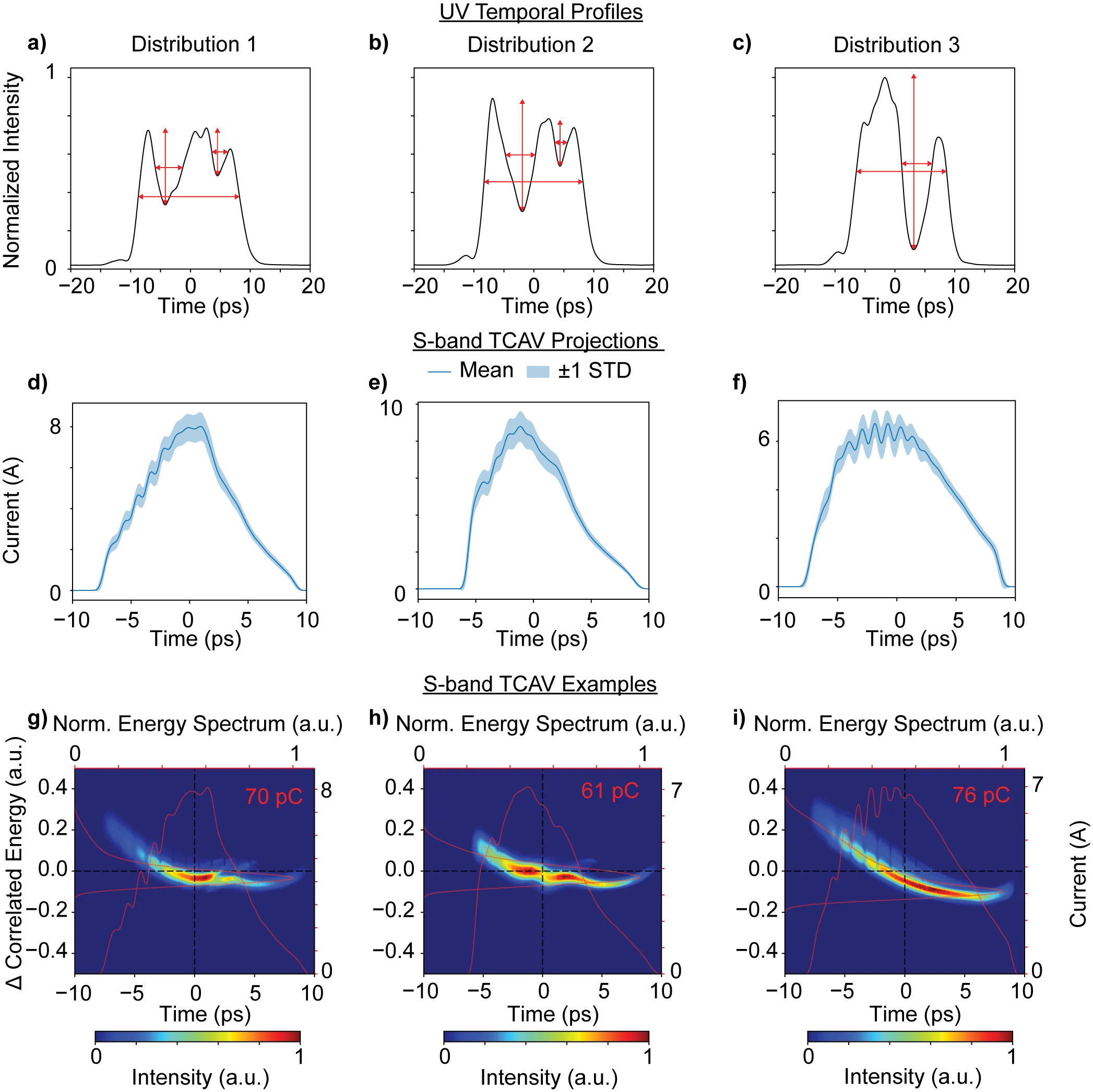
At LCLS-II, electrons are knocked out of a metal by a short laser pulse. Previously, this pulse had a simple shape, like a stamp with a fixed pattern. Now, the researchers have built a system that can draw arbitrary patterns on the laser pulse: multiple peaks, steps, complex profiles. This pattern is transferred to the electron bunch, and it persists through acceleration and compression.
This approach turns the electron source into a programmable tool. Instead of manually tuning the accelerator for each new task, an operator can simply load the desired laser pulse 'pattern.' This paves the way for automatic optimization and even autonomous operation of X-ray lasers.
Original abstract
as written by the authors arXiv:2603.15996
Leveraging the full scientific capabilities of next-generation high-repetition-rate free-electron lasers requires programmable control over electron-beam properties at their source. The photoinjector drive laser defines the electron beam's initial six-dimensional phase-space distribution, yet has historically been limited to Gaussian or static flat-top profiles, with most manipulation occurring downstream. Here we demonstrate software-programmable ultraviolet pulse shaping at the LCLS-II photoinjector as a source-level actuator that complements traditional accelerator controls. Using a coupled architecture combining dispersion-controlled nonlinear frequency conversion with spatial-light-modulator spectral shaping, we generate user-defined temporal structures and observe their imprint on electron bunches through high-resolution time-domain diagnostics. Laser-imposed multi-peaked modulation persists through acceleration, magnetic compression, and undulator transport with shot-to-shot repeatability, producing clearly resolved current structure in the compressed beam. Variance-based reconstruction from transverse deflecting cavity measurements reveals structured X-ray emission profiles exhibiting temporal features consistent with the programmed laser waveform. By providing rapid, software-controlled reconfiguration of electron-beam initial conditions, this source-level control approach establishes a programmable upstream actuator for future adaptive optimization and autonomous facility operation at high-repetition-rate light sources.
An electron bunch in an accelerator is so short that its length is measured in femtoseconds — quadrillionths of a second. In one femtosecond, light travels a distance hundreds of times smaller than the thickness of a human hair.
This technology is reminiscent of the replicator from Star Trek, but instead of matter, the shape of a particle beam is programmed.