A Spaceship Made from a Comet express
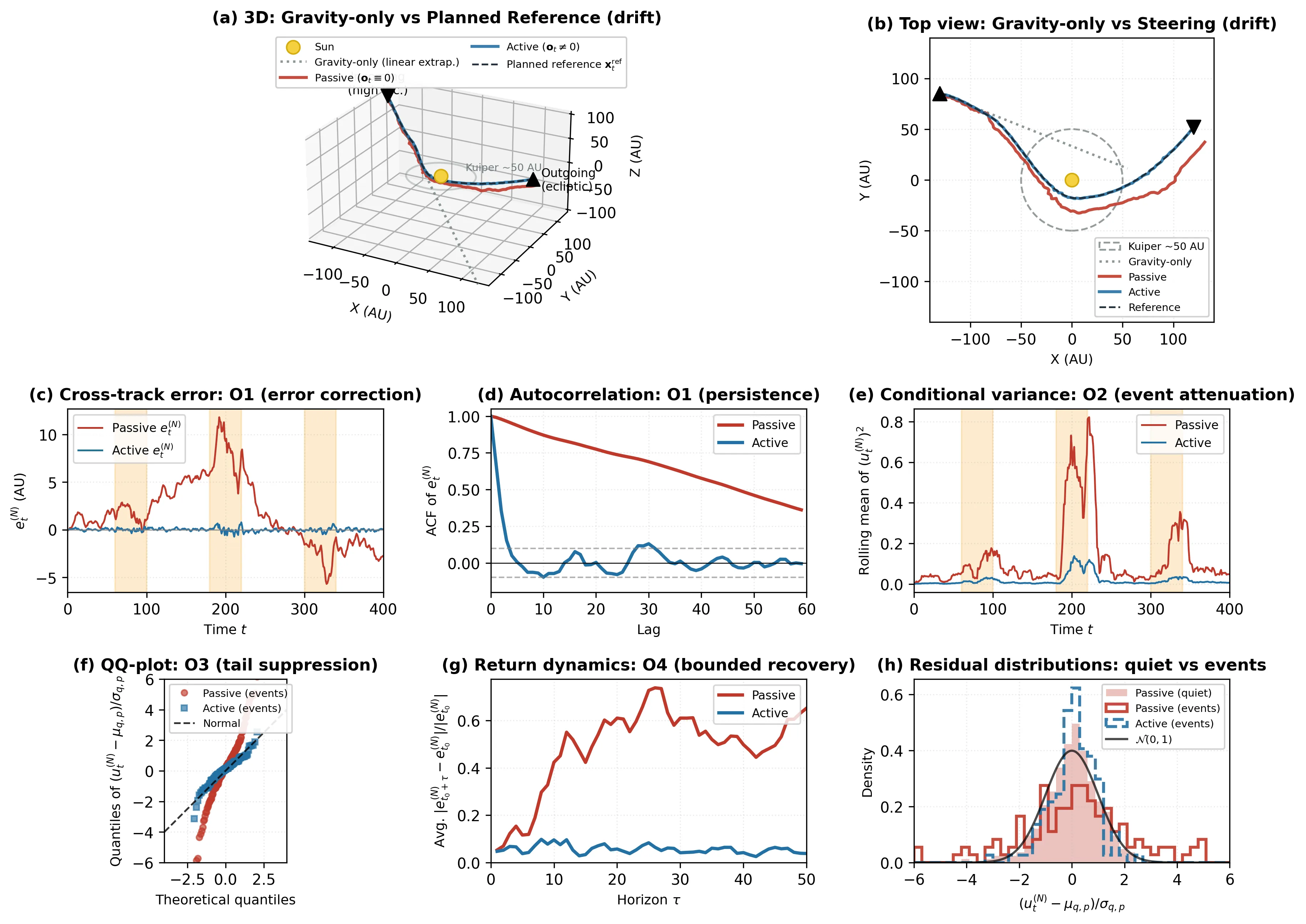
A comet hurtling through space is a mountain of ice and dust that carries itself across the Solar System. If you mount small engines on such a mountain, it becomes a ship with its own fuel: gas from the interior can be vented through nozzles to change course. But keeping such a behemoth on the right trajectory is like leading a loaded cart along a tightrope while it also spins.
The study examines under what conditions a comet-ship will answer the helm. It turns out the key is to prevent small jolts from accumulating. Each disturbance must be damped immediately, like a gust of wind, otherwise the error grows and the course drifts. The scientists derived four levels of stability, from simple energy balance to complex interaction with the comet's rotation. If all are met, the ship returns to its trajectory after any jolt, like a roly-poly toy.
Such navigation is useful not only for distant missions. If a dangerous asteroid is heading toward Earth, the same principles could help nudge it aside, or, conversely, reveal that some celestial body is already being steered. By the character of its motion, one could tell a natural comet from a controlled one: in the latter, course errors are corrected faster and do not accumulate.
Original abstract
as written by the authors arXiv:2603.16982
Interstellar objects (ISOs) motivate a coupled mission-design and inference question relevant to spacecraft dynamics and control in extreme environments: if volatile-rich, rotating comet-like bodies were used for sustained deep-space navigation by exploiting pre-existing hyperbolic motion and in-situ propellant, what stability requirements arise under non-gravitational forcing, and what astrometric signatures might distinguish active stabilization from uncontrolled natural dynamics? We develop a stability-theoretic framework for trajectory tracking with jet-actuated correction, and show that high-speed transit geometry -- including debris-belt avoidance and encounter phasing -- tightly constrains feasible trajectories, making long-horizon tracking stability mission-critical. We model tracking residuals as the balance of disturbances and corrective action, and derive stability conditions across four levels: disturbance-energy stability, outer-loop contraction, actuator-memory stability, and rotation-mediated (Floquet) stability. The analysis implies residual diagnostics that can motivate empirical tests: under comparable forcing, effective stabilization is expected to strengthen short-horizon error correction, reduce event-conditioned persistence and variance clustering, regularize standardized innovations, and yield bounded post-shock recovery. More broadly, the framework provides a reference for deep-space guidance and control under nonlinear, multi-field disturbances and for planetary-defense concepts involving attitude shaping or impulsive kinetic impact.
Comet 67P/Churyumov–Gerasimenko, studied by the Rosetta probe, has a day lasting 12.4 hours, and gas jets erupt from its surface at speeds up to 800 meters per second — twice as fast as a bullet.
In Arthur C. Clarke's novel Rendezvous with Rama, humans explore a huge object that turns out to be a ship using the resources of the celestial body itself.