A Spaceship Made from a Comet express
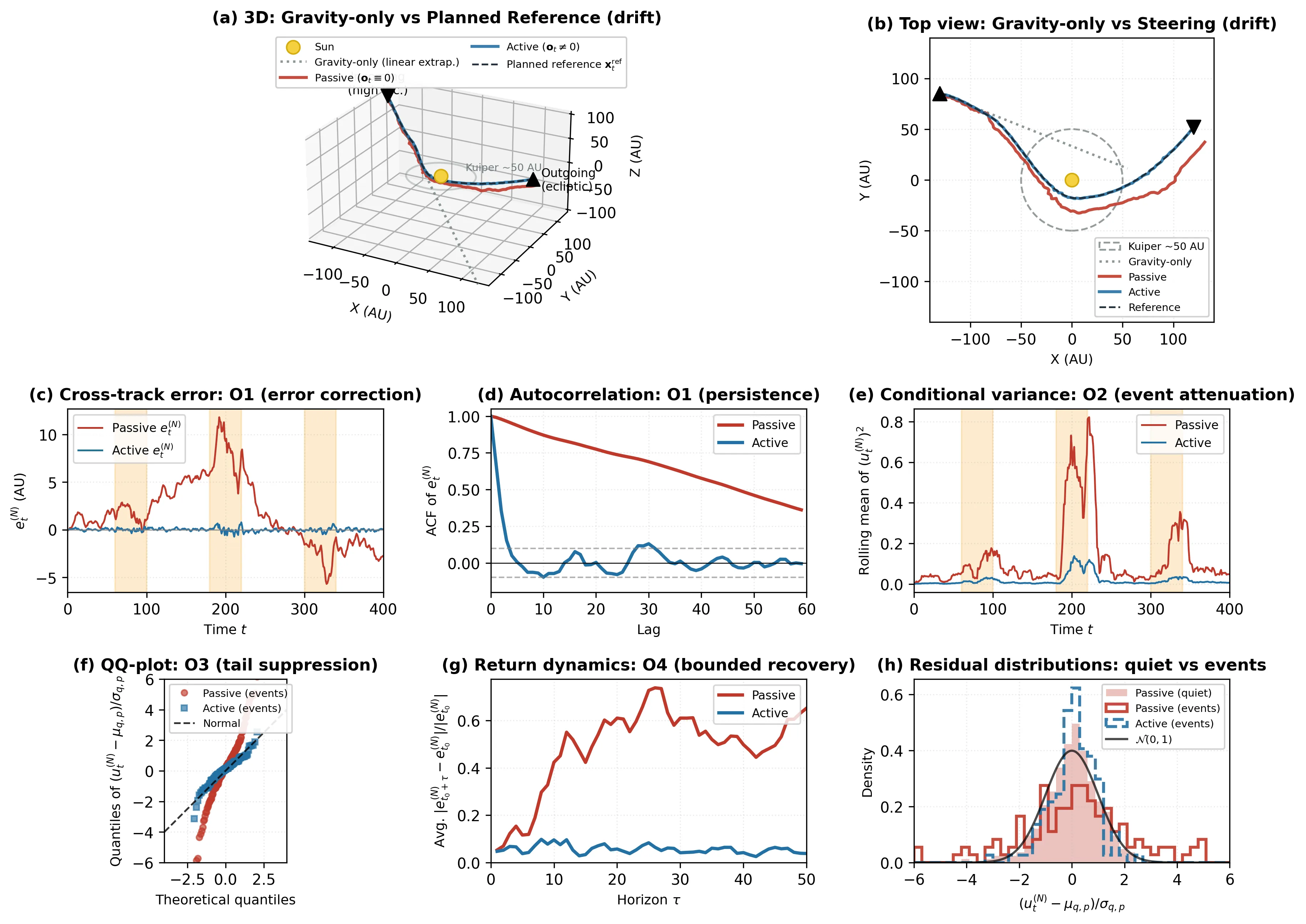
A comet hurtling through space is a mountain of ice and dust that carries itself across the Solar System. If you mount small engines on such a mountain, it becomes a ship with its own fuel: gas from the interior can be vented through nozzles to change course. But keeping such a behemoth on the right trajectory is like leading a loaded cart along a tightrope while it also spins.
The study examines under what conditions a comet-ship will answer the helm. It turns out the key is to prevent small jolts from accumulating. Each disturbance must be damped immediately, like a gust of wind, otherwise the error grows and the course drifts. The scientists derived four levels of stability, from simple energy balance to complex interaction with the comet's rotation. If all are met, the ship returns to its trajectory after any jolt, like a roly-poly toy.
Such navigation is useful not only for distant missions. If a dangerous asteroid is heading toward Earth, the same principles could help nudge it aside, or, conversely, reveal that some celestial body is already being steered. By the character of its motion, one could tell a natural comet from a controlled one: in the latter, course errors are corrected faster and do not accumulate.
Comet 67P/Churyumov–Gerasimenko, studied by the Rosetta probe, has a day lasting 12.4 hours, and gas jets erupt from its surface at speeds up to 800 meters per second — twice as fast as a bullet.
In Arthur C. Clarke's novel Rendezvous with Rama, humans explore a huge object that turns out to be a ship using the resources of the celestial body itself.