Quantum Entanglement in Z Bosons express
Two particles flying apart in opposite directions behave as a single whole: measuring one instantly determines the state of the other. Such quantum entanglement has long been known for light particles, but now it has been observed for the first time in heavy Z bosons — the carriers of the weak force.
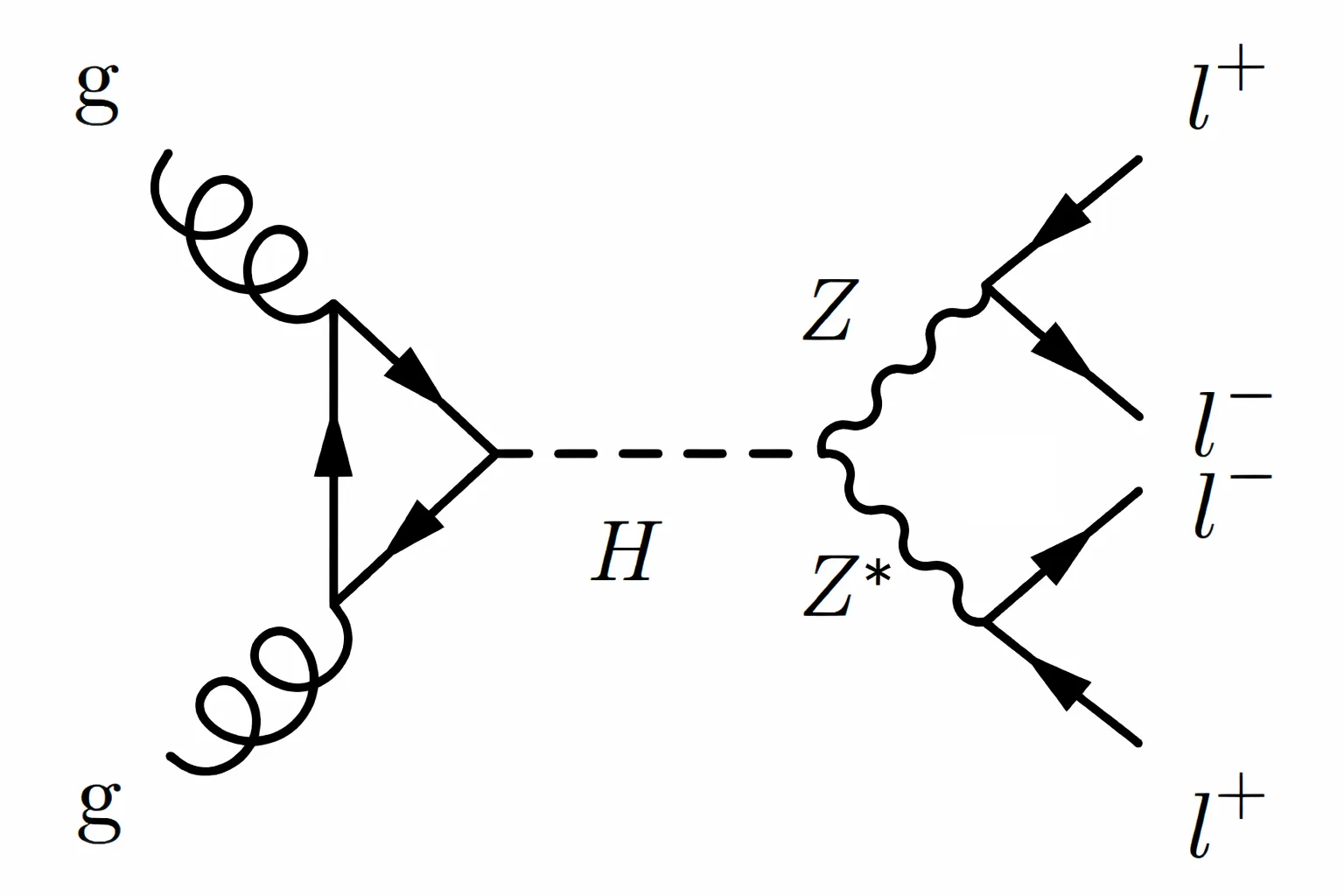
In the experiment at the Large Hadron Collider, protons collided to produce Higgs bosons, which quickly decayed into two Z bosons, which in turn decayed into pairs of electrons or muons. The ATLAS detector recorded the emission angles of these leptons, from which the spin states of the Z bosons were reconstructed. It turned out that the spins of the particles are correlated more strongly than any classical model without entanglement allows.
The result agrees with the predictions of the Standard Model and rules out the hypothesis of independent (separable) states at the level of 4.7 standard deviations. This opens the way to studying quantum correlations in the world of massive particles and testing the fundamental principles of quantum mechanics at new energy scales.
Original abstract
as written by the authors arXiv:2603.26463
Entanglement is a key property of quantum systems. In this Letter the first measurements of quantum entanglement between spins in pairs of $$Z$$ bosons are reported, using proton-proton collision data from the Large Hadron Collider (LHC) at center-of-mass energies of 13 TeV and 13.6 TeV, recorded with the ATLAS detector. Measurements of angular observables sensitive to $$ZZ^*$$ spin-density-matrix elements in the $$H\rightarrow ZZ^* \rightarrow \ell^+\ell^-\ell^+\ell^-$$ process yield coefficients $$C_{2,1,2,-1} = -0.71 \pm 0.45$$ and $$C_{2,2,2,-2}=0.08 \pm 0.44$$, consistent with their Standard Model predictions. A complementary hypothesis test using the full angular distribution, and relying on several Standard Model assumptions in the decays, provides substantially higher sensitivity to quantum correlations and disfavors the separable-state hypothesis at a significance of 4.7 standard deviations (expected $$4.9\sigma$$) relative to the entangled Standard Model hypothesis. These results provide strong evidence of quantum entanglement between massive bosons (spin qutrits) at the electroweak scale.
The spin of a Z boson can take three values (0, +1, -1), so it is called a qutrit — a quantum system with three states, unlike a qubit with two.
In the TV series "Dark Matter," entanglement is used for instantaneous communication between ships, echoing the idea of nonlocal correlations, although in reality information transfer is impossible.