Are you one of the authors of this paper? Email us from your institutional or work email address mentioning this article's arXiv ID and we'll verify you and give you edit access to this page.
Are you an author who sees something we missed or got wrong? Write to us — the subject line already carries the paper id. We read every note and correct the write-up.
The supermassive black hole at the center of our galaxy shines erratically, and the polarization of its emission varies more than its overall brightness.
📄 Showing the "Simple" version — "Advanced" is not ready yet. Add it to favorites to help prioritize it.
At the center of the Milky Way lies the supermassive black hole Sagittarius A*. It is four million times more massive than the Sun, but by cosmic standards it behaves quietly: it only occasionally flares up when it swallows a clump of gas. Astronomers monitored it with the ALMA radio telescope — an array of antennas high in the Chilean Atacama Desert.
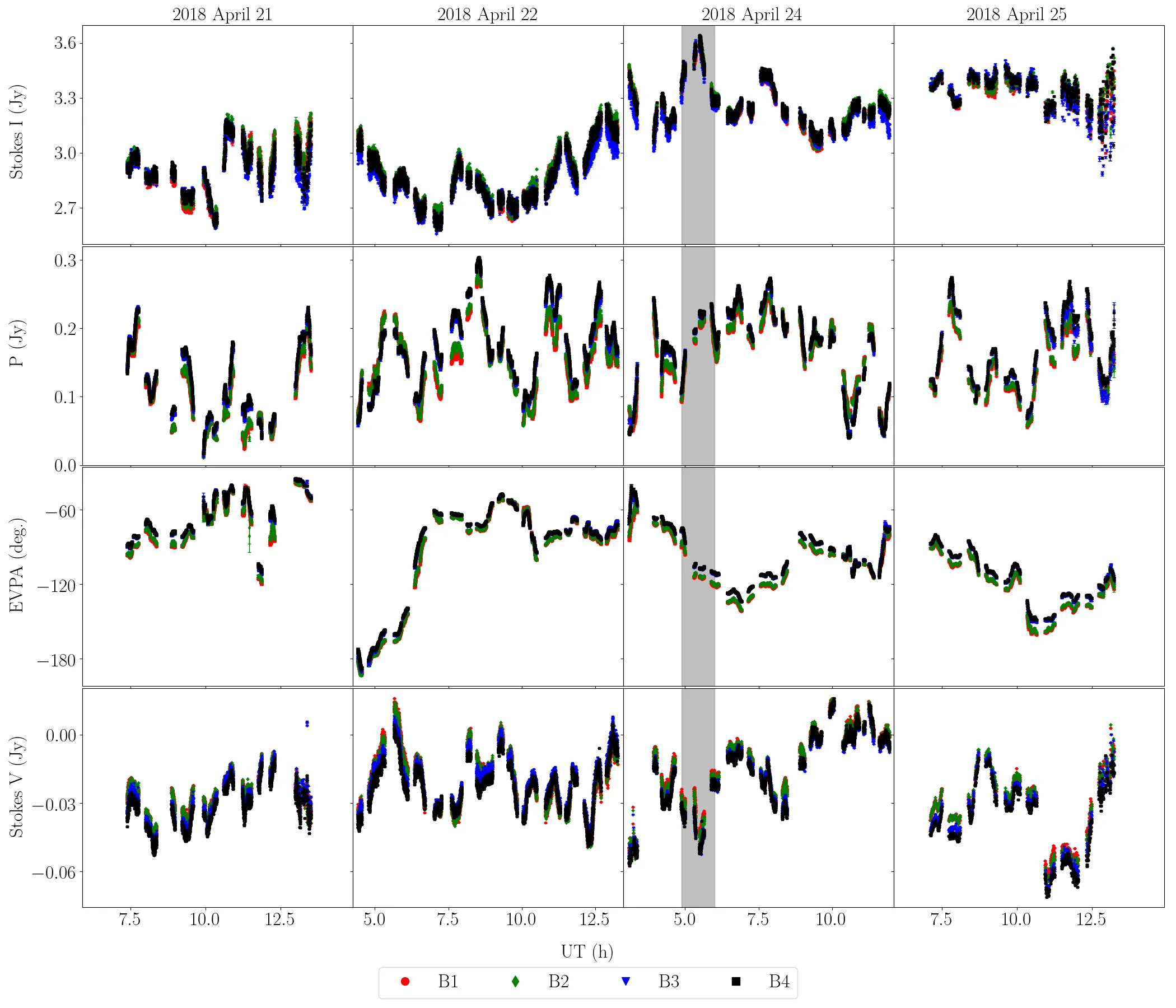
The total brightness of the hole changes only weakly — by less than 10%. But the direction of light oscillation, its polarization, jumps much more noticeably: by about 30% for linear and 50% for circular polarization. It is as if a campfire burned steadily, but the flames danced in different directions. The polarization remained stable over the course of a day, while the brightness did not. It seems that the polarized light originates in a compact clump, while the ordinary light comes from a more extended region.
On April 24, 2018, the Chandra X-ray telescope caught a flare from Sagittarius A*. At the same moment, the peak of polarized light at millimeter wavelengths arrived without the usual delay. Usually, X-rays flare first, and radio responds later, like thunder after lightning. Here, everything happened simultaneously.
Such synchrony breaks the familiar picture where electrons first accelerate and then cool, emitting at different wavelengths in sequence. Instead, energy seems to be injected continuously into a rarefied region. This is an important clue for understanding how matter behaves at the very edge of a black hole.
Sagittarius A* (Srg A*), the supermassive black hole at the center of the Milky Way, provides a unique laboratory to study accretion dynamics and plasma processes near the event horizon. We investigated the variability and polarization properties of Srg A* using ALMA observations during the 2018 Event Horizon Telescope campaign. We analyzed high-cadence full-polarization light curves from ALMA at millimeter wavelengths, performed time-series analysis, and investigated the temporal behavior during an X-ray flare observed by Chandra on 2018 April 24. The variability characteristics are compared with expectations from standard accretion flow models. We find low variability in total intensity ($$\sigma/\mu < 10\%$$), but significantly higher variability in linear and circular polarization (~ 30% and ~ 50%, respectively). A time-series analysis reveals red-noise variability, with power spectral densities between -2 and -3 across all Stokes parameters. Polarized intensity shows stable intra-day timescales, while total intensity exhibits more variable timescales, suggesting distinct emission regions, with polarization likely arising from a coherent structure. On April 24, a statistically significant inter-band delay in polarized intensity coincides with a near-simultaneous X-ray and millimeter peak that deviates from the typical delayed flare scenario. This event also features enhanced millimeter variability and coherent polarization loop evolution. The observed simultaneity challenges standard models of transient synchrotron emission with cooling delays, favoring instead a scenario of continuous energy injection in an optically thin region. Our results offer new constraints on the physical mechanisms driving variability in Srg A*, and provide key observational input for refining theoretical models of accretion and plasma behavior in the vicinity of supermassive black holes.
Sagittarius A* is 26,000 light-years away — the light we see today began its journey when Neanderthals still roamed the Earth.
In the movie "Interstellar," the black hole Gargantua is shown with a bright accretion disk: this is exactly the kind of glow and polarization that scientists study in Sagittarius A*.