A Laser Pendulum in a Suitcase express
A pendulum swings with such precision that, had it been counting seconds since the Big Bang, it would have drifted by only half a second by today. That is the stability of the new portable ultraviolet laser — the heart of aluminum atomic clocks.
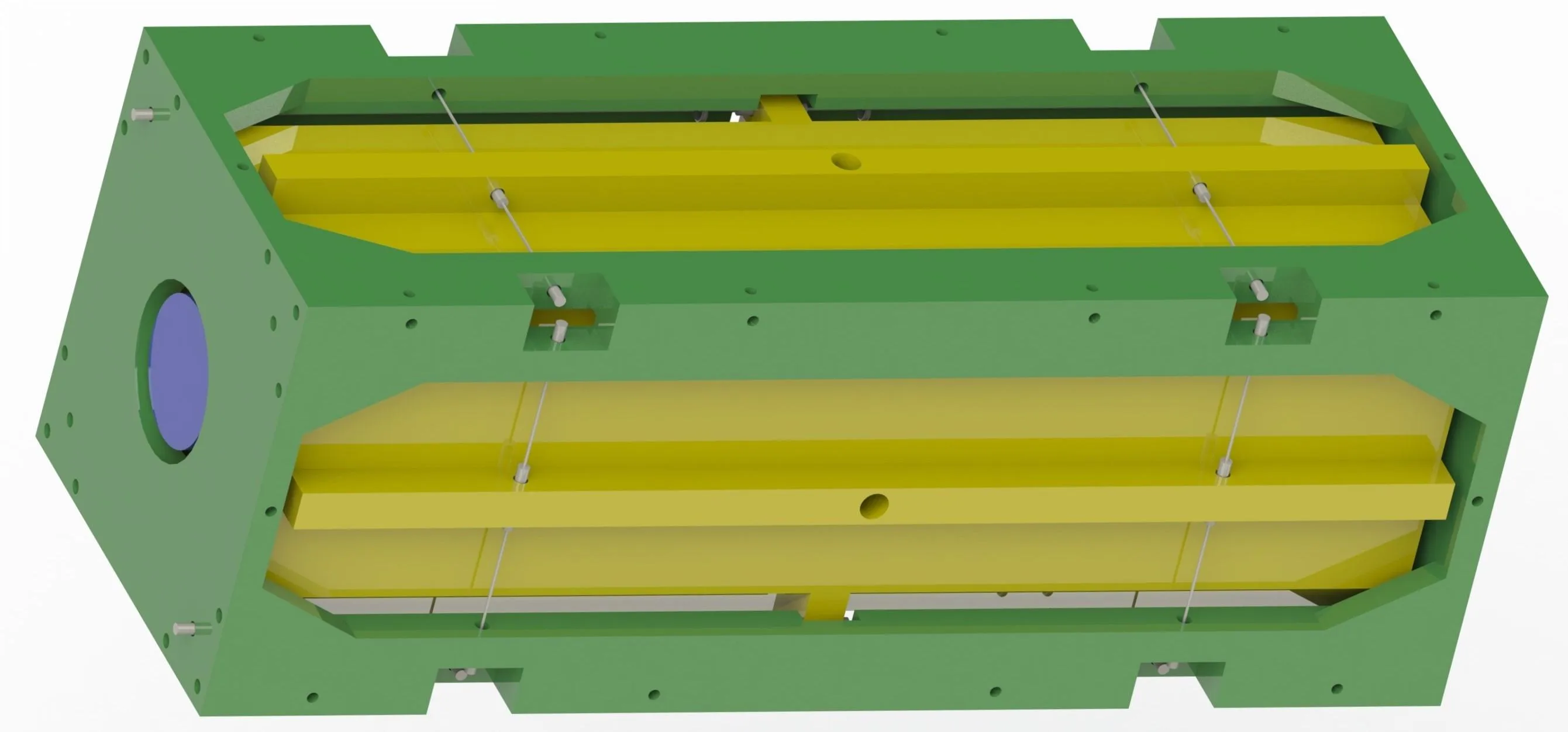
This laser acts as an ultra-precise ruler for measuring the frequency of an atomic transition. Atomic clocks need a perfectly steady light tone, like a tuning fork that never goes off pitch. In the new device, the beam passes through a tiny cavity with mirrors made of crystalline layers of aluminum gallium arsenide. This material barely distorts light under temperature fluctuations. The laser's frequency is then quadrupled in two stages, converting infrared light into ultraviolet — the very light that tickles aluminum atoms.
The key trick lies in fighting noise. Light inside the laser cavity slightly heats the mirrors, causing them to expand imperceptibly and shift the frequency. But here, a mutual compensation effect is used: thermal expansion distorts the beam in one direction, while light pressure distorts it in the other. The net error cancels out. It's like two inaccurate watchmakers who, working together, suddenly produce perfect chronometers.
Such a laser can be packed into a suitcase and taken wherever ultra-precise clocks are needed: onto a spacecraft, to a geodesic observatory, or into an underground laboratory searching for drift in fundamental constants. It is unfazed by road vibration and temperature swings: its stability is built into the very physics of the materials and the optical design.
Now our pendulum is a real beam of light, trapped in a crystalline cage. Its oscillations set the rhythm by which we can synchronize not only clocks but also the very flow of time across different corners of the universe.
Aluminum quantum clocks are so precise they can detect time dilation at heights of just a few centimeters, an effect predicted by Einstein's general theory of relativity.
In Greg Bear's novel "Eon," ultra-precise clocks are used to synchronize signals between star systems, and the slightest glitch in laser stabilization threatens the loss of entire civilizations.