How Dark Matter’s Invisible Lens Alters a Black Hole’s Face ✛ ✦
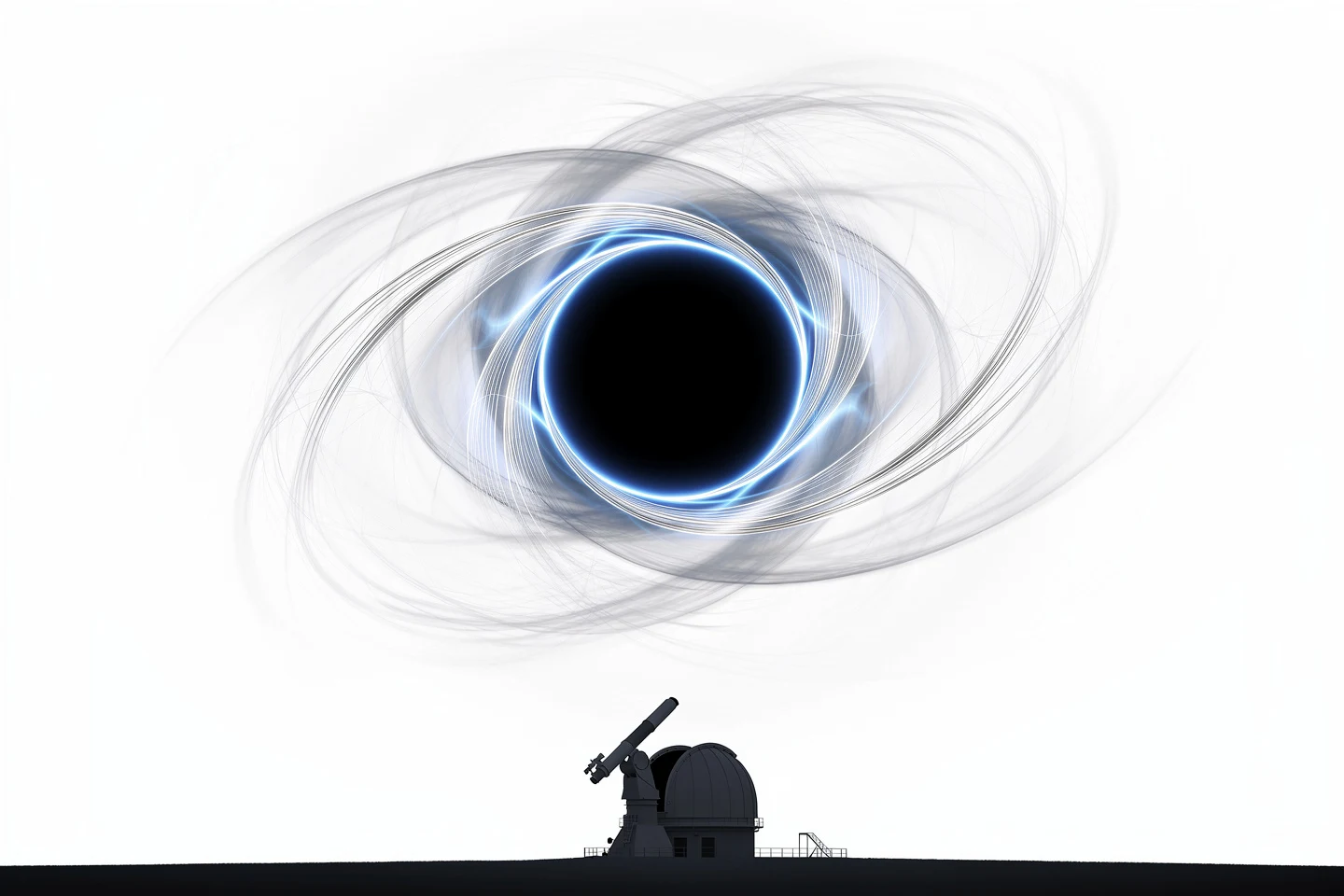
Images of black holes from the Event Horizon Telescope show a bright ring encircling a dark pit. This ring is scorching hot gas in the accretion disk, swirling around a black hole in distant galaxies. But new research suggests the picture is heavily distorted by invisible dark matter, which, through spacetime curvature, acts as a giant lens, bending light rays.
Computer simulations have compared three scenarios: a standard spinning black hole and two models with dark matter. It turns out that if the invisible mass is distributed as a flattened cloud, the brightness center shifts, and the ring itself grows by tens of percent. Strikingly, this “lensed” picture matches real observations of active galactic nuclei, while the model without dark matter produces a ring that’s too small.
This means that in the images, we aren’t seeing the object itself, but its “reflection” in the gravitational lens of dark matter. In the future, analyzing light color will help disentangle the contributions of the black hole and its invisible surroundings — bringing us closer to solving the dark matter puzzle. Back in the mid-20th century, astrophysicist Vera Rubin proved that galaxies are surrounded by a vast cloud of invisible mass — work that became key to the discovery. Now it’s clear that the elegant models of Karl Schwarzschild with empty space around a black hole need refinements. The shadow’s shift and the ring’s brightness may stem not from rotation, but from an invisible dark matter lens.
Dark matter’s gravity works like an invisible lens: it doesn’t block light, but bends its path, changing the appearance of distant objects.