How dark matter changes the appearance of rotating black holes: from shadow to photon ring ✛ ✦
Context
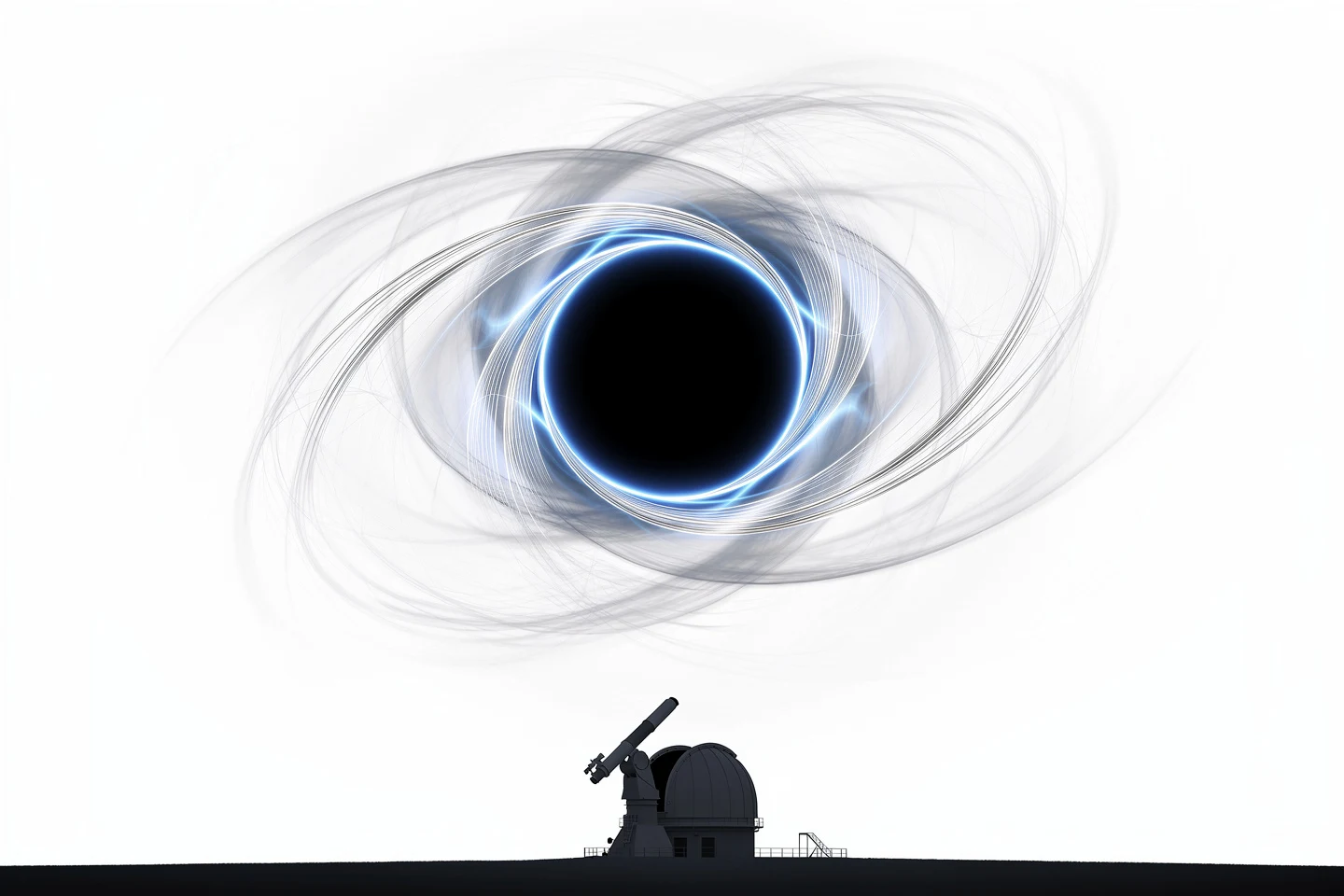
Observations of central objects in galaxies, such as M87* and Sgr A*, have shown that the visible image of a black hole is shaped not only by the event horizon but also by plasma motion in the accretion disk and gravitational lensing in the strong field. Although dark matter dominates galaxy masses, its direct influence near the horizon has traditionally been considered negligible. However, theoretical models allow constructing metrics of black holes immersed in realistic dark matter density profiles, opening the possibility of searching for its signatures on event horizon scales.
Methods
To construct images, adaptive ray tracing was used in reverse: photons were emitted from the observer's point, and their trajectories were computed in the given spacetime until they intersected the equatorial plane or were captured by the horizon. Geometries of rotating black holes were built as effective extensions of static solutions with Einasto and cored-NFW profiles. For each model, the shadow boundary, lensing bands, transfer maps, and synthetic images were computed based on a semi-analytical optically thin disk model. This approach allows a direct comparison of the role of spacetime curvature without the complexities of full magnetohydrodynamics.
Results
At moderate parameters (spin χ=0.95, inclination 70°), the Einasto model is virtually indistinguishable from Kerr: effective image diameter, centroid shift, and asymmetry agree within fractions of a percent. Meanwhile, cored-NFW shows noticeable differences: the centroid shifts by 5.13M versus 3.65M for Kerr, left-right asymmetry increases from 0.19 to 0.32, and the peak of the radial brightness profile shifts outward from 6.64M to 10.78M. When converted to angular scales using the masses and distances to M87* and Sgr A*, the characteristic angular size of the bright ring for cored-NFW (40.96 μas for M87* and 51.74 μas for Sgr A*) turns out to be close to the EHT reference values (42±3 and 51.8±2.3 μas, respectively), whereas Kerr and Einasto give smaller values (~25.2 and 31.9 μas). These numbers are not a fit to the data, but show that the environment's influence can be significant on observational scales.
Implications
The main conclusion is the existence of a degeneracy between dark matter parameters, spin, and orbital inclination. Changes in the distribution of the dark halo can mimic effects traditionally attributed to black hole spin or accretion flow geometry. This raises the question of how unambiguously current methods can separate the contributions of the central object and its environment. For future tests of gravity theories and dark matter models, accounting for such systematic uncertainties is critical, which is especially relevant in the context of data from active galactic nuclei.
Future development
In the future, it is planned to replace the semi-analytical emission model with full-fledged transport calculations within general relativity including magnetic fields (GRRMHD), as well as to incorporate polarization and scattering effects for Sgr A*. Joint analysis of metric parameters and the dark matter profile using Monte Carlo methods on realistic EHT data will either constrain the properties of dark matter or set upper limits on its influence at horizon scales. Galactic centers are becoming a natural laboratory for testing fundamental physics.
Impact
The results impact several areas: interpretation of black hole images in strong gravitational fields, indirect searches for dark matter via gravitational signatures, and tests of general relativity under conditions where environmental effects become substantial.
Next steps
The next steps include implementing full radiation transport with magnetohydrodynamics of the accretion flow and adapting the method for analyzing polarimetric EHT data, which will allow direct comparison of models with observations of redshift and Doppler boosting.
Key open problems
This work is directly connected to the unsolved problem of the nature of dark matter and testing the hypothesis that it may consist of unknown particles that form characteristic density profiles around supermassive black holes. Furthermore, it touches on the fundamental question of the uniqueness of the Kerr solution for astrophysical black holes and the need to go beyond the standard model in strong gravitational fields.
The knowledge machine's view
This section is addressed to the author of the paper and their colleagues. Neighbouring works were found by meaning-based search across our archive, not by word overlap. We do not review: we show the field around the work.
What the work does
In this work, ray-traced images of rotating black holes embedded in dark matter halos with Einasto and cored-NFW profiles are constructed. Comparison with the Kerr metric at χ=0.95 and inclination 70° shows that cored-NFW significantly shifts the centroid, increases asymmetry, and moves the brightness peak outward, while Einasto is nearly indistinguishable from Kerr. The authors also compared angular sizes with EHT observations of M87* and Sgr A* and pointed out the degeneracy between dark matter parameters, spin, and inclination.
Where its strength is
A strong point is the direct quantitative comparison of two dark matter profiles within a unified ray-tracing scheme, revealing which profile yields observable deviations from Kerr. This provides a basis for assessing systematic uncertainties in interpreting EHT images.
Where it could go next
- It might be interesting to compare the obtained shadow changes with predictions for black holes in alternative gravity theories, as in the review 2606.15727, where the shadow is used as a mirror of unknown gravity. This would allow seeing how distinguishable dark halo effects are from modifications of gravity itself.based on: A Black Hole's Shadow as a Mirror of Unknown Gravity arXiv:2606.15727
- A related approach involves fuzzy dark matter: there, ultralight scalar fields are considered as modifying the horizon. One could check whether such a model produces characteristic differences in shadow shape and photon ring compared to the cored-NFW used in this work.based on: Black Hole Shadow: How Fluffy Dark Matter Reshapes the Horizon arXiv:2608.00519v1
- In the archive, there is a review 2608.05861v1 about a black hole in a dark matter cocoon; it might be worth examining how the presence of a dense cocoon affects the image at the same spin and inclination parameters as in your work, and compare with your results for Einasto and cored-NFW.based on: Black hole in a dark matter cocoon arXiv:2608.05861v1
Worth trying
- Test the method on a fuzzy dark matter profile and compare the centroid shift and asymmetry with the cored-NFW results.
- Check whether the parameter degeneracy persists when adding a second profile parameter (e.g., characteristic radius) to the analysis.
- Generate synthetic images for inclinations close to 90° to reveal the maximum possible deviations from Kerr.
Why this may matter
This could be important for interpreting future higher-resolution EHT observations: if dark matter effects are indistinguishable from changes in spin or inclination, additional observational constraints will be needed to separate the contributions of the central black hole and its environment.
Nearby works in our archive
- A Black Hole's Shadow with a Secret from Other Dimensionssimilarity 0.70
- The Shadow of a Black Hole: How Bent Light Paints a Portrait of the Invisiblesimilarity 0.70
- A Black Hole's Shadow as a Mirror of Unknown Gravitysimilarity 0.70
- Black hole in a dark matter cocoonsimilarity 0.69
- Black Hole Shadow: How Fluffy Dark Matter Reshapes the Horizonsimilarity 0.69
- Black Holes in Dark Matter Halossimilarity 0.69
The archive is crowded around this work: 10 reviews nearby, closest at 0.70. This ground is well walked — and there is plenty to compare against.
Original abstract
as written by the authors arXiv:2605.05635v3
We study the optical appearance of rotating black holes embedded in dark matter environments using a phenomenological ray tracing framework. Rather than focusing on a single geometry, we compare two effective rotating backgrounds obtained from static dark matter sourced seed metrics: a regular Einasto-type black hole and a cored-NFW black hole. Kerr is used as the reference spacetime. We construct observer-screen images by numerical backward ray tracing and analyse the horizon structure, shadow boundary, lensing bands, transfer maps, and synthetic intensity distributions produced by a common semi-analytic accretion prescription. We also introduce simple image-level diagnostics, an angular-size confrontation with M87* and Sgr A*, and simplified visibility-amplitude diagnostics. These additions are not intended as an EHT fit, but as a controlled way to identify which observables are most affected by the dark matter dressing. For the representative parameters considered here, the Einasto-supported geometry remains very close to Kerr, while the cored-NFW case produces a stronger redistribution of the image, with larger centroid displacement, stronger brightness asymmetry, an outward shift of the characteristic bright-ring scale, and a visible change in the normalized visibility amplitude. The results indicate that rotating dark-matter-dressed backgrounds can produce systematic image-domain and Fourier-domain deviations that are partially degenerate with spin, inclination, and emission modelling. The framework is lightweight and extensible, and provides a first step toward future GRRT and GRMHD studies of rotating black holes in dark matter environments.
Although dark matter makes up about 85% of all galaxy mass, its direct gravitational influence on the scales of a black hole horizon billions of times more massive than the Sun is only a small fraction. Nevertheless, as simulations show, this is enough to change the apparent size of the bright ring by tens of percent.
Key numbers
- Centroid shift (Kerr): 3.65 M
- Centroid shift (cored-NFW): 5.13 M
- Peak diameter (Kerr): 6.644 M
- Peak diameter (cored-NFW): 10.779 M
- Peak angular scale (M87*) for cored-NFW: 40.96 μas