When Two Currents Merge into One express
Sunlight hits a silicon wafer, and a current flows in the circuit. That's the familiar work of a solar cell: light knocks out electrons, and a p–n junction (the boundary between two layers with different conductivities) forces them to move in one direction. But in some crystals, current arises differently — without any junctions, purely from the material's internal structure. Among such responses, two stand out. The injection current: light “throws” electrons into the conduction band, and they all rush in one direction. The shift current: when a photon is absorbed, electron clouds shift in space, barely changing energy. For a long time, these currents were thought to have completely different natures and mechanisms.
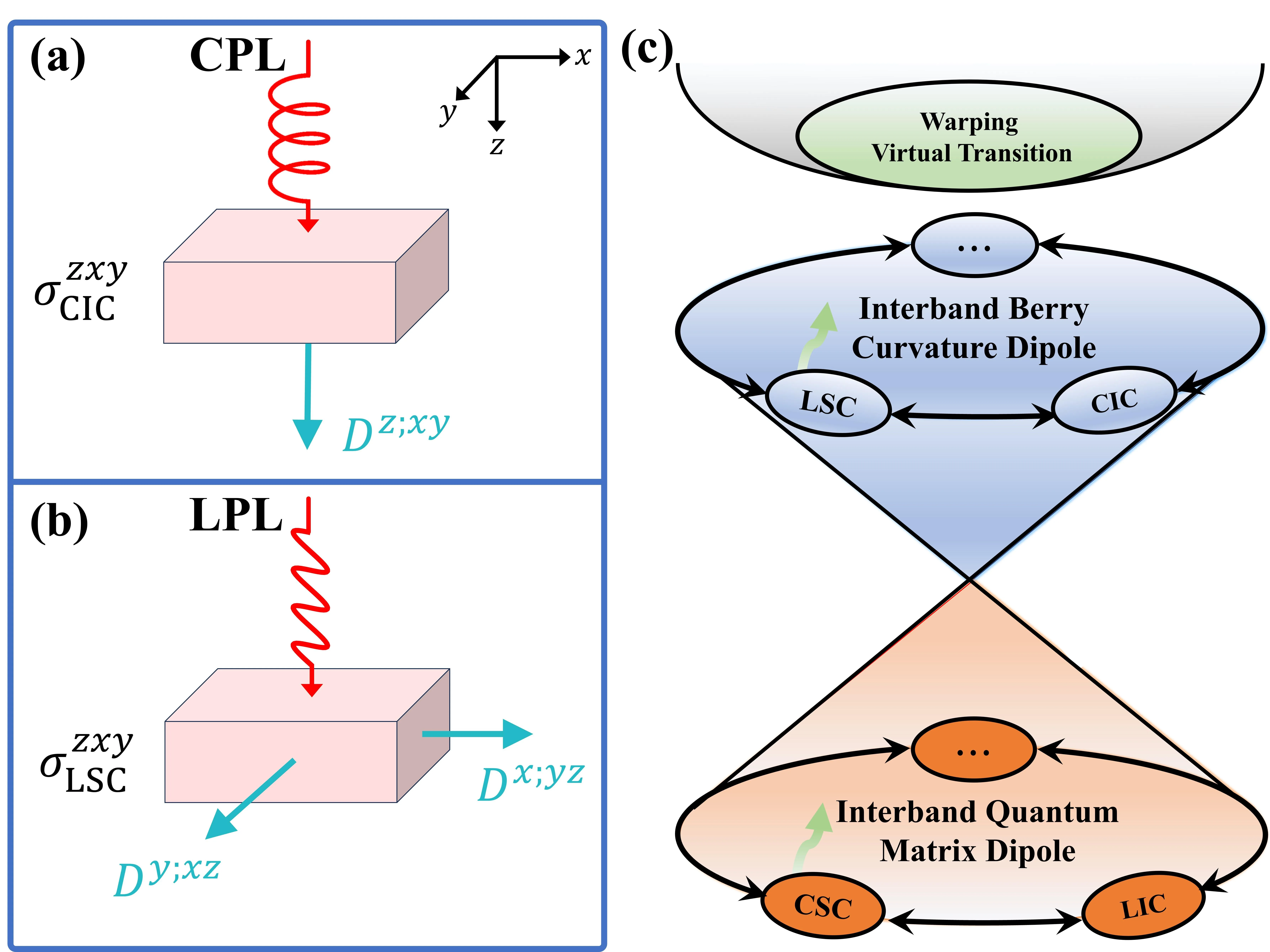
The authors of the new work show that this is not so. Both currents are linked through the geometry of electron quantum states — through the so-called Berry curvature and the quantum metric. An electron in a crystal is described by a wave function. It has a shape and curvature — much like the surface of a hill. When light makes an electron jump between energy bands, what matters is not just the energy difference but also how “twisted” these wave functions are and how strongly they overlap. The injection current depends on curvature; the shift current depends on the metric. But under certain conditions, they merge into one.
Such a regime naturally arises in graphene under bias, as well as in Dirac and Weyl semimetals. Instead of two different experiments, one now suffices to measure a single geometric characteristic of wave functions. The discovery offers a new framework for understanding nonlinear optics. It hints that quantum geometry may be a universal key to many phenomena in solids that previously seemed unrelated. And then, light falling on a crystal can tell us about its internal curvature, just as in the very beginning, when an ordinary sunbeam generated current in silicon, only now we see deeper.
In graphene, electrons behave as if they have no mass: they obey the Dirac equation, like relativistic particles, but at a speed 300 times slower than light.
In Arthur C. Clarke's novel The Light of Other Days, wormholes allow seeing through space — a similar principle of geometric connection is used here to unify different optical responses through a single “curvature” of quantum states.