Wormholes demand the impossible: even the vacuum is powerless ✛ ✎ ✦
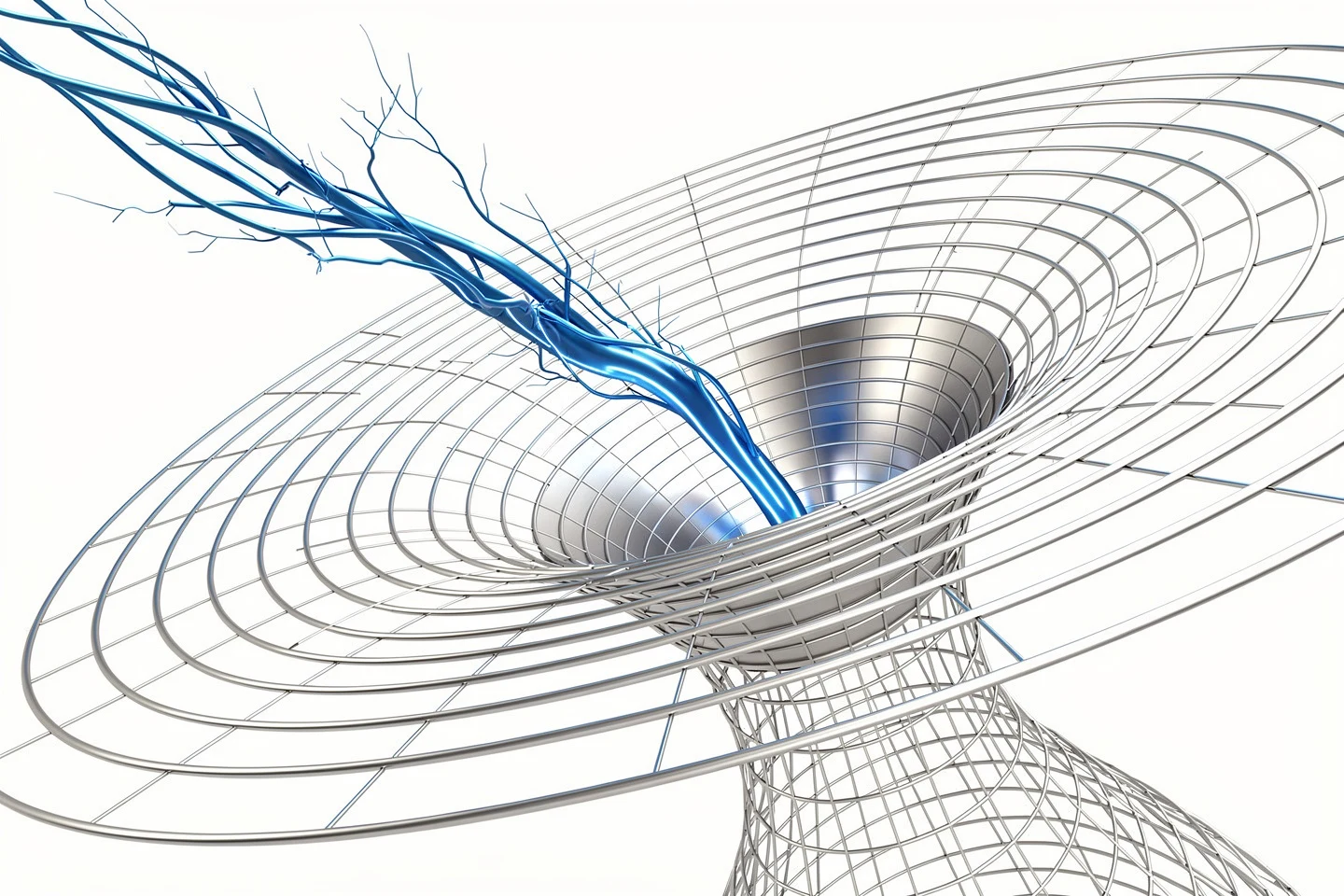
A hole in an elastic sponge closes on its own. To keep it open, you need a brace that pushes from the inside with negative effort — effectively pulling the walls inward rather than pushing them apart. Ordinary matter can't do this: it only attracts, causing the hole to collapse faster. Such is a wormhole — a tunnel in curved spacetime. It requires exotic matter with negative energy.
Adding dark energy, the very vacuum that stretches the Universe, and its energy exchange with matter does not change the picture. As shown by John Wheeler and Kip Thorne, the throat opens only when pressure exceeds energy density. A new theorem proves that quantum fluctuations and tricks with redshift won't save you. Gravity will mercilessly collapse the tunnel.
This conclusion is important for searching for wormhole traces in gravitational waves at LIGO and Virgo. And for science fiction: time dilation at the throat is such that even light won't slip through. Nature doesn't need shortcuts — known physics won't allow them.
Space is like a sponge: any hole in it tends to collapse. To keep it open, you'd need a brace that not just pushes, but essentially pulls the walls from within. Even a vacuum pumped with dark energy cannot serve as such a brace.
In the series 'Star Trek', wormholes are commonplace, but in reality, a starship would have to carry exotic matter that doesn't exist. Astrophysicist Carl Sagan also encountered this barrier in his novel 'Contact': his characters couldn't have traveled even a meter without violating physical laws.