Why Wormholes Are Impossible Without Exotic Matter: A New No-Go Theorem ✛ ✎ ✦
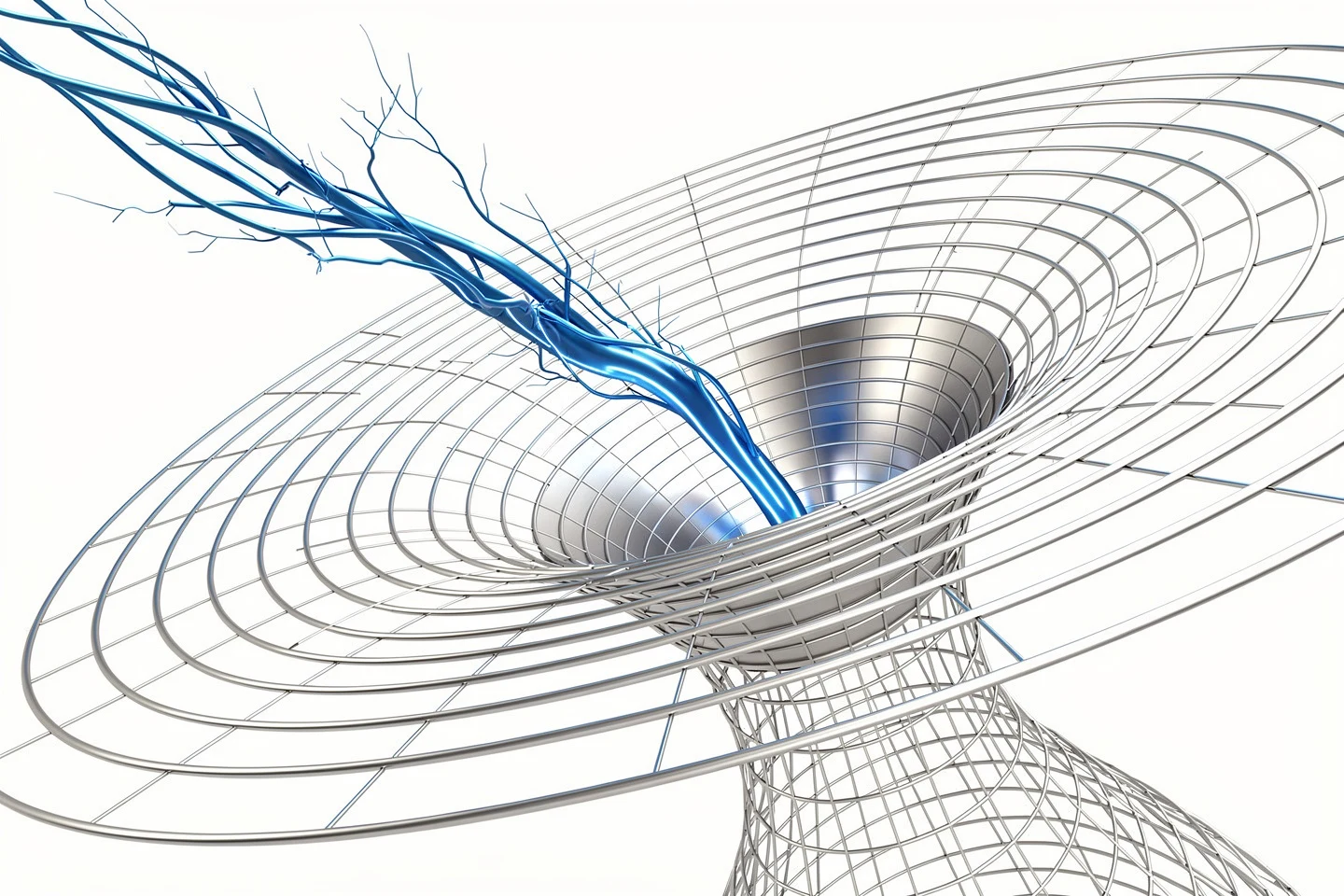
Context
Traversable wormholes—hypothetical bridges between distant regions of the universe—remain one of the most intriguing possibilities of Einstein's gravity. The classic work of John Wheeler and Kip Thorne showed that a wormhole throat requires 'flaring out' geometry, which mathematically compels a violation of the null energy condition (NEC): the effective energy density must turn negative. For a long time, this exotic matter was considered the main obstacle. However, recent cosmological tensions, particularly the 4.2σ discrepancy in the standard ΛCDM model flagged by the DESI instrument, hint at the possible existence of a dynamic dark energy that interacts with matter. This raised hopes: could we offload the 'exotic burden' onto the vacuum itself, letting ordinary matter stay normal?
Methods
The author applied a mathematical approach within curved spacetime described by Einstein's equations. A static, spherically symmetric case with zero tidal forces (the redshift function is constant) was studied, physically meaning no gravitational time dilation for a hypothetical traveler. An interaction term Q(r) was introduced—a position-dependent exchange of energy-momentum between ordinary matter and the vacuum. The general solution was sought for an anisotropic fluid with radial tension and tangential pressure. Then a geometric 're-embedding' followed: the metric was projected into three-dimensional Euclidean space, and the flaring-out condition at the throat was analyzed—the second derivative of the embedding function must be positive.
Results
The analysis revealed a stark incompatibility. Plugging in physical and geometric parameters showed that the effective difference between radial tension and energy density equals an expression involving the shape function b(r) and its derivative. Yet the flaring-out condition demands b - r b' > 0—meaning tension always exceeds density: τ > ρ. This is a direct NEC violation. The most striking part: the interaction function Q(r) completely drops out of the final NEC expression! A detailed derivation (via conservation laws and the relation V' = -Q) demonstrates that the vacuum energy gradient, driven by Q, enters the equations in such a way that its influence on the energy-momentum tensor components cancels out. As a result, the flaring-out condition 'locks' the geometry, making NEC violation inevitable regardless of the coupling function or the matter equation of state.
Implications
This no-go theorem deals a heavy blow to hopes of 'humanizing' wormholes. It shows that vacuum interaction not only fails to help but itself becomes an anatomical constraint: the energy flow from matter to vacuum is blocked by gradient requirements, and the throat 'chokes' without exotic matter. Physically, this means chronological protection in the physical world is wired at the level of differential geometry—it’s not just a local artifact of simple gravity. This result echoes the Topological Censorship Hypothesis, which states that non-contractible topological structures are hidden from outside observers.
Future development
The result leaves little room for macroscopic workarounds. Any attempt to 'resuscitate' a wormhole will demand non-static solutions, rotation, or the introduction of other fields (e.g., axions or a dark photon)—but all these scenarios face the problem of quantum instabilities. A sharp interest lies in pairing the proven theorem with quantum energy inequalities (QEIs), which impose tightened constraints on averaged negative energy along a worldline. Perhaps the next step is a search for 'semi-classical patches' where quantum effects might bypass the prohibition, but the price will likely be exorbitant.
Impact
The work directly impacts gravitational-wave astronomy and cosmology. It cleanly separates wormhole geometry from observable signatures (echoes, gravitational lensing), cutting off 'non-exotic' throat hypotheses from LIGO-Virgo data analysis. At the same time, the theorem prescribes caution when interpreting dynamic vacuum models popular for explaining the accelerated expansion of the universe: the same interactions that delicately tune cosmological evolution cannot create local topological stunts.
Next steps
The immediate task is generalizing the theorem to the case of rotation and non-static throats, where the Raychaudhuri equation may offer new insights. Additionally, a rigorous assessment of the quantum 'kickback' at high interaction frequencies is needed, which could link this proof to quantum information calculus.
Key open problems
The theorem strikes at the heart of one of the biggest unsolved problems in physics: why time flows only forward and whether we can trick the universe into making a time machine. It suggests that the ban on non-trivial topology is likely a consequence of fundamental field symmetries, uniting gravity and quantum mechanics through the principle of energy honesty—no 'free' miracles allowed.
The knowledge machine's view
This section is addressed to the author of the paper and their colleagues. Neighbouring works were found by meaning-based search across our archive, not by word overlap. We do not review: we show the field around the work.
What the work does
The author examined static spherically symmetric traversable wormholes with zero tidal forces in general relativity, adding an interaction between matter and vacuum through the function Q(r). It was shown that the flare-out condition inevitably requires the violation of the null energy condition, and the interaction function drops out of the final expression.
Where its strength is
The strength is the rigorous analytical proof that the prohibition is independent of the details of the vacuum interaction, which closes an entire class of attempts to circumvent exotic matter.
Where it could go next
- It might be interesting to compare this prohibition with the analysis of wormholes supported by vacuum energy, where alternative equations of state for vacuum are considered.based on: Wormholes Powered by Vacuum Energy arXiv:2607.22876
- Closely related is work on five-dimensional wormholes; perhaps in higher dimensions or with additional fields the prohibition condition is modified.based on: Five-Dimensional Wormholes arXiv:2605.01602
- The archive contains analyses of models with sign-changing dark energy; it would be interesting to check whether the theorem holds for phantom equations of state or across phantom transitions.based on: Dark Secrets: When Energy Changes Sign arXiv:2606.22023
Worth trying
- Check whether the NEC is violated in non-static or rotating wormholes with interaction.
- Consider quantum corrections to the energy-momentum tensor that might weaken the flare-out condition.
- Investigate whether the prohibition persists when spherical symmetry is broken, for example in cylindrical wormholes.
Why this may matter
The result is important as a constraint on wormhole models with dynamical dark energy: it shows that interaction with vacuum does not remove the need for exotic matter, and it directs the search toward other mechanisms such as modified gravity or quantum effects.
Nearby works in our archive
- Wormholes Powered by Vacuum Energysimilarity 0.63
- A Trap for a Black Hole That Can't Be Overfedsimilarity 0.62
- The Universe as a Layered Cakesimilarity 0.61
- Dark Secrets: When Energy Changes Signsimilarity 0.61
- Locked Up Forever: How Physicists Measured the Force That Holds Quarkssimilarity 0.61
- A Universe Without an Edge: Why an Open World Cannot Be Eternalsimilarity 0.60
- Five-Dimensional Wormholessimilarity 0.60
The closest work in the archive sits at 0.63 by meaning — the usual level for our corpus.
Imagine trying to prop open a tunnel in a sponge, only the sponge is space itself and your struts are negative energy. It turns out, even if you enlist a 'helper crew' from a parallel universe (vacuum interaction), geometry says: 'Nope, not happening.'
In the series 'Star Trek,' travel through wormholes is routine, but if Meyer's theorem holds, Captain Picard would have to haul a stash of exotic matter that breaks all known laws of physics. Carl Sagan's novel 'Contact' (the wormhole idea, by the way, was suggested by Kip Thorne) would have required taming quantum fluctuations at Planck scales, a task still equally fantastical.
Key numbers
- DESI tension (DR1): 4.2σ
- Zero tidal force condition: Φ' = 0 throughout the throat
- Flaring-out condition: d²r/dz² = (b - r b')/(2b²) > 0