Geometry's Verdict: Why Wormholes Are Doomed to Exoticity ✛ ✎ ✦
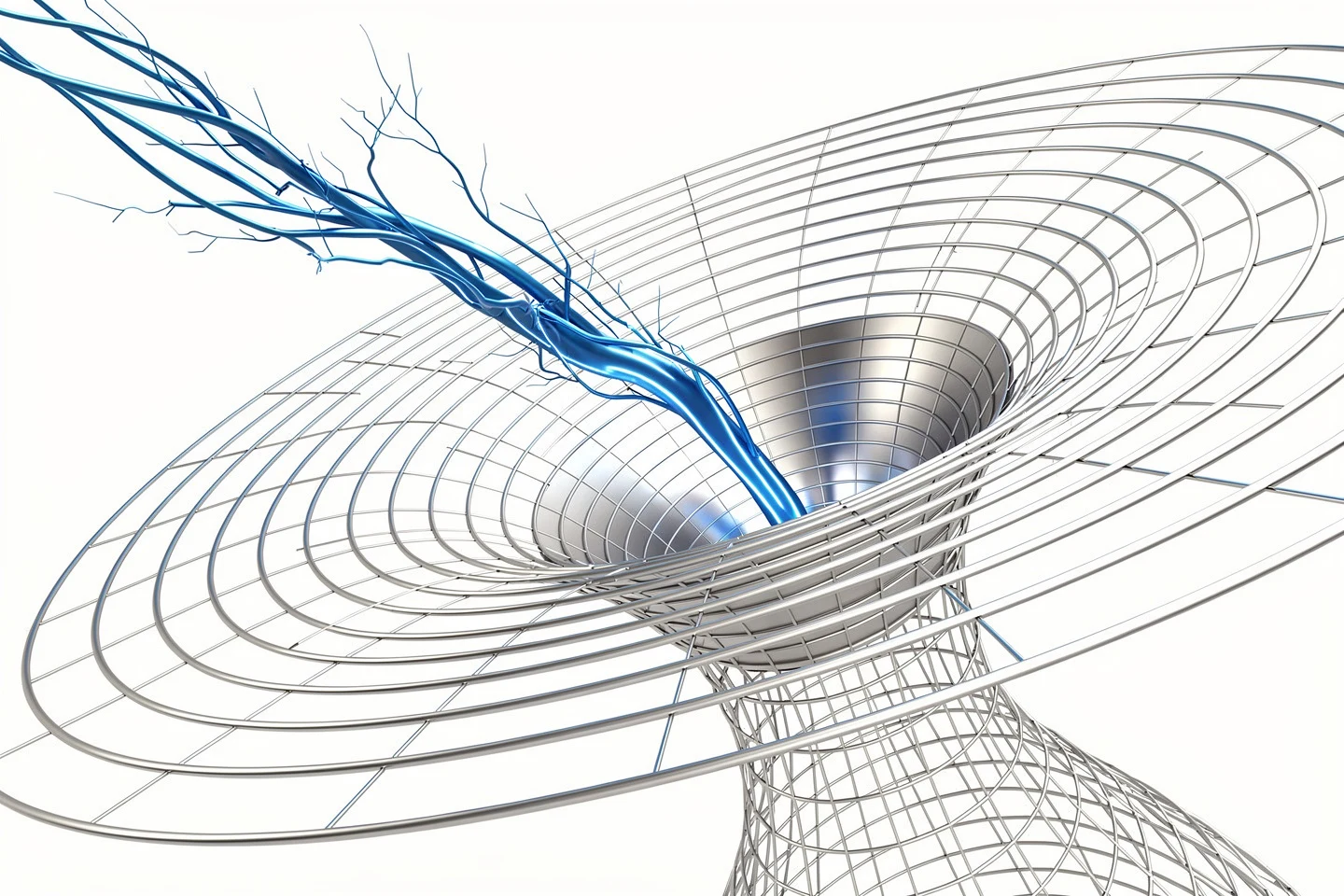
Since time immemorial, physicists have dreamed of tunnels piercing the cosmos — wormholes, capable of connecting far-flung corners of the Universe in an instant. But mathematics issued a harsh verdict: the throat of such a bridge must flare out, and that requires exotic matter with negative pressure — that very 'anti-gravity' substance that stretches space instead of squeezing it. John Wheeler and Kip Thorne showed back in the last century that without it, any passage collapses as soon as it begins to open. Yet with the discovery of the accelerated expansion of the Universe, a hope dawned: what if dark energy itself, responsible for the cosmic speed-up, takes on the role of the exotic scaffold? After all, it already causes space itself to push apart — so why not locally prop up a wormhole?
The new theorem is merciless. The study's author imagined a cosmological deal: ordinary matter gives energy to a dynamic vacuum, like a trickster trying to bribe the judge. But the geometric law is unyielding. Consider a static, spherically symmetric wormhole without tidal forces. Here, gravitational time dilation is absent, and redshift is frozen. The throat-flaring condition becomes a simple inequality: \[ \frac{$d^2$ r}{dz^2} = \frac{b - r b'}{2b^2} > 0. \] This means the embedding profile bulges outward, like a matchstick being bent with a flick. Ordinary matter cannot achieve this — it pulls inward, creating dips, not humps. And here's the crucial point: for any interaction \(Q(r)\) describing energy transfer to the vacuum, the final balance of tensions and pressures reduces to \[ \tau - \rho = \frac{b - r b'}{\kappa^2 $r^3$} > 0. \] The function \(Q(r)\) vanishes from the equation, like a false alibi presented to a sharp prosecutor. The judge — spacetime curvature itself — delivers the verdict: the effective tension exceeds the density, which is a direct violation of the null energy condition. No vacuum lubrication helps; the geometric fact of the throat's flaring locks in the need for negative energy, no matter how much energy is thrown back and forth.
This result strikes a blow to a whole class of models that tried to 'humanize' wormholes without exoticity. The physical world as we know it guards causality as effectively as a seasoned warden: the ban on nontrivial topology seems built into differential geometry at the level of axioms. To bypass it, one would have to invoke rotation, nonstationarity, or fields like axions, but all such tricks run up against quantum energy inequalities (QEI), which forbid prolonged local negativity. In other words, even if a microscopic quantum effect momentarily opens a loophole, on macroscopic scales the verdict stands.
What does this mean for the distant future? For gravitational-wave astronomy — clarity: wormhole signatures will not be disguised as non-exotic hybrids, and the search for 'echoes' in LIGO-Virgo data gets a clear theoretical boundary. For fundamental physics — a profound caveat: the drive to circumvent conservation laws by playing with vacuum dynamics crashes against the wall of geometric honesty. Perhaps in the Planckian froth of spacetime, where gravity becomes quantum, lifesaving patches may emerge, but the price will be staggering — the throat will most likely snap shut before we can pass through it. For now, the no-go theorem stands as the final word in a case where the defendant is hope itself for faster-than-light travel.
Keeping a wormhole open is like trying to preserve a tunnel in a bottomless sponge that immediately sucks in its pores at the slightest attempt to expand. Adding a 'helper' in the form of vacuum interaction is analogous to bringing in a crew from a parallel universe: they pour in water, but the sponge shrinks even faster, pushing everything out.
In 'Star Trek,' wormholes are commonplace, but that would require filling the holds with exotic matter of negative mass, overriding the Standard Model. And stabilizing a wormhole according to Kip Thorne's recipe from 'Contact,' though it relies on quantum fluctuations, demands energy control in the Planckian froth — something even more out of reach than starships.