The Mystery of Eclipse Shadow Bands Solved express
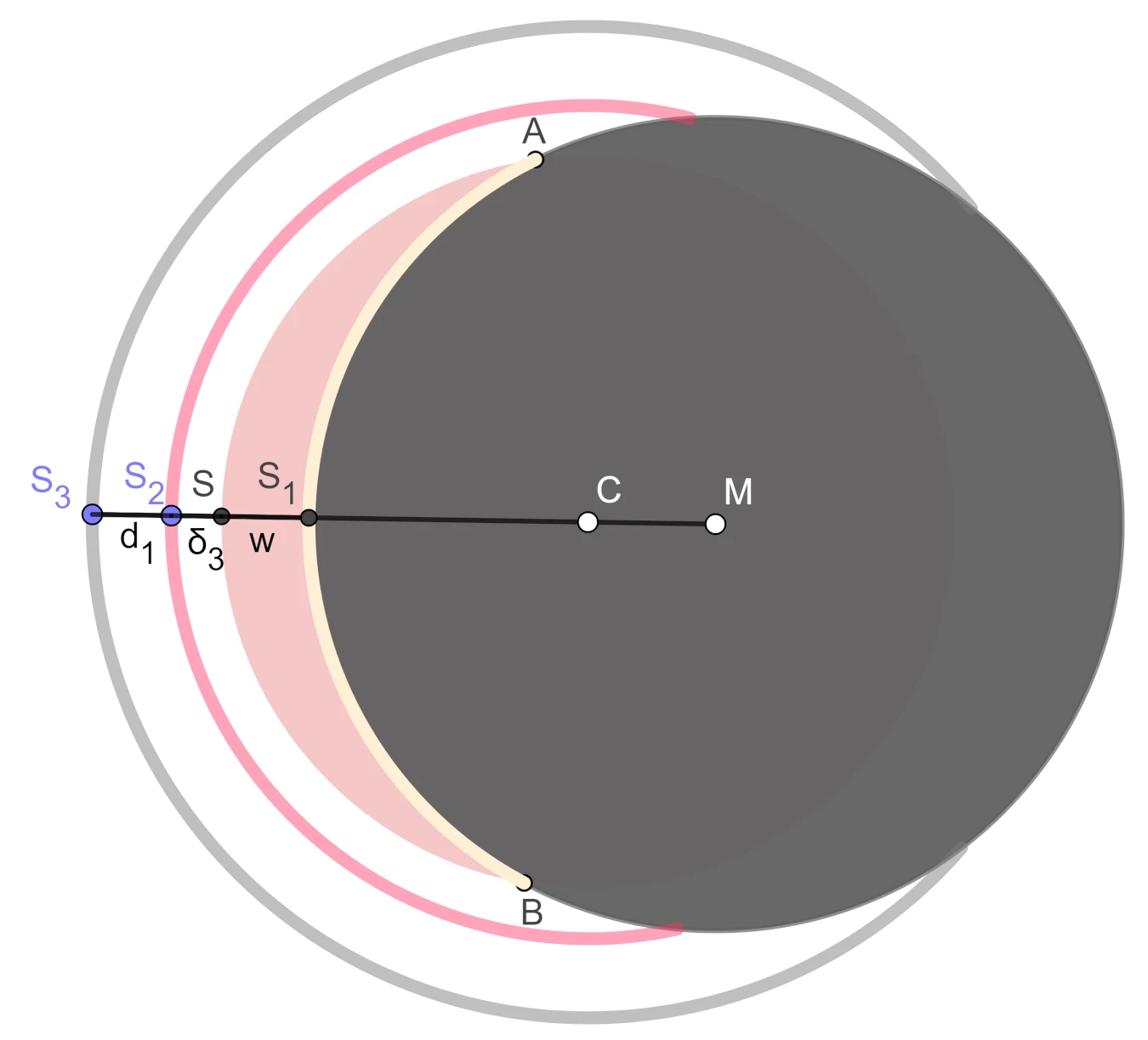
Moments before totality, swift shadow bands glide across the ground, like ripples from pebbles tossed into water. For centuries, this phenomenon baffled scientists. It turns out the key is that light is a wave.
The Sun isn't a pinpoint lamp but a vast disk. When the Moon nearly covers it, a thin glowing crescent remains. Its two opposite edges behave like independent sources: the waves they emit overlap, like ripples on water. Where crests coincide, brightness doubles; where a crest meets a trough, shadow appears. This is how the striped pattern is born. The same idea once proved light's wave nature in the lab; now celestial mechanics has repeated the experiment on a cosmic scale.
Original abstract
as written by the authors arXiv:2606.28366
Shadow bands are transient, rippling patterns of light and dark that may appear in moments before and after totality in a solar eclipse. Despite centuries of reports, their physical origin has remained unresolved. This preprint develops a geometric-optical solution in which the Sun's extended structure produces a celestial analogue of Young's double-slit experiment, generating an interference-like intensity pattern on the ground, modulated by Earth-atmosphere effects. The analysis combines solar limb geometry, atmospheric propagation effects, and a wave-based formulation that yields quantitative predictions for fringe width and spacing. The resulting model accounts for the principal observational features of shadow bands and clarifies why the phenomenon is both elusive and highly sensitive to viewing conditions.
The earliest descriptions of shadow bands are found in Chinese chronicles from 2000 BCE, yet the explanation didn't come until the 21st century.