Popular

The Mystery of Eclipse Shadow Bands Solved ⚡ экспресс

Original: "The Optics of Shadow Bands"
· Branko Sretenović
arXiv:2606.28366 · 2026-06-14 · CC BY 4.0 · ⏱ 1 min · Popular Physics Stellar Optics
A simple explanation of the shimmering light bands appearing at the edge of a solar eclipse turns them into a tool for studying the atmosphere.
Abstract

During a solar eclipse, mysterious wave-like bands of light and shadow appear on Earth. New research reveals their nature: the edge of the Sun acts like a pair of slits in the classic Young's experiment, creating an interference pattern (overlapping light waves), while the atmosphere modulates it. The authors combined solar limb geometry, atmospheric propagation, and a wave model to calculate the thickness and spacing of the bands. This explains why the bands are so changeable and dependent on viewing conditions.

Links in the knowledge graph 1

📄 Showing the "Simple" version — "Popular" is not ready yet. Add it to favorites to help prioritize it.

Moments before totality, swift shadow bands glide across the ground—like ripples from pebbles tossed into water. For centuries, this phenomenon baffled scientists. It turns out the key is that light is a wave.

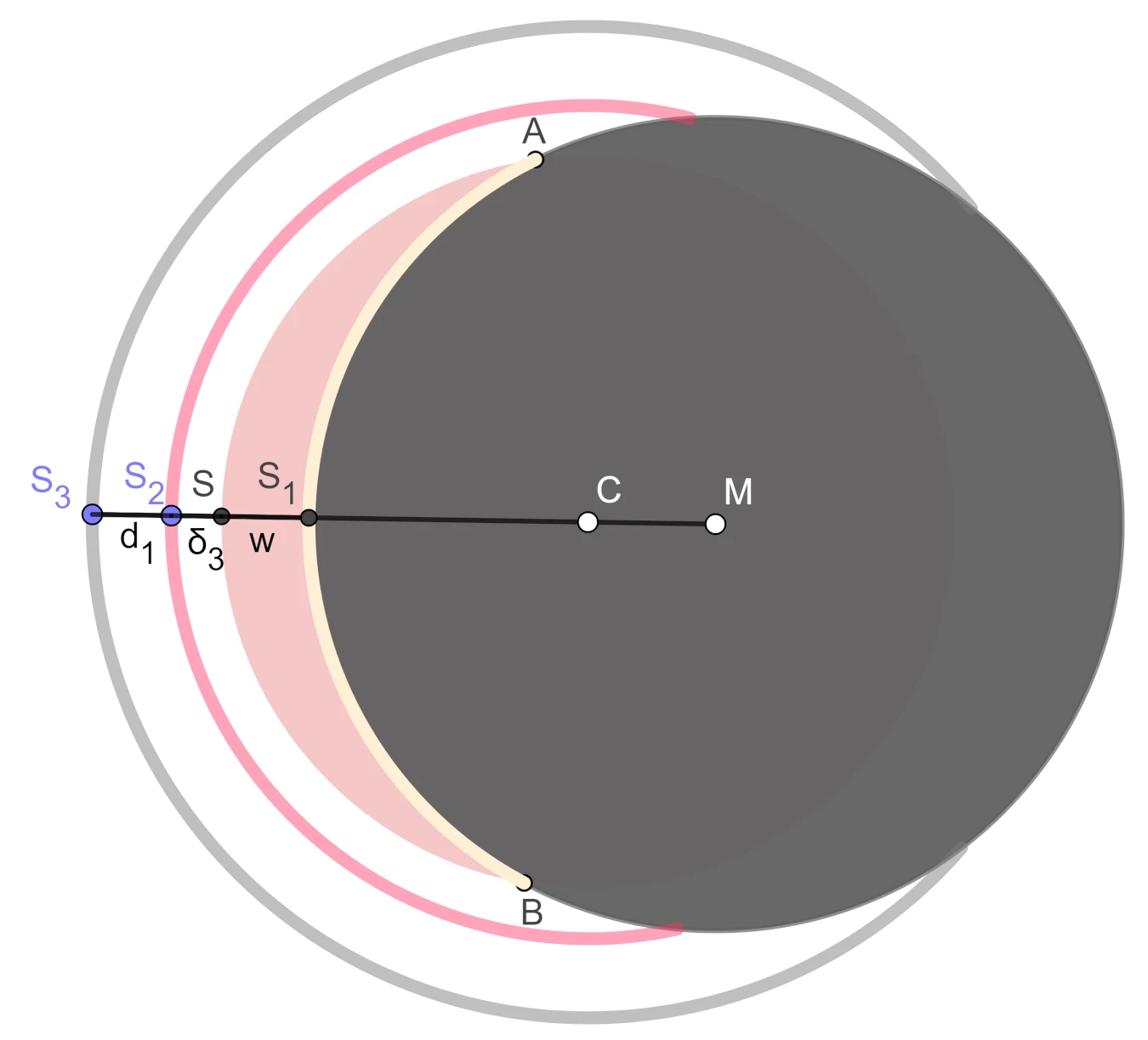
The Sun isn't a pinpoint lamp but a vast disk. When the Moon nearly covers it, a thin glowing crescent remains. Its two opposite edges behave like independent sources: the waves they emit overlap, like ripples on water. Where crests coincide, brightness doubles; where a crest meets a trough, shadow appears. This is how the striped pattern is born. The same idea once proved light's wave nature in the lab; now celestial mechanics has repeated the experiment on a cosmic scale.

Earth's atmosphere usually smears the delicate pattern, like ripples on water distorting a reflection. But scientists turned the obstacle into an advantage: by matching theory with precise brightness measurements (photometry) and factoring in the speed of light, they created a model that measures air turbulence from the bands' motion. This will improve weather prediction and sharpen astronomical observations.

🎯 The earliest descriptions of shadow bands are found in Chinese chronicles from 2000 BCE, yet the explanation didn't come until the 21st century.

Scientists
Christian DopplerD. B. McLaughlinDidier QuelozMichel MayorR. A. RossiterAlbert Einstein
Tags
Sun speed of light photometry
Laws
Doppler effectprinciple of constancy of the speed of lightmass–energy equivalenceMaxwell's equationsLorentz transformationsStefan–Boltzmann law
Original: arXiv:2606.28366 · CC BY 4.0 · bridge42worlds