Levitating Magnet Catches Dark Matter express
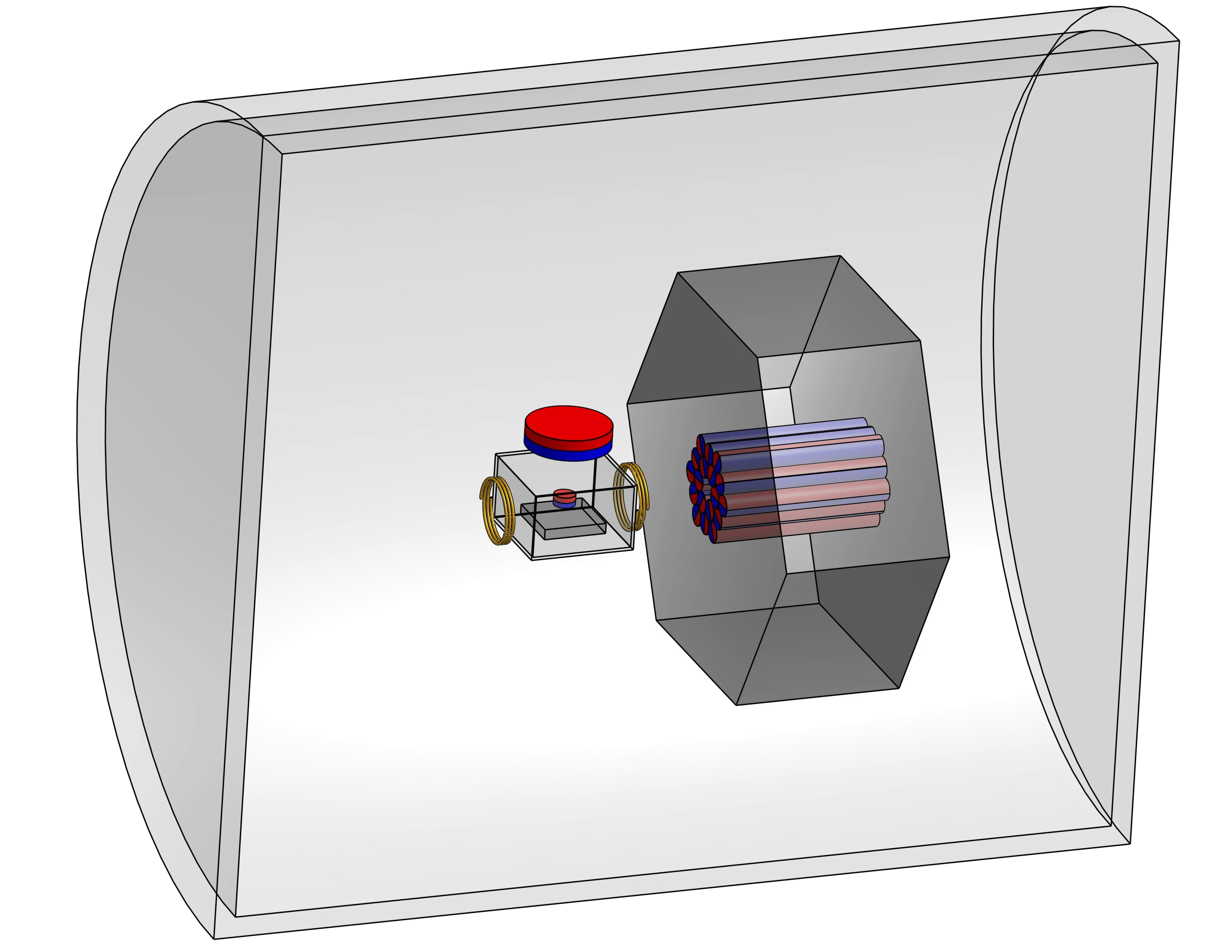
In the pitch darkness of a vacuum chamber, a tiny magnet floats. It touches no walls and loses almost no energy — an ideal sentinel, ready to catch the faintest nudge. Such a sentinel is exactly what you need for axion hunting. These particles are prime suspects in the case of the Universe's hidden mass, which we call dark matter.
Previously, detectors like this were like a keen ear that hears only a single note. The new sensor uses dual resonance, as if the ear had learned to hear a wide chord at once. The working frequency band has widened by roughly a thousand times. The sensor itself is a levitating magnet wrapped in a magnetic cocoon: an array of stiff magnets amplifies the axion signal, while a shield of soft ferromagnet (a material that easily loses magnetization) quenches environmental noise.
The setup swept the range from 40 to 3000 Hz and set new direct limits on the axion-photon coupling constant. At 276 Hz, the limit improved by more than ten thousand times over previous experiments. Thus, the levitating magnet transforms from a lab curiosity into a working tool for fundamental physics.
Original abstract
as written by the authors arXiv:2606.22814
Levitated particles have demonstrated ultrahigh sensitivity to magnetic fields and accelerations owing to their extremely low dissipation. Such systems have strong potential for fundamental physics research, particularly for the detection of axions and axionlike particles, well-motivated dark matter candidates spanning a broad mass range. In this context, both high sensitivity and large bandwidth are essential. Here, we demonstrate a levitated magnet magnetometer based on an engineered double-resonance mode, achieving an effective linewidth at its optimal sensitivity that is approximately three orders of magnitude broader than those of previous approaches. Together with a hard-magnet array that enhances the axion-induced signal and soft-ferromagnetic shielding that suppresses environmental magnetic noise, this system constitutes a hybrid ferromagnetic platform for axionlike dark matter searches. We search for axionlike dark matter through its photon coupling $$g_{a\gamma}$$ over the $$40$$-$$3000\,\mathrm{Hz}$$ frequency range and establish new direct limits in this frequency band. The best sensitivity is achieved near the upper resonance around $$276\,\mathrm{Hz}$$, where the magnetometer reaches a magnetic-field resolution of $$0.7\,\mathrm{fT}$$, corresponding to a limit of $$g_{a\gamma}\sim10^{-7}\,\mathrm{GeV}^{-1}$$. At this frequency, this result improves upon previous direct limits by more than four orders of magnitude. The demonstrated high-bandwidth levitated sensor may also enable a broad range of applications, including biological sensing and precision measurements.
Axions barely interact with ordinary matter, but in a strong magnetic field they can turn into photons, and back. This is exactly the effect the experiment tries to catch.
In Peter Watts's novel Echopraxia, dark matter particles form complex structures that influence consciousness — for now that's fiction, but the search for axions brings us closer to its edge.