The Secret Growth of Black Holes: Webb Telescope Finds Hidden Giants ✛
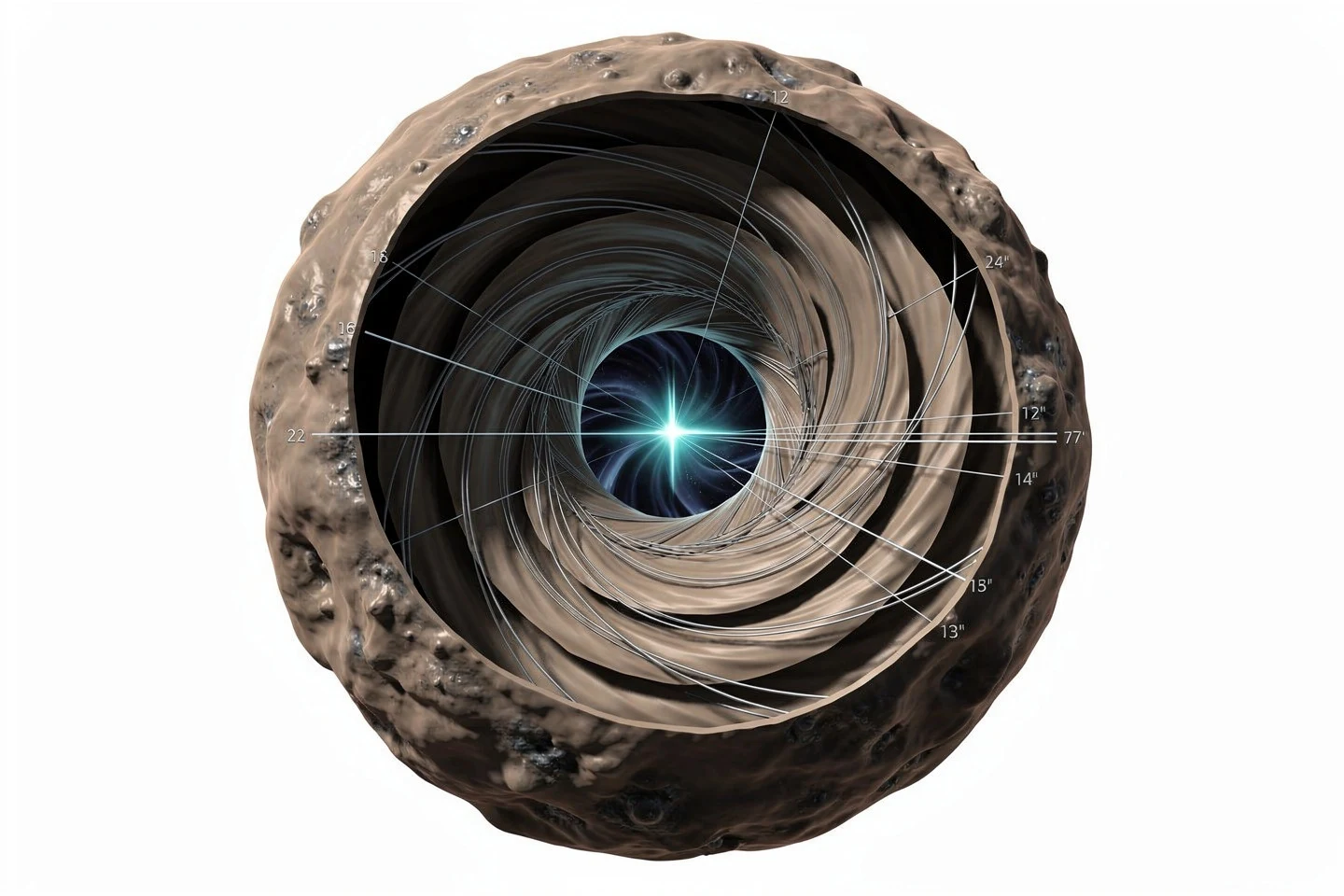
A new survey with the James Webb Space Telescope allowed astronomers to peer far back into the universe's past, when it was less than a billion years old. They were hunting for active black holes — cosmic “vacuum cleaners” that suck in surrounding matter and shine brightly. The trouble is, many of them are hidden by thick clouds of dust, like trying to spot a campfire through dense smoke. But the JWST is equipped with a camera that sees thermal radiation, and it was this that helped uncover 16 such hidden objects in distant galaxies. Nearly all of them “switched on” less than 700 million years after the Big Bang.
To understand the nature of these finds, scientists used spectroscopy — a method that breaks light into colors, much like sheet music dissects a melody. In the spectra, they looked for the characteristic lines of hydrogen, which were first described in the 19th century by Johann Balmer. Hot carbon dust gave itself away with distinctive emission at wavelengths of 10 and 21 micrometers. By cross-checking new data with the Hubble telescope’s archives and determining distances using the law of Edwin Hubble, the astronomers confirmed: 12 of the 16 active nuclei had never been seen before — they were completely invisible in the optical range.
This discovery means that early supermassive black holes grew in a completely different way than we thought. Previously, it was believed that their visible counterparts were enough to explain the observed picture. But now it turns out that at least half of the active nuclei were hiding behind dusty cocoons, gaining mass at an accelerated pace. This “hidden growth” helps explain how black holes managed to become billions of times heavier than the Sun already in the universe’s infancy. Further observations may reveal that similar processes are more common in modern galaxies than currently assumed.
The survey’s name MEOW stands for MIRI Early Obscured-AGN Wide Survey, but it sounds like “meow.” Scientists joke that their work is like a nighttime hunt — a cat too sees in the dark what is hidden from humans.