Cosmic Cocoons: MEOW's Infrared Hunt Reveals the Secret Growth of Black Holes ✛
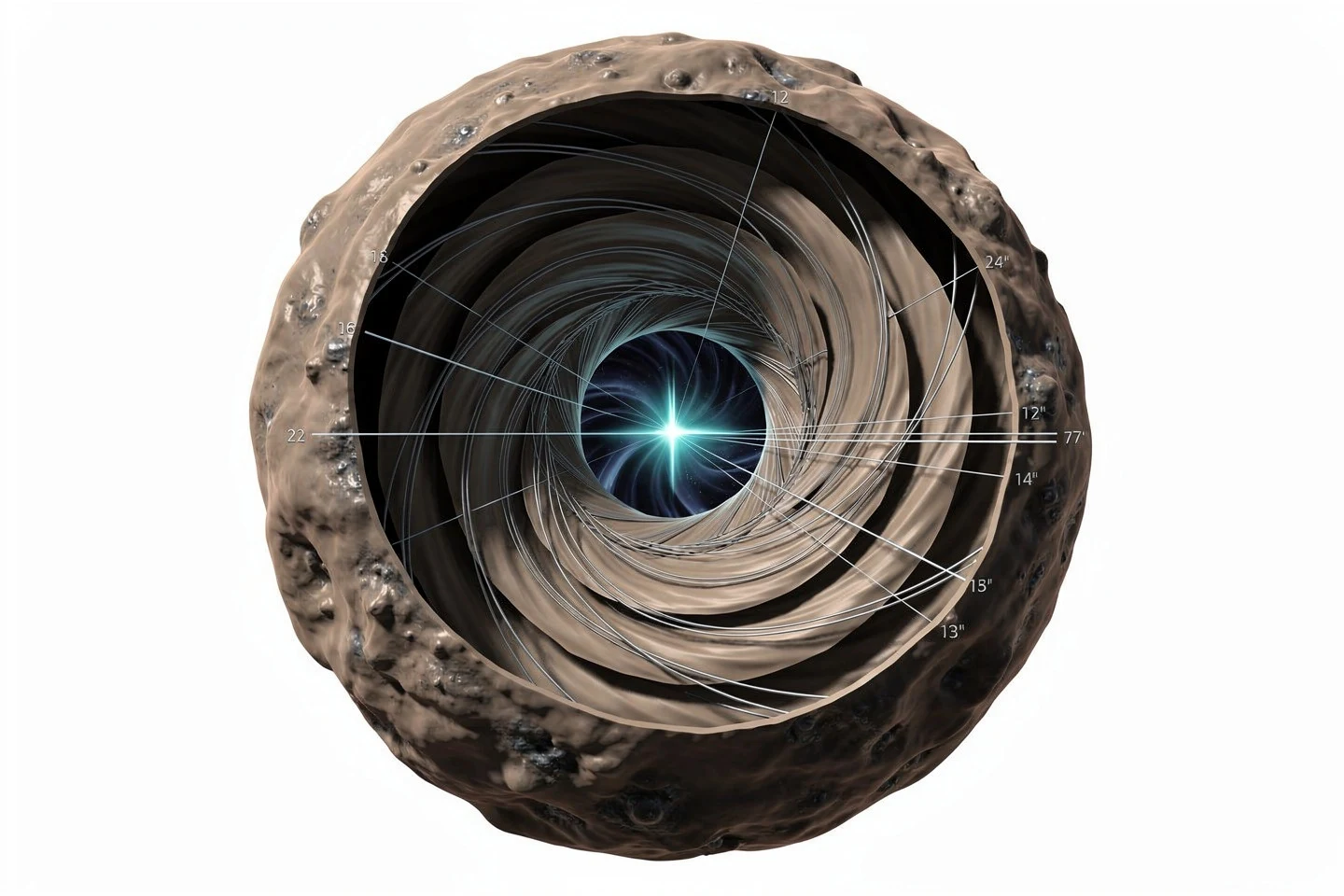
The Universe is less than a billion years old, yet at its centers already sit black holes with masses of a billion suns. According to the conventional picture, they grew by voraciously devouring matter, but calculations show that 'feeding' must have been almost continuous, while visible quasar flares last only a few million years. So where does all the accreting fuel go? The answer is simple: most of the growth is hidden behind dense curtains of dust. It is these hidden 'cosmic cocoons' that the MEOW survey set out to find using the MIRI infrared camera on the James Webb telescope.
Imagine a caterpillar transforming into a butterfly inside an opaque cocoon. From the outside, you can't see what's happening within, but the cocoon heats up, betraying the vigorous metamorphosis. Similarly, supermassive black holes in the young Universe wrapped themselves in carbon dust heated to 1200 K, becoming invisible to optical telescopes like Hubble. However, infrared radiation seeps through the dusty veil, like heat from the cocoon. MIRI on JWST catches it at 10 and 21 µm — and here cosmological redshift, discovered by Edwin Hubble, comes to the rescue: distant galaxies recede, and their ultraviolet and visible photons, after traveling billions of years, become infrared. It's like listening to music without seeing the orchestra but guessing it from the vibrations.
Analysis of 43 MIRI pointings in the GOODS-N and GOODS-S fields revealed 16 active nuclei, and 12 of them turned out to be new — invisible in any optical survey. For seven objects, spectroscopy was obtained with NIRSpec, and in five of them the Hα line (first cataloged by Johann Balmer) was narrow — a sure sign of so-called Type II AGN, where the accretion disk is hidden from direct view by a dusty torus. Two others showed broad lines but with different infrared signatures: one resembles compact 'little red dots,' the other a classic quasar with a powerful hot dust component. Bolometric luminosities — from $10^{44}$.6 to $10^{46}$.4 erg/s — indicate these are no meek rejects but true monsters, rivaling the brightest quasars in power.
Most striking, the luminosity function constructed for redshifts 4.5–6 showed that the space density of such hidden black holes is at least comparable to that of visible broad-line quasars, and at high luminosities even surpasses it. In other words, for every shining quasar there is at least one twin hidden by dust. This upends our understanding of how the first galaxies and their central engines grew. A significant fraction of accretion occurred in a 'dark growth' mode, and a complete census of the early Universe is impossible without infrared ears.
Looking ahead, accumulating MIRI data over larger areas and combining with X-ray surveys (e.g., the future Athena observatory) will reveal which obscuration mechanisms dominate, compact torus or galactic dust, and how this hidden phase relates to chemical enrichment and star formation in the host galaxies. This is not just filling a gap in statistics; it is the key to understanding how black holes managed to accumulate billions of solar masses in such a short time after the Big Bang. Perhaps within the next few years we will witness the first supermassive giants emerging from these cosmic cocoons.
The name MEOW is an acronym evoking a cat's meow; the authors likened their hunt for hidden black holes to a cat's curiosity and night vision.