Dance of Light: How Binary Stars Reveal the Secrets of the Invisible Cosmos ✛
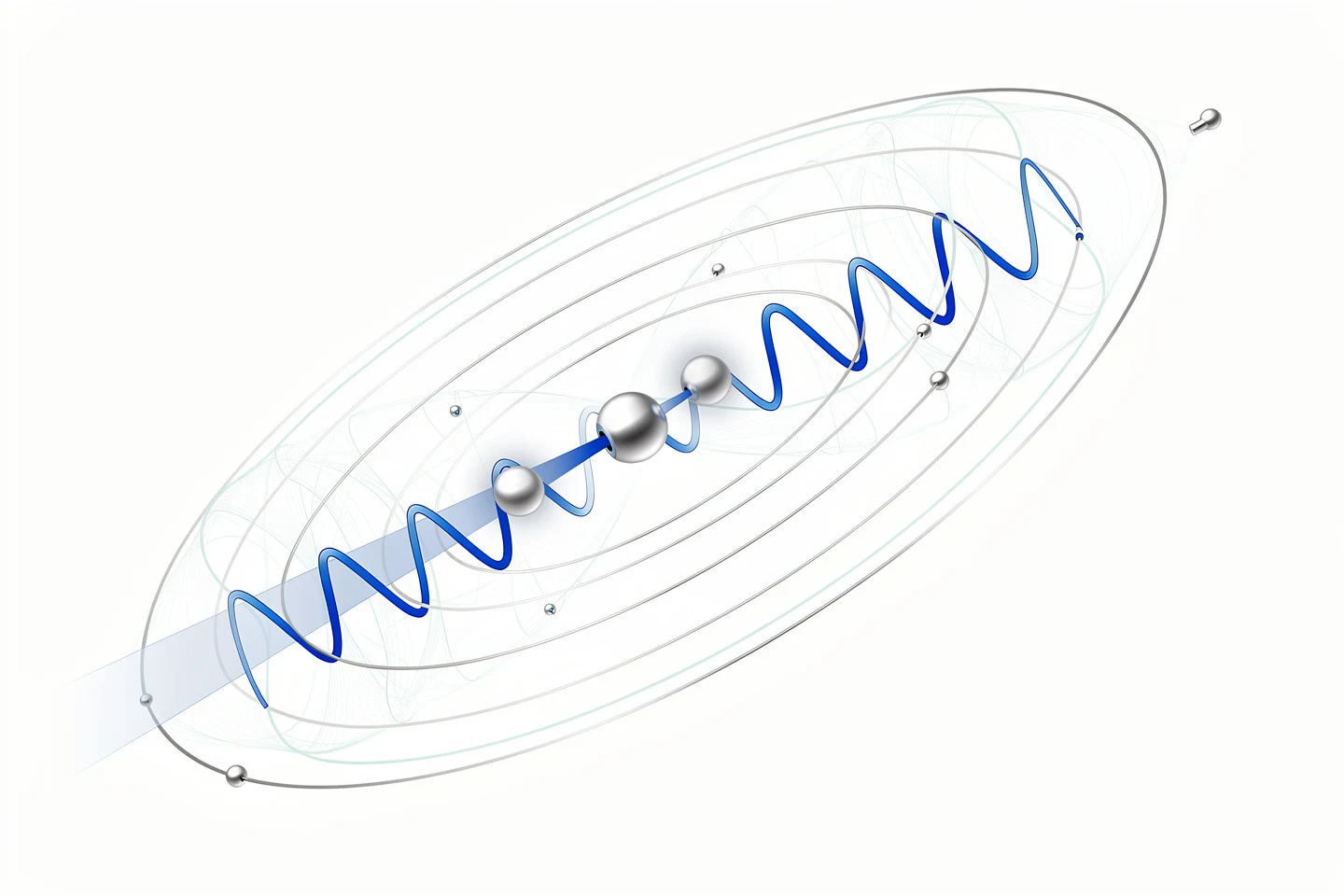
It is believed that most of the matter in the cosmos is dark matter — something mysterious that emits no light. Its existence was first convincingly demonstrated by astronomer Vera Rubin in the 1970s while studying the rotation of galaxies. Since then, scientists have been searching for candidate particles that could make it up. One of the lightest and most elusive contenders is the axion, which interacts so weakly with ordinary matter that it can be compared to a breath of wind barely stirring a cobweb. If axions fill the halo of our Galaxy, they should slightly affect the light passing through them.
Tight binary stars are like a pair of dancers swirling in a slow waltz. One of them shines brightly, and its light reflects off the other’s clothing, creating faint glints. From how those glints flicker in time with the movements, you can learn a lot about the pair. Star pairs behave much the same: light from a hot blue star scatters off free electrons in its cooler neighbor’s atmosphere, producing a tiny polarized signal whose intensity changes with the orbital rhythm. The theory of this scattering was developed by Subrahmanyan Chandrasekhar back in the mid-20th century. If space is filled with an axion field, it acts as a subtle medium, slightly rotating the plane of polarization. This rotation overlays the usual dance of light, adding side harmonics — as if a quiet chime of a distant bell were superimposed on the steady rhythm of a waltz.
To extract this faint signal, astronomers use high-precision instruments — polarimeters operating on the principle of spectropolarimetry: light is split into individual colors, and the rotation of polarization is measured for each color. This technique allows them to track the slightest deviations from the expected pattern. The observations involve not only single bright systems with hydrogen stars but entire arrays of dozens of binaries. This is reminiscent of radio telescope networks that monitor the regular signals of pulsars — rapidly rotating neutron stars discovered by Jocelyn Bell Burnell in 1967. By collecting data from many pairs, scientists hope to identify a collective “terrestrial” contribution from the axion field, clearing it of random noise. If they succeed, this approach could provide the first direct evidence for axion dark matter, which would be a breakthrough for physics beyond the Standard Model.
The idea of using binary star polarization was proposed half a century ago, but only modern instruments have achieved the sensitivity to notice the effect.
This search is akin to the attempts by the heroes of Stanisław Lem's 'Solaris' to decipher signals from a sentient ocean. Only here the ocean is dark matter, and the signals are the trembling of polarized light.