Cosmic Metronome: Binary Stars Search for Axion Dark Matter ✛
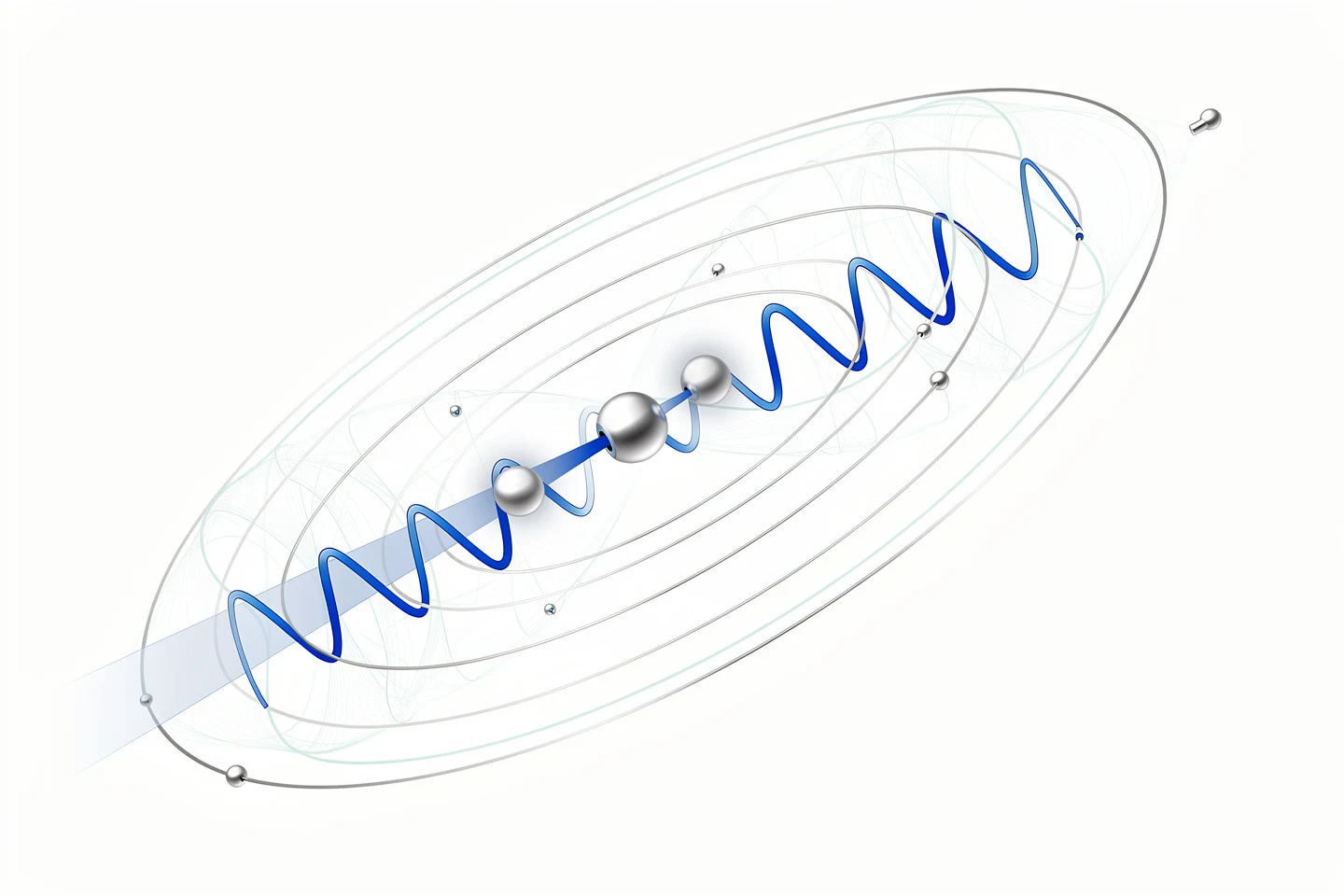
In a close binary system, the hot star, like a searchlight, illuminates its cooler companion. Some of the light scatters off free electrons in its atmosphere — this is Thomson scattering — and acquires linear polarization. As the stars orbit each other, this polarization rotates, like the hand of a peculiar cosmic metronome. The pattern repeats with each revolution with the precision of clockwork, and the degree of polarization is only a few hundredths of a percent — but it is this predictability that turns binary hydrogen stars into an ideal tool. The theory of radiative transfer, laid down in the works of Chandrasekhar, allows us to calculate the phase dependence down to the finest details, creating an exact template.
But what if something invisible intrudes into this well-tuned rhythm? The axion field, filling the dark matter halo, acts like a faint tidal force on the very fabric of electromagnetism. It causes birefringence: left and right circular polarizations of photons travel at different speeds, and the angle of linear polarization begins to oscillate. Against the strict background of orbital harmonics, sidebands appear — as if the metronome suddenly starts beating out an inaudible second rhythmic line. The amplitude of this trembling follows a simple formula: $θ_{a,0}$ = ($g_{aγ}$/2)·(√2ρ/μ), where $g_{aγ}$ is the photon coupling constant, ρ is the dark matter density, and μ is the axion mass. The lighter the particle and the stronger its coupling to light, the more noticeable the rotation. The second key relation tells us where to look for the signal: the oscillation frequency $f_{signal}$ = n·$f_{orb}$ ± μ, that is, shifted by the axion mass relative to the orbital beats. This hypothetical effect lies beyond the Standard Model of particle physics and, if confirmed, will be direct evidence of new physics.
To catch this ghostly accompaniment, astronomers use a method similar to timing arrays of pulsars — those ultra-precise neutron stars discovered by Jocelyn Bell Burnell. Only instead of intervals between radio pulses, they analyze polarization phases. For a bright binary like μ¹ Sco, with monthly observations at one-minute cadence and a precision of 10 microdegrees, the sensitivity to the coupling constant will reach 2.4×10⁻¹² GeV⁻¹. And if we network a dozen such systems and improve the precision to one microdegree, the threshold drops to 1.3×10⁻¹³ GeV⁻¹ — a level comparable to the most ambitious laboratory experiments. Such a distributed 'interferometer' of binary stars scattered across the Galaxy will probe axion masses from 10⁻²¹ to 10⁻¹⁸ eV, precisely in the range where motivated models predict particles that can resolve the dark matter mystery, first proposed by Vera Rubin from galaxy rotation curves.
Polarimetry of close binaries fills the gap between cosmological observations and ground-based detectors, turning each such system into a microscope for the dark field. If nature has endowed axions with any appreciable coupling to light, sooner or later the cosmic metronome will skip a beat — and then we will not just hear the rhythm of the dark ocean, but decipher its notes.
The polarization degree of Spica is just 0.02%—like spotting a candle through frosted glass from a kilometer away.
Using polarized light to detect elusive fields remotely echoes the attempts of the characters in Stanisław Lem's novel 'Solaris' to decipher signals from a sentient ocean. Only in our case, the 'ocean' is dark matter, and the 'signals' are microscopic oscillations of the polarization angle.