How Magnetic Order Fluctuations Alter the Surface Signal express
A guitar string keeps vibrating even after the musician lets it go, and that vibration changes the sound the listener hears. Magnetic moments in a crystal behave much the same way: they align into a strict antiferromagnetic order (neighbors point in opposite directions), but they never completely freeze. Their collective oscillations are called magnons, and they can influence the electrons flowing through the material.
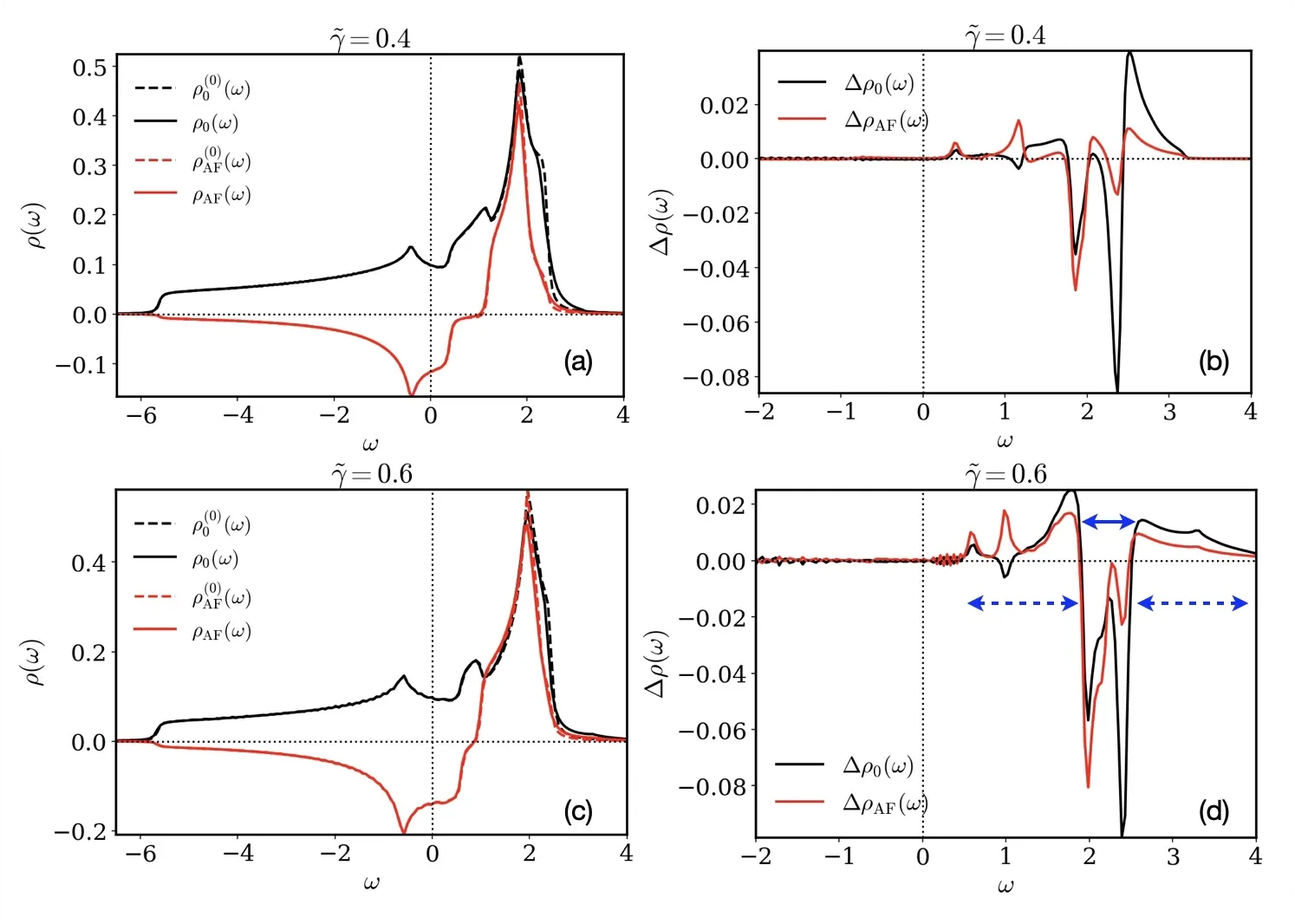
When scientists probe the surface of such a crystal using scanning tunneling microscopy, they measure how electrons tunnel across the gap between the tip and the sample. If the magnetic order were completely static, the spectrum of reflected electrons would show only one characteristic feature — a peak at a specific wave vector. But the authors showed that electron scattering off magnons adds new features: sidebands appear in the spectrum — satellite peaks. This is like the extra overtones that arise when a string vibrates not as a whole but with bends.
To describe the effect, the researchers accounted for how an electron, interacting with a magnetic moment, can create or absorb a magnon. This process changes the electron's energy and leads to additional structures in the tunneling spectrum — magnon satellites. Their position and intensity depend on the magnon properties, such as their stiffness (spin stiffness). Thus, by measuring these satellites, one can literally hear how the magnetic lattice 'sounds.'
The static picture of magnetic order is only half the truth. Dynamics born from thermal or quantum fluctuations leave a distinct imprint on experiments. And this imprint can now not only be noticed but also decoded, just as a musician distinguishes the finest overtones in a string's sound.
In some antiferromagnets, magnons can travel at speeds of several kilometers per second — tens of times faster than sound in air.
In Arthur C. Clarke's novel 'Childhood's End,' an alien spacecraft uses manipulations of quantum fields reminiscent of magnon control to create invisible barriers.